There was a poor father with three daughters, and when all work dried up he said he’d go to the fields to gather chicory. It was a wet day and the girls begged to stay home, so he went alone.
He found the biggest chicory plant he’d ever seen and pulled it up by the root. Up came the earth with it, and a voice came out of the hole.
“Who’s there?”
“Friends!” said the chicory-gatherer.
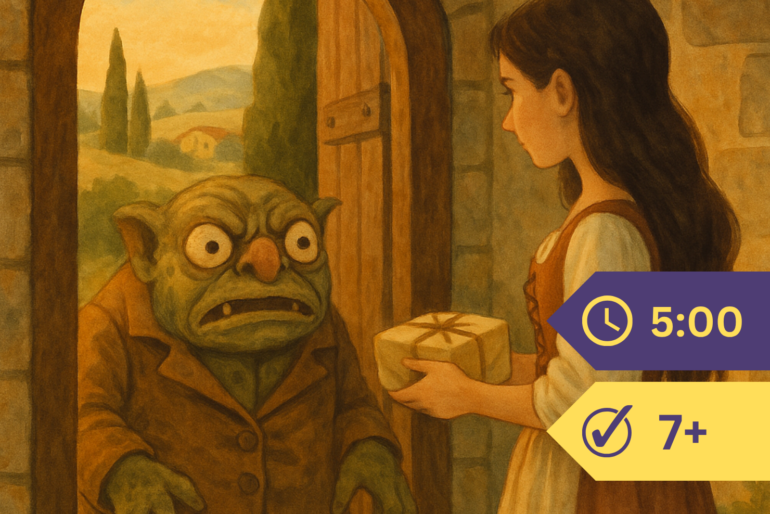
Something sprang up through the hole — odd-looking, alarming at first glance, and not the sort of creature you argue with. The father held his tongue.
“Come with me,” said Monsu Mostro. The father followed to a palace in the countryside, where Monsu Mostro gave him a horse and a heap of money. “But you must bring me one of your daughters in return.” Too frightened to refuse, the father agreed.
He came home on horseback with his hands full of money and three delighted daughters dancing around him. He couldn’t bring himself to tell them what he’d promised. Not until the next morning, when the time came to leave and there was no putting it off, did he take a breath and say: “I’ve found a husband for one of you. Which shall it be?”
“Not me!” said the eldest. “I’m not marrying someone I haven’t seen.”
“Not me!” said the second.
“Take me, papa! I’ll go!” said the youngest.
So the father put her up behind him on the horse and rode to the palace of Monsu Mostro and knocked.
“Who’s there?”
“Friends! Here’s my daughter, as I promised.”
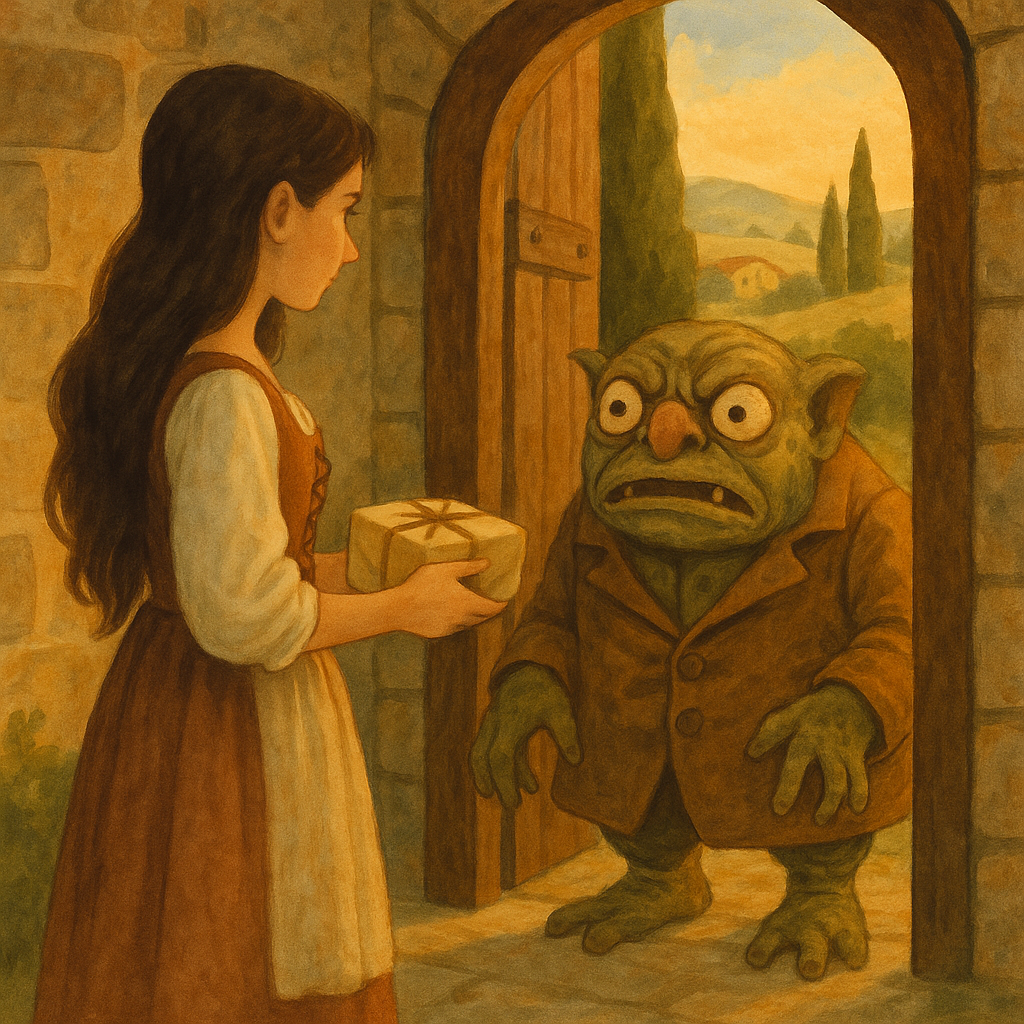
“All right,” said Monsu Mostro, handing the father another sum of money and seeing him off. When they were alone he said to the girl: “I’m not going to marry you as your father thought. I want you to run the house. But remember — if anyone comes, call me papa.”
Not long after, some hunters who had lost their way knocked at the door. Monsu Mostro told her to let them in, give them supper, and find them dry clothes. She did. One of the hunters couldn’t stop looking at her — he was the king’s son — and after supper he asked if she’d marry him.
“I’d love to,” she said, “but you must ask papa.”
The prince asked Monsu Mostro, who raised no objection. A grand party came to escort her to the royal palace.
As she was leaving, Monsu Mostro pressed a small wrapped parcel into her hands. “Here is a comb. Don’t forget you have it.” She was too happy to pay much attention, but she tucked it into her bodice and left.
By the time the procession reached the royal palace she had grown a pair of horns — large, very much like a cow’s. The queen was horrified and refused to let her in. The prince argued that such a thing was impossible, but the horns were undeniably there. He wouldn’t have her sent away, though — he put her in a house in the countryside and sent a servant every day with gifts and enquiries. The horns kept growing.
Then the queen decided to test the three candidates for her son’s hand with three challenges. First, each girl was given a puppy to train. The other two girls had no idea what to do with puppies and let them run wild. The girl took hers to the palace of Monsu Mostro and knocked.
“Who’s there?”
“It’s me,” she said, in a miserable voice, and told him everything.
Monsu Mostro looked at the dog. “Go away, you ugly horned thing,” he said, and shut the door.
She went home crying — but she peeked under the cloth to look at the puppy and felt strangely reassured, and sent it to the queen by a servant.
When the queen uncovered the basket a small golden dog leapt out and performed every kind of trick, exactly like a real dog.
The queen said it didn’t count.
The second challenge: three pounds of flax each to spin. The other two girls ignored theirs. The girl took hers to Monsu Mostro.
“Who’s there?”
“It’s me.” More wretched than before, and the whole story.
“Go away, you horned wretch!” said Monsu Mostro, and shut the door.
She sent the basket to the queen by a servant. It arrived filled with gold thread.
The queen said that didn’t count either.
The third challenge: whichever girl had hair reaching to her heels could marry the prince. The other two gave up. The girl went back to Monsu Mostro.
“Who’s there?”
“It’s me,” in the most doleful voice yet, and the whole story.
“Now you see,” said Monsu Mostro, “what comes of not paying attention. I told you not to forget the comb. It’s your remedy — use it.” And he shut the door.
She went home and combed her hair with the comb. The horns disappeared, and her hair fell all the way to the ground.
The jealous competitors came to ask her secret, and she sent them to Monsu Mostro. He told them to make themselves pitch nightcaps and sleep in them. When they got up in the morning, all the hair they had came off.
She and the prince were married amid great rejoicing.