A widower king had one beloved daughter, Maria, and a dying wife’s instruction: give her only to the man whose finger fits a golden ring she left behind. Year after year suitors came and went, and the ring fitted none of them.
Then arrived a most polished cavalier — handsome, richly attended, armed with costly gifts — who declared himself a prince from a distant country. Maria’s father was already half-persuaded when the ring was discovered missing. The cavalier shrugged off this inconvenience with charming logic: surely the ring would have fitted him if it could be found, for he was exactly the sort of husband the dead queen had in mind? He proposed three trials instead — whatever Maria chose — three chances to prove himself.
Maria had a secret ally: her teacher, who was in truth a fairy godmother sent by her mother. And the fairy teacher knew something the father could not be told — the charming cavalier was the devil himself. Father would only laugh and tell Maria to dry her eyes. There was no hope there. Maria must outwit him alone.
So Maria asked her suitor for a dress woven of the stars of heaven. He bit his lip, and a fiercer look crossed his face than had ever appeared there before — then he smiled, and accepted. In the morning six pages brought the dress, and they could barely carry it for the dazzle of starlight.
For the second test Maria demanded a dress woven of moonbeams. Twelve pages delivered it the next day, so blinding they had to hand it off in relays of six. For the third she asked for sunbeams. The cavalier grew so angry she nearly hoped he’d refuse — but after a long silence he accepted, and told her to be ready at the door when it arrived, for after that she would belong to him.
Maria’s father found her weeping on the floor and could not understand it. Such a fine match, he said. Be a good girl.
That night her fairy teacher told her everything. She had made ready a wooden figure of an old woman — hollow, with supple jointed limbs — inside which Maria could walk freely, disguised as an aged peasant. In this figure Maria’s valuables were stored, including all three magical dresses. She was to take it into the carriage the next morning.
When twenty-four pages arrived at dawn with the dress of sunbeams — too dazzling to carry for more than five minutes at a stretch — Maria accepted it calmly. Then she drove away in the cavalier’s grand carriage, waved off by all her neighbours and friends.
As the sun set they entered a deep forest. Maria said she was stiff from sitting all day and asked to walk a little in the trees. The cavalier agreed pleasantly; he had everything his way and was in a fine mood.
In a quiet clearing, Maria spotted the wooden figure waiting under a tree exactly as the teacher had promised. She had already contrived to twitch the ring from the feather in the cavalier’s cap without his noticing. Now she exclaimed: “Oh! A firefly — do catch it for me!” He lifted his hat and gave chase; she darted to the figure, stepped inside, and walked calmly away in the shuffling gait of an old woman.
When the cavalier returned with the firefly, Maria was nowhere to be seen. He questioned the only witness he could find — the old woman.
“Which way did the young lady go?”
“Down that path to the right,” said Maria Wood, in the cracked voice of old age, “quick as a firefly herself, and she’ll no doubt be back just as quickly.”
He ran the wrong way and was lost in the forest all night.
Maria walked on under the stars until she came to a camp of charcoal-burners who offered her what shelter they had. She stayed with them through the season, doing their hard work alongside them without complaint.
One day, far from the camp, the king of that country came riding through the forest at the head of a hunt. The crash of hooves and hounds sent her scattering — she fainted in the bracken. The king pulled up his horse just in time and ordered her carried to his palace to recover.
When he came to check on her that evening she said, in the sorrowful voice of someone with nothing left, that she had neither home nor kin and little cared where she ended her days. He took pity and found her a place helping the kitchen scullions.
Her new colleagues were not kind. She was pushed from task to task, given the worst food and the fewest words. But she took everything patiently and never complained.
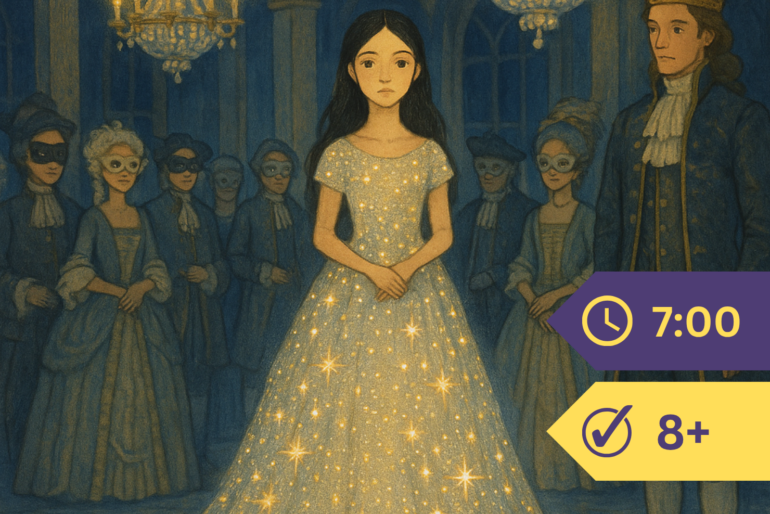
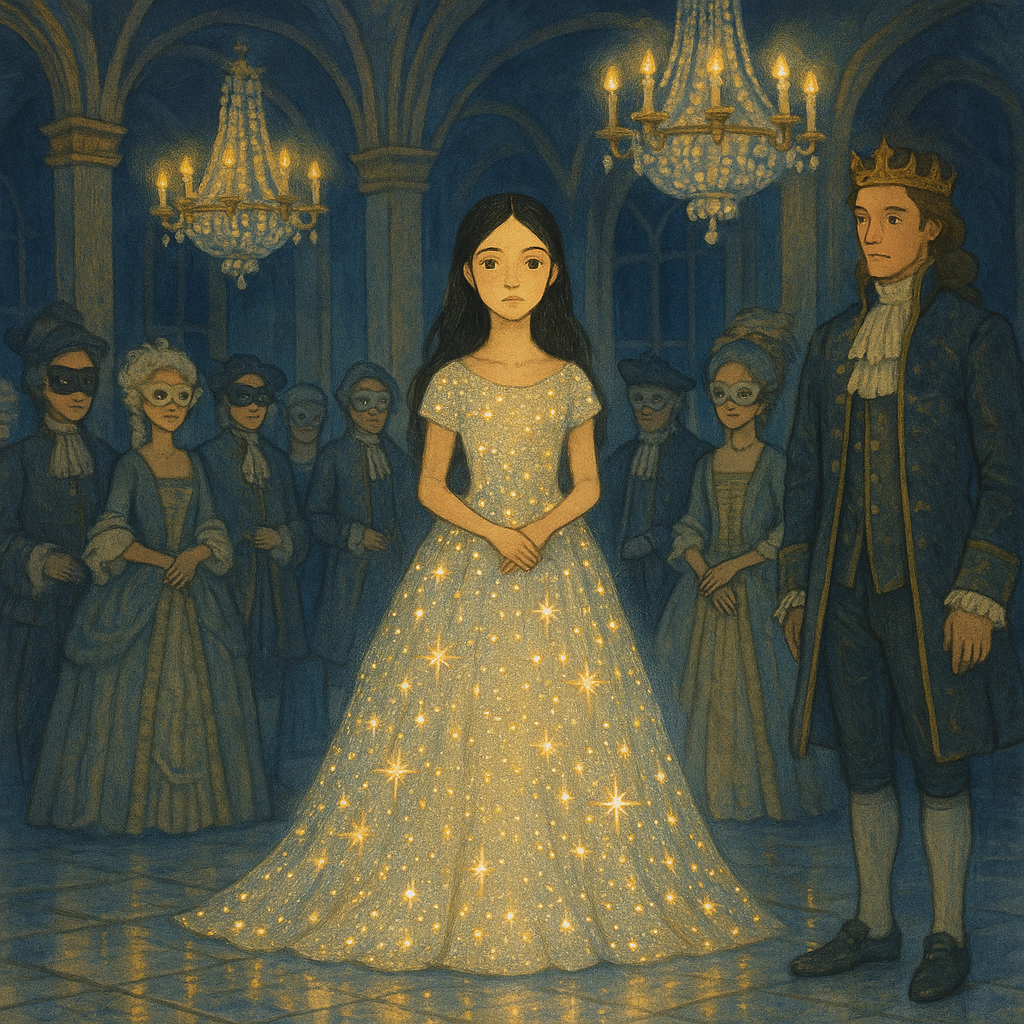
Then came Carnival — three nights of masked balls, when even the kitchen staff were given leave to don a domino and dance. Maria slipped away to her loft, stepped out of her wooden disguise for the first time in a year, and dressed herself in the gown of stars.
At the ball she was a revelation. Guests couldn’t approach her — there was such majesty in her bearing. Only the king himself felt equal to asking her to dance, and she accepted. All evening he tried to discover who she was, and all evening she deflected him charmingly. She left early, slipping away while he was occupied with other guests.
The second night she wore the moonbeam dress. The third, the dress of sunbeams — the chandeliers paled beside her. On that last night she asked the king, as a curiosity, to try on a ring that had never yet fitted anyone. It fitted him perfectly, and she could not quite conceal her pleasure. But she gave no explanation and left without being caught.
The king was bereft. He shut himself in a darkened room and grieved, unable to look at sun, moon, or stars without being reminded of the luminous stranger he’d lost. His physicians despaired.
Word reached even the kitchen, and Maria knew it was time.
She made a small cake and put the ring inside, then brought it to the queen-mother with strict instructions: the king must eat the entire cake himself, not a crumb to anyone else, or the remedy would fail. The ladies-in-waiting laughed. The queen-mother, more open-minded, brought it to her son. He barely noticed what he ate — until his knife struck something hard and he pulled out the ring.
He startled as if waking from a long sleep.
“How did this get here?” The queen-mother sent for Maria Wood — but she was nowhere to be found.
The king assembled every goldsmith and alchemist in the kingdom and set them to studying the ring. A week later the oldest alchemist returned: the gold was from a far country; the workmanship was western; the inscription named a princess of domains considerably larger than the king’s own.
A search was ordered. Maria heard the announcement through the palace gossip. She went to her loft, dressed herself in fine clothes and jewels the fairy had provided, put on the wooden disguise one last time, and went to answer the summons.
“Old woman,” said the king kindly, “you did me great service with that ring. If you can bring me the princess it belongs to, you shall live here in royal state.”
At these words Maria stepped out of her wooden casing and stood before him, alive and young, and told him the whole story.
The proofs she showed him silenced every doubt. When the people were called together for the wedding, the whole nation cheered for their new queen.
Maria’s father lived long enough to know she was well settled, and when he died his kingdom joined her husband’s. Of her old teacher, Maria inquired and was told: she had gone back to Fairyland long ago.