Once upon a time a woman lived with her son in a small cottage in the hills. To her great grief, the young man, though barely twenty, had no more hair on his head than a baby. Worse, he was idle. Whatever trade his mother set him to, he refused to work at it and was back home again in a few days.
One fine summer morning he was lying half asleep in the little garden in front of the cottage when the sultan’s daughter rode by, followed by a crowd of brightly dressed ladies. The young man lazily propped himself on his elbow to look at her, and that one glance changed him completely.
“I’ll marry her and nobody else,” he thought. He jumped up and went to find his mother.
“Go to the sultan right now and tell him I want his daughter for my wife,” he said.
“What?” The old woman shrank into a corner. Nothing but sudden madness could explain such a request.
“Didn’t you hear me? Go to the sultan and tell him I want his daughter for my wife.”
“But do you know what you’re saying?” she stammered. “You’ve never learned a trade, you have only the five gold pieces your father left you, and you think the sultan will give his daughter to a penniless bald-head like you?”
“That’s my business. Do as I say.” And day and night he gave her no peace, until in despair she put on her best clothes, wrapped her veil about her and went over the hill to the palace.
It was the day the sultan set aside for hearing his people’s complaints and petitions, so she had no trouble getting in to see him.
“Please don’t think me mad, Your Excellency,” she began, “though I know I must seem it. I have a son who, since he saw the princess’s veiled face, has given me no peace day or night until I agreed to come here and ask for your daughter’s hand. I told him my head might pay for my boldness, but he wouldn’t listen. So I’m here. Do with me as you will.”
Now the sultan always liked anything out of the ordinary, and this was certainly new. Instead of having the trembling woman flogged or thrown into prison, as some rulers might have done, he said only, “Tell your son to come here.”
The old woman stared in astonishment. But when the sultan repeated the words even more gently, with no sign of anger, she took heart, bowed again and hurried home.
“Well, how did it go?” her son asked eagerly as she came through the door.
“You’re to go to the palace at once and speak to the sultan himself.” His face lit up so wonderfully that his mother thought what a pity it was he had no hair, because otherwise he’d be quite handsome.
“Lightning won’t be faster!” he cried, and in a moment he was out of sight.
When the sultan saw his daughter’s bald suitor, he was no longer in the mood for jokes, and he decided he must get rid of this unwelcome lover somehow. But he had sent for the young man, so he couldn’t send him away without a reason. He said quickly:
“I hear you want to marry my daughter. Very well. But the man who marries her must first gather all the birds in the world and bring them into the palace gardens. So far no birds have ever made their homes in the trees.”
The young man was in despair. How could he trap all the birds in the world? And even if he did, it would take years to carry them to the palace! But he was too proud to let the sultan think he had given up without a struggle, so he took a road that ran past the palace and walked on, not noticing where he was going.
A week slipped by. At last he found himself crossing a desert with great rocks scattered about. In the shade of one sat a holy man, a dervish, who waved to the young man to sit beside him.
“Something troubles you, my son,” said the dervish. “Tell me what it is. Maybe I can help.”
“Father,” said the young man, “I want to marry the princess of my country. But the sultan won’t give her to me unless I collect all the birds in the world and bring them into his garden. How could I, or any man, do that?”
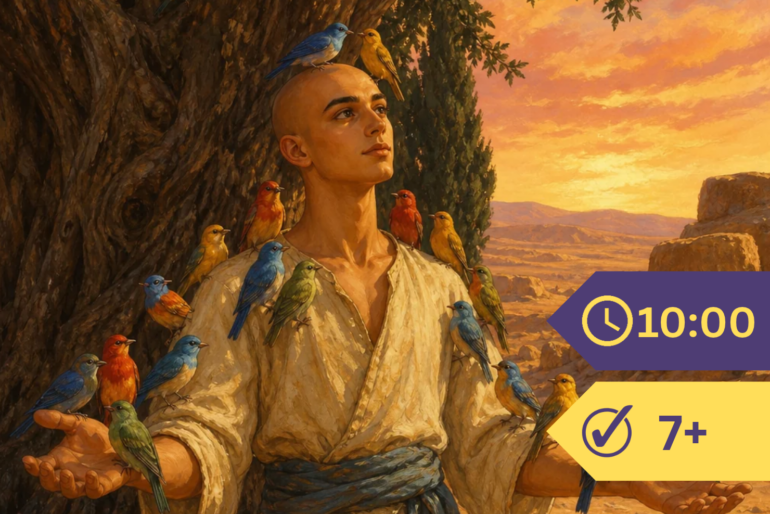
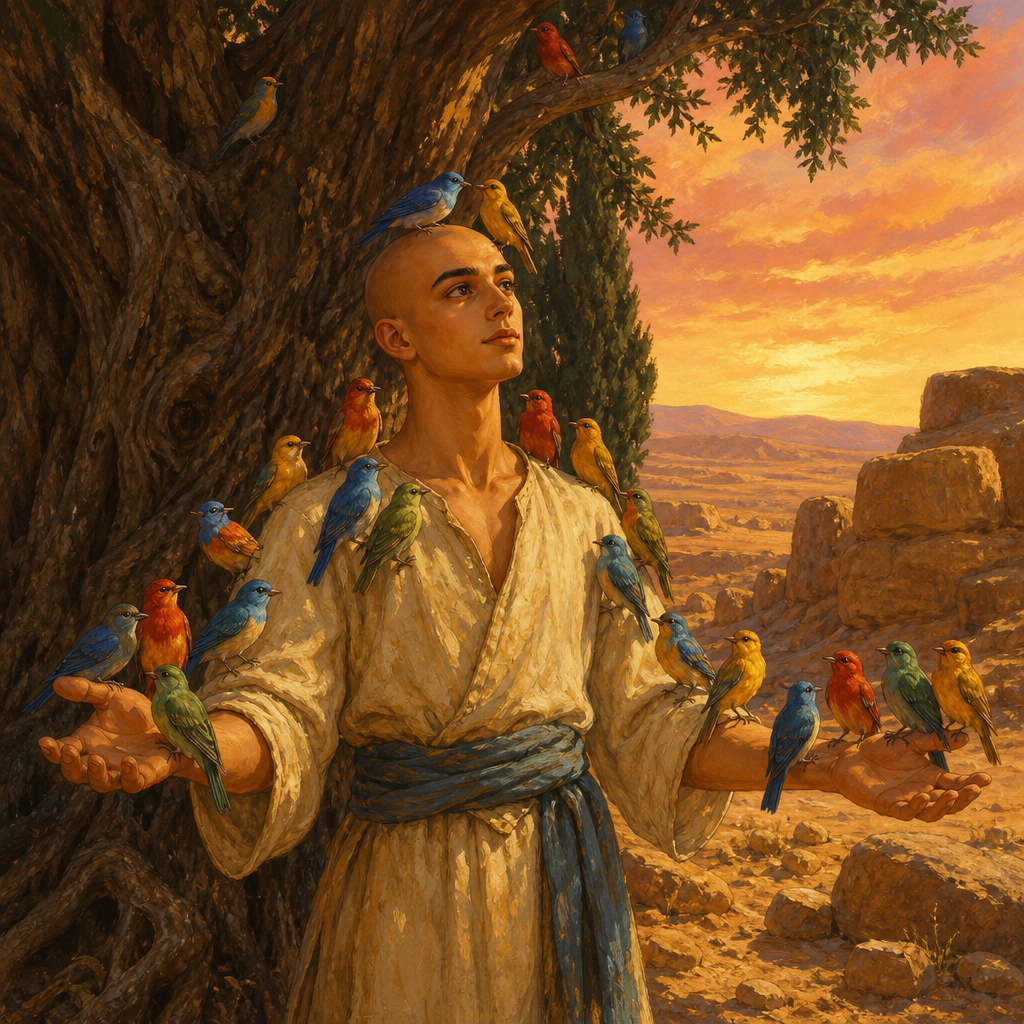
“Don’t despair. It isn’t as hard as it sounds,” said the dervish. “Two days’ journey from here, toward the setting sun, stands a cypress tree bigger than any other on earth. Sit where the shadow is darkest, close to the trunk, and keep very still. After a while you’ll hear a mighty rushing of wings, and all the birds in the world will come and settle in its branches. Don’t make a sound until everything is quiet again. Then say ‘Madschun!’ The birds will be forced to stay where they are. Not one will be able to leave its perch. You can then place them all over your head and arms and body, and that’s how you must carry them to the sultan.”
The young man thanked him gladly and followed his directions so carefully that a few days later a strange figure covered in soft feathers walked into the sultan’s presence. The sultan was amazed. He had never seen such a sight. How lovely the little bodies were, with their bright, frightened eyes! Soon came a gentle stirring and a great opening of wings: blue wings, yellow wings, red wings, green wings. When the young man whispered “Go,” the birds flew in circles around the sultan’s head and then streamed out of the open window to find homes in the garden.
“I’ve done what you asked, Sultan. Now give me the princess.”
“Yes, yes!” said the sultan hurriedly. “You’ve pleased me very much. Only one thing remains to make you a husband any girl would want. That head of yours, you know, is so very bald! Get it covered with nice thick curly hair, and then I’ll give you my daughter. You’re so clever, I’m sure this won’t give you any trouble.”
The young man listened in silence, and in silence he sat in his mother’s kitchen for many days. Then one morning came news that the sultan had promised his daughter to the vizier’s son and that the wedding would be held at the palace at once. The young man rose in a fury. He made his way quickly and secretly to a side door that only the workmen used, slipped into the mosque, and from there entered the palace by a gallery that opened onto the great hall. There the bride and bridegroom and a few friends were gathered, waiting for the sultan to appear so the contract could be signed.
“Madschun!” whispered the young man from above. At once everyone froze to the spot, and so did some messengers the sultan had sent to see that all was ready.
At last the sultan, angry and impatient, came down himself to see what was going on. When nobody could explain it, he ordered an attendant to fetch a magician who lived near one of the city gates and have him break the spell that some evil spirit had cast.
“It’s your own fault,” said the magician when he’d heard the sultan’s story. “If you hadn’t broken your promise to the young man, this wouldn’t have happened to your daughter. There is only one cure: the bridegroom you’ve chosen must give up his place to the bald-headed young man.”
The sultan was sore at heart, but he knew the magician was wiser than he was. He sent his most trusted servants to find the young man at once and bring him to the palace. The young man, who had been hiding behind a pillar all this time, smiled to himself when he heard this. He hurried home and told his mother: “If messengers come from the sultan asking for me, tell them it’s a long time since I left and you can’t say where I am. But say that if they give you enough money for the journey, since you’re poor, you’ll do your best to find me.” Then he hid in the loft above so he could hear everything.
A moment later someone knocked loudly. The old woman jumped up and opened the door.
“Is your bald-headed son here? If so, let him come with me. The sultan wants to see him directly.”
“Alas, sir,” she said, putting the corner of her veil to her eyes, “he left me long ago and I’ve heard nothing of him since.”
“Can you guess where he might be? The sultan means to give him his daughter’s hand, and whoever brings him back will get a large reward.”
“He never told me where he was going,” she said, shaking her head. “It’s a great honour the sultan does him, and worth some trouble. There are places where he might be found, but only I know them, and I’m a poor woman with no money for the journey.”
“That won’t be a problem,” said the man. “This purse holds a thousand gold pieces. Spend them freely. Tell me where to find him and you’ll have as many more.”
“Very well, it’s a bargain. Now goodbye, because I must get ready. But within a few days you’ll hear from me.”
For almost a week the old woman and her son were careful not to leave the house except after dark, lest the neighbours see them, and they didn’t even light a fire or lantern, so everyone thought the cottage was empty. At last, one fine morning, the young man got up early, dressed, put on his best turban, ate a hasty breakfast and set off for the palace.
The tall guard at the door obviously expected him and let him through without a word. Another attendant inside led him straight to the sultan, who welcomed him warmly.
“My son! Where have you been hiding all this time?”
“Sultan,” said the young man, “I won your daughter fairly, but you broke your word and wouldn’t give her to me. Then my home grew hateful to me and I wandered the world. But now that you’ve repented your bad faith, I’ve come to claim the wife who is mine by right. So tell your vizier to prepare the contract.”
A new contract was prepared and, at the new bridegroom’s wish, signed by the sultan and the vizier in the room where they met. After that, the young man asked the sultan to take him to the princess, and together they entered the big hall, where everyone was still standing exactly as they had been when he spoke the fateful word.
“Can you remove the spell?” asked the sultan anxiously.
“I think so,” said the young man, who, to tell the truth, was a little anxious himself. He stepped forward and cried:
“Let the victims of Madschun be free!”
As soon as he said the words, the statues came back to life, and the bride put her hand joyfully into the new bridegroom’s. As for the old one, he vanished completely, and nobody ever knew what became of him.