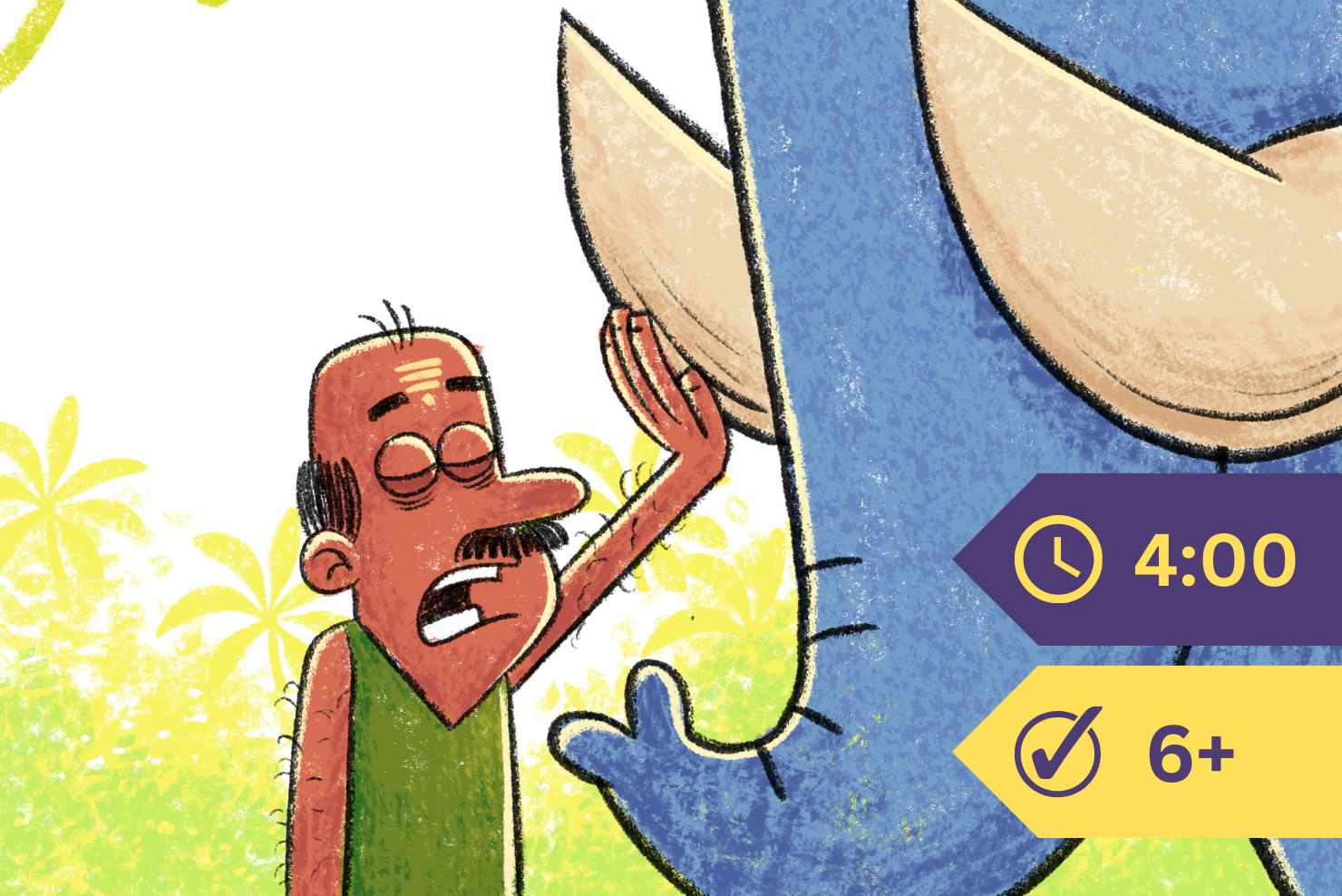
Once there was a very old man, a hundred years old or more, and his wife was nearly as old. They’d had a happy life, but they would have been happier with a child. One day the old man said, “Wife, give me money from the chest. I’m going all through the world to find a child. If I don’t, I won’t come home.”
He wandered a long time, till one morning he reached a forest so thick that no light came through. He was afraid, but he said to himself, “The unexpected is what happens,” and went in. After hours he came to the mouth of a cave, darker than the wood. Then he saw a faint light. An old hermit with a long white beard sat reading a book. The old man said good morning twice, and at last the hermit made a sign for him to approach.
“What brings you here? It’s hundreds of years since my eyes have seen a man.”
“We have no child, and all our lives we’ve longed for one.”
The hermit picked up an apple from the floor. “Eat half of this and give the rest to your wife. Stop wandering.”
The old man kissed the hermit’s feet and hurried out. In a field of flowers he was seized by a terrible thirst. No stream. At last he forgot the hermit’s words and ate the whole apple. Then he fell asleep.
When he woke, he found something lying on a bank among pink roses: a little girl of two, with a skin as pink and white as the roses. He wrapped his cloak around her and carried her home. At the cottage door he set her in a pail and ran in. “Wife, come quick! I’ve brought you a daughter!”
But when they came out, the pail was empty.
They searched everywhere. Fairies? A wild beast? At last, with sore hearts, they gave up. They’d already named her Wildrose.
What had happened? Left alone in a strange place, the baby had begun to cry. An eagle heard, swooped, and carried her to his nest at the top of a tree, among his eaglets. The eaglets didn’t eat her; they nestled against her and spread their little wings to shade her from the sun.
At the foot of the tree, beside a poisoned stream, lived a monstrous seven-headed lindworm who preyed on young eaglets that fell from the nest. That midnight he came for the young birds, and something stopped him: a clamour and a thump, and the whole tree shook. Wildrose slept right through it. By morning, the lindworm lay dead, and the eagle wondered whether the girl had brought him luck.
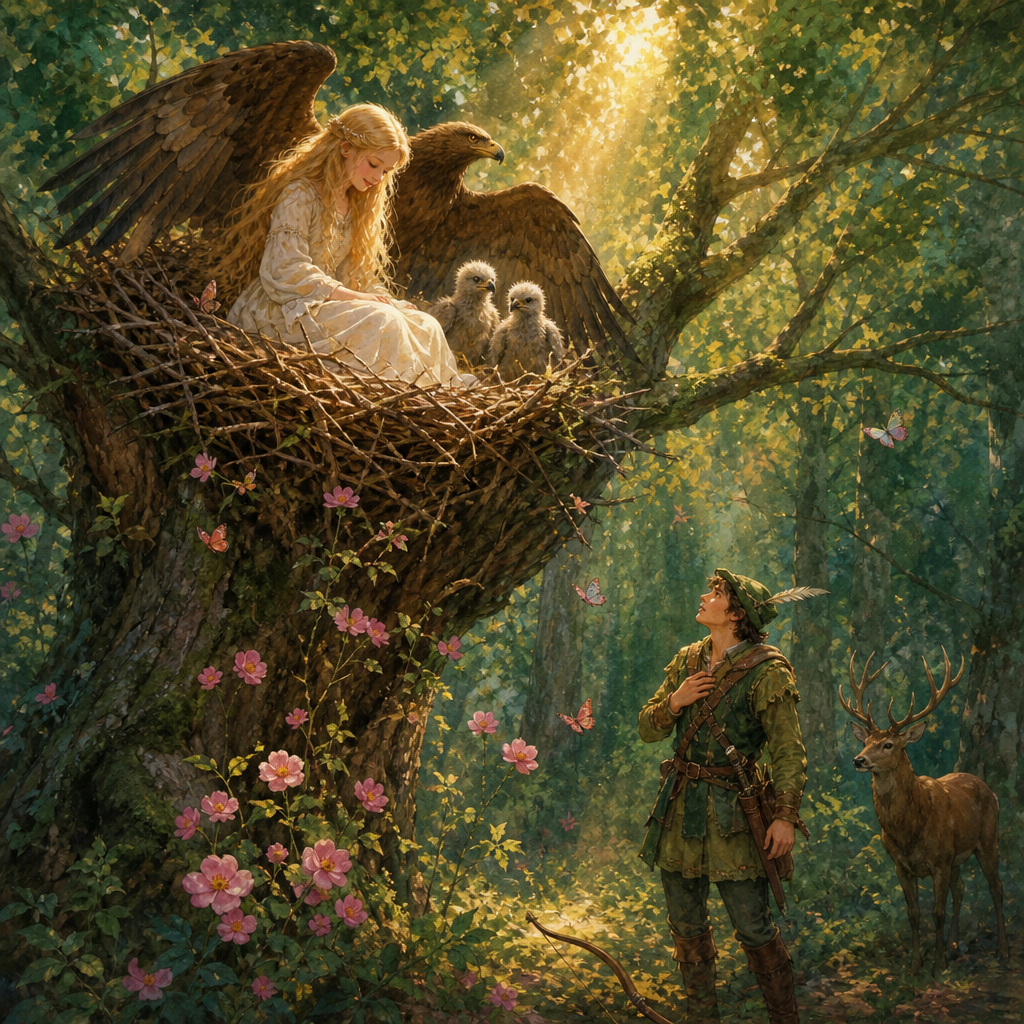
From that day Wildrose lived like a little princess. The eagle fetched the softest moss for her bed, and the brightest flowers to decorate it. The birds of the forest came to talk to her, and butterflies danced for her. She grew tall and beautiful and was fourteen years old, and had never seen a human being.
One morning the emperor’s son rode out hunting. A stag led him deeper into the forest than any man had gone. In the silence, a shaft of light shone from the top of a tall tree, and he looked up and saw a nest, and in it a girl with golden hair, watching him. He lifted his bow, thinking it was some strange bird, and a ray of light dazzled him so that he dropped it. When he opened his eyes, Wildrose was smiling down at him.
“How can I reach you?” he called. She only smiled and shook her head. He returned twice, and she did not come down.
His father worried at the prince’s mood and finally learned the truth. He wasn’t sure a girl from a treetop would make a good empress, but he loved his son. Heralds went out across the land: whoever knew of a girl who lived at the top of a tree would be rewarded. No one did. Girls laughed. “A fine empress she’d make!” Then an old woman stepped from the crowd. She was bent and bald, and the heralds laughed in her face and called her a witch. “I can show you the girl in the tree,” she said. At last the eldest herald said, “The emperor’s orders are clear. Bring her along.”
“Can you bring her?” the emperor asked.
“Yes, Your Majesty. Give me a kettle and a tripod.” She tucked them under her arm and followed the huntsmen. They could hear her coming a mile away, chattering and clanking like a camp of travelling tinkers. At the forest edge she told everyone to wait. She walked in alone, stopped beneath the tree, lit a fire, and tried to set the kettle on its tripod. It rolled off. Again. Again. From her nest, Wildrose finally lost patience. “It won’t stand there. Move it!”
“Where, my child?” The old woman looked up and tried again.
“I told you! Make the fire near a tree and hang the kettle from a branch.”
The old woman hung it from a twig, which broke. “If you’d only show me,” she sighed.
Wildrose slid down the trunk to show her. At once the old woman seized her and ran to the edge of the wood, where the prince was waiting. He took Wildrose in his arms, and she, finding herself among kind, delighted faces, stopped struggling. She was dressed in a golden gown with pearls in her hair, put in a carriage drawn by six white horses, and carried to the palace. In three days there was a wedding.