It was a stormy December morning. Effie had been playing with her dolls, and Lill had been reading, and both were thoroughly bored. The snow was coming down too hard to go out, and Mrs. Pelerine had said they needn’t do anything useful for two whole hours—which meant there was nothing to do but yawn.
“Effie,” said Lill at last, “shall I tell you a story?”
“Oh yes! Do!” said Effie, and she scrambled up beside Lill in the big rocking chair in front of the fire. She kept perfectly still, because she knew Lill’s stories were not to be interrupted—not by a sound, not even a wriggle. Lill fixed her eyes on the flames and rocked backward and forward for a minute or two. Then she said, “Now. I’m going to tell you about my thought travels—and they are quite a bit stranger than the ordinary kind, but oh, ever so much nicer.”
Lill always began her stories the proper way.
“Once upon a time,” she said, “when I was walking through the big field beyond the orchard, I followed the path all the way around behind the hill—and I came to a high wall built right up into the sky. At first I thought I had found the ends of the earth, or perhaps somehow walked all the way to the Great Wall of China. But after walking along it for a while, I came to a large gate, and over it, in beautiful gold letters large enough for a baby to read, were the words: Santa Claus Land.“
How large that might be, Lill did not stop to explain.
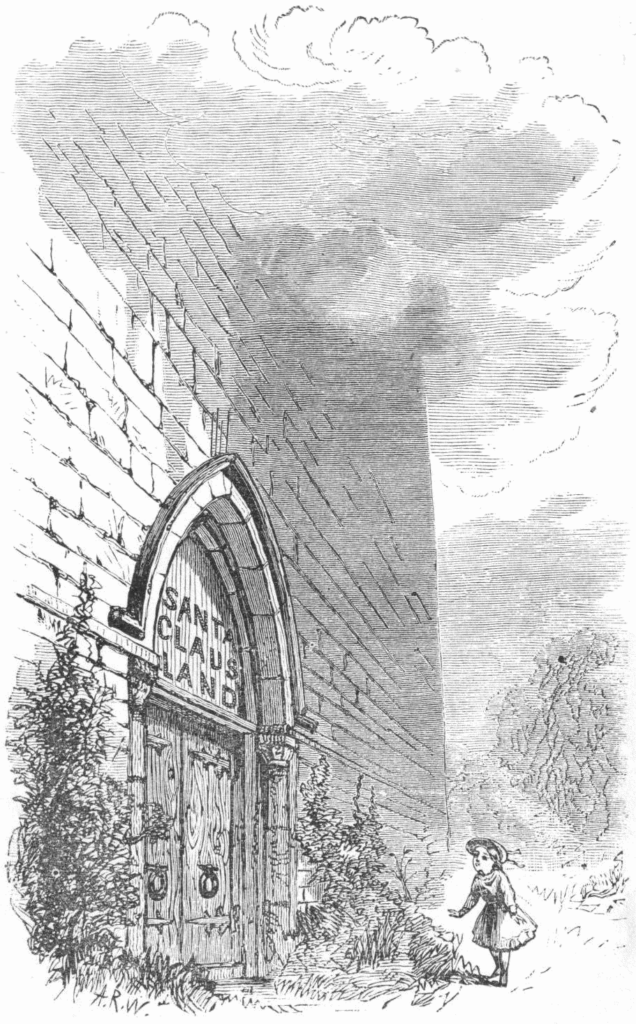
“The gate was shut tight,” she continued, “and I knocked and knocked and knocked as hard as I could, but nobody came. I was dreadfully disappointed—because it seemed to me that Santa Claus must live here all year round, except when he went out to pay Christmas visits, and it would be so lovely to see him in his own home. But what could I do? The gate was far too high to climb, and there wasn’t even a crack to peek through.”
Effie drew a long, disappointed breath. Lill went on.
“But as I was poking about, I pressed a little bell-spring in the wall—and in a moment, jingle, jingle, jingle, the bells went ringing far and near, with the merriest sound ever heard. And while they were still ringing, the gate slowly swung open, and I walked in.
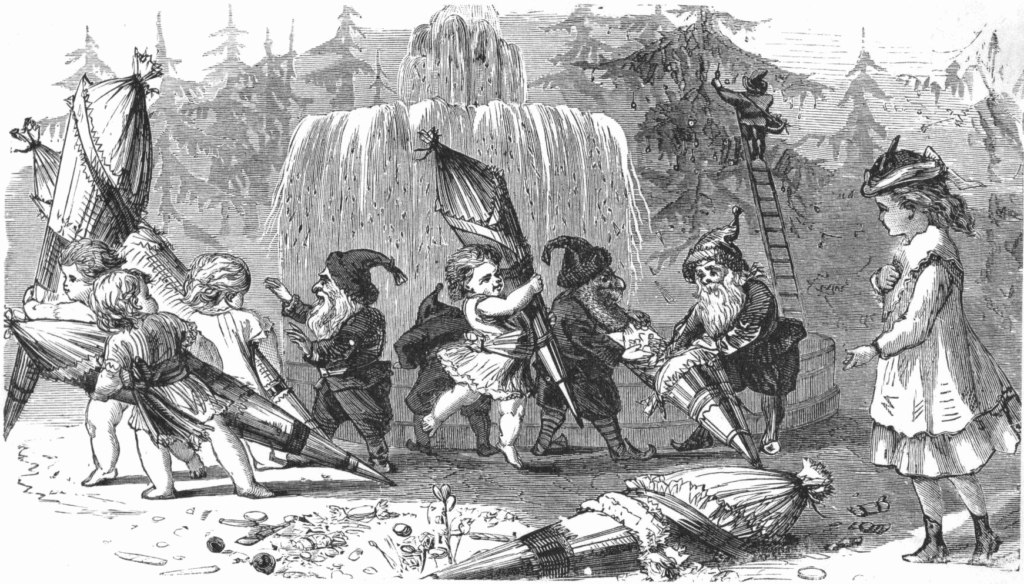
“I didn’t even stop to ask if Santa Claus was at home, because I forgot all about my manners the moment I saw what was inside. First there was a small paved courtyard, surrounded by rows and rows of dark green trees, with several avenues opening between them. In the center of the court stood a beautiful marble fountain—but instead of water, streams of sugar plums and bon-bons came tumbling out of it! Funny little men were filling paper cornucopias at the fountain, and plump little barefoot children with chubby hands and dimpled shoulders snatched them up the moment they were full and ran off down the avenues. They were all too busy to speak to me, but as I came up, one of the little men pressed a cornucopia into my hands, and I marched along with the children.
“The avenue was lit with Christmas candles, which was fortunate, as it would have been quite dark otherwise. I noticed the little ones were slyly eating a candy or two as they walked, so I tasted one of mine—and they were delicious, the real Christmas kind. After a while, the trees grew smaller and farther apart, and here were more little men up on ladders, tying toys and bon-bons to the branches. The children stopped to make their deliveries. I walked on, because I had spotted something in the distance I was curious about.
“It turned out to be a large, very well-tended garden. But even from afar, it didn’t look quite natural. When I reached it, I found it was the most extraordinary garden imaginable. Growing in long, straight rows were—dolls, and donkeys, and toy wagons, and little cars, and croquet sets, and ever so many other things besides. In one bed, the wooden dolls had only just sprouted; their funny little heads barely peeked above the soil, looking very surprised at their surroundings. Farther along were china dolls standing tall and proper, evidently nearly ripe for picking. And a gardener was hoeing a row of toy soldiers that did not appear to be doing very well—their arms and legs looked rather weak.
“The gardener seemed familiar. As I came closer he stopped, leaned on his hoe, and said, ‘How do you do, Lilian? I am very glad to see you.’
“The moment he raised his face, I knew it was Santa Claus—he looked exactly like the portrait we have of him. I ran and put both hands in his, nearly shouting with delight.
“He laughed, and his laugh was the funniest thing you ever heard—like a brook going over stones, and the wind up in the trees all at once. Two or three times I thought he had finished, and then he would burst out again, laughing through all the vowels: ‘Ha, ha, ha, ha! He, he, he, he, he! Hi, hi, hi, hi, hi! Ho, ho, ho, hooooo!'”
Lill did it very well. Effie laughed until the tears came to her eyes, and she could quite believe Lill when she said:
“It grew so funny that I couldn’t stand up anymore, and I fell right over into one of the little chairs that were growing in a bed just past the soldiers.
“When Santa Claus saw that, he stopped quite suddenly. ‘There, that will do,’ he said. ‘I take a hearty laugh every day, for digestion.’ Then he leaned in and whispered, ‘That is the reason I live so long and never grow old. I’ve been the same age since the chroniclers first began to keep notes—and those who are best placed to judge believe I shall remain exactly this age for approximately one thousand eight hundred and seventy-six years more. They probably took fresh observations at the Centennial, so they know exactly.’
“I told him I was delighted to hear it, and he nodded and winked and said it was ‘all right.’ Then he asked if I would like to see the rest of the place.
“‘Very much indeed,’ I said.
“He threw down his hoe with a sigh. ‘I don’t think I’ll get more than half a crop of soldiers this season. They came up well enough, but the arms and legs are weak. When I get to town, I’ll have to send out some girls with glue pots to set them right.’
“The town was some distance away. Our path took us past flower beds where the most exquisite small toys were growing, and a little glass hot-house where new varieties were being propagated. Then we came to a plantation of young trees with rattles and rubber balls and ivory teething rings growing on the branches, bobbing and bouncing about in the merriest way as we walked past.
“‘There’s a nice growth,’ said Santa Claus approvingly.
“It was a very fine growth indeed—but just beyond it I saw something so perfectly splendid that I nearly forgot about everything else.”
Lill paused impressively. Effie looked as expectant as could be.
“It was a beautiful grove. The trees were large, with long drooping branches—and the branches were loaded, positively loaded, with dolls’ clothes. Silk dresses in every color you could name, with sashes to match—”
“Oh!” said Effie, who had a particular weakness for sashes. Lill gave her a stern look and placed a warning hand over her mouth before going on.
“—and everything else a fashionable doll could possibly want, growing in the most wonderful profusion. Some garments had already fallen, and there were girls going about picking them up and packing them carefully into trunks and boxes. ‘These are all ripe,’ said Santa Claus, giving one of the trees a good shake, and clothes came tumbling down so fast that the girls could hardly keep up.
“The grove stood on a hill, so we had a fine view in every direction. Below us was a park full of reindeer, and beyond that the town, and off to one side a big farmyard full of animals of every kind.
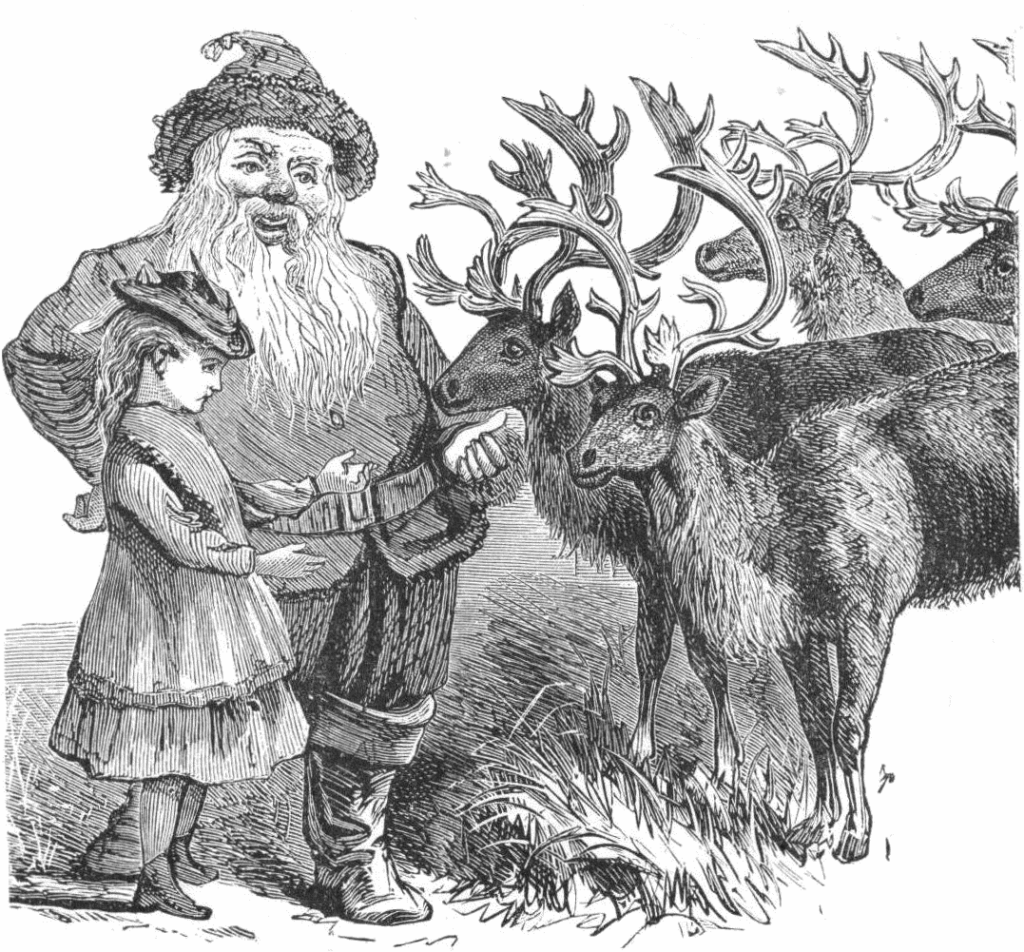
“Santa Claus was in a hurry, so I didn’t stop to look for long. Our path went through the reindeer park, and we paused to call for Prancer and Dancer and Donder and Blitzen, and Santa Claus fed them lumps of sugar from his pocket. He pointed out Comet and Cupid browsing in the far corner of the park. Dasher and Vixen were nowhere to be seen.
“Most of the buildings in the town were Swiss cottages, but there were also some fine churches and handsome public buildings—all built of beautifully illustrated wooden blocks. We stopped for a moment at a long depot where a toy locomotive was being gleefully smashed to pieces by some small helpers.
“Santa Claus’s own house stood in the middle of town. It was an old-fashioned place, broad and low, with an enormous chimney. A wide step fronted the door, shaded by a fig tree and a grape vine, and morning glories and scarlet beans clambered up beside the latticed windows. Great round rose bushes with great round roses grew on either side of the path to the door.”
“Oh, it must have smelled like a party,” murmured Effie, then quickly fell silent, remembering herself.
“Inside, the house was cozy and comfortable—a proper grandfatherly sort of place. A big armchair stood before the window, with a big open book on the table beside it. A great pack, half assembled, lay on the floor, and Santa Claus stopped to tuck a few more things in from his pocket. Then he went to the kitchen and brought me a lunch of milk, strawberries, and cookies, because he said I must be tired after my long walk.
“After I had rested a little, he said I might come with him to the observatory. But just as we were leaving, a funny little fellow appeared at the door with a wheelbarrow piled high with boxes of dishes. Santa Claus took them all out and added them to the pack. Then he stood there a moment and said slowly, ‘Let me see.’
“He laid his finger beside his nose and looked at me very attentively, as if I were a sum he was working out in his head. I suppose I must have added up correctly, because he looked satisfied, and told me I had better go see the mine first, and then meet him in the observatory.
“I followed the little fellow with the wheelbarrow to what looked like the entrance of a cave—I suppose it was the mine. Inside, I found more little people busy at work with picks and shovels, drawing out wooden dishes from the floor of the cave, and china and glass from the walls and ceiling—for the cups and bowls and plates hung down in clusters, just like stalactites in a great cavern.”
Here Lill opened the book she had been reading and showed Effie a picture of stalactites, so she would understand.
“It was so curious and pretty that I would have stayed much longer, but I remembered the observatory. And just then I heard Santa Claus calling from somewhere above: ‘Lilian! Lilian!‘ His voice sounded very far away, and yet somehow it filled the air the way the wind does.
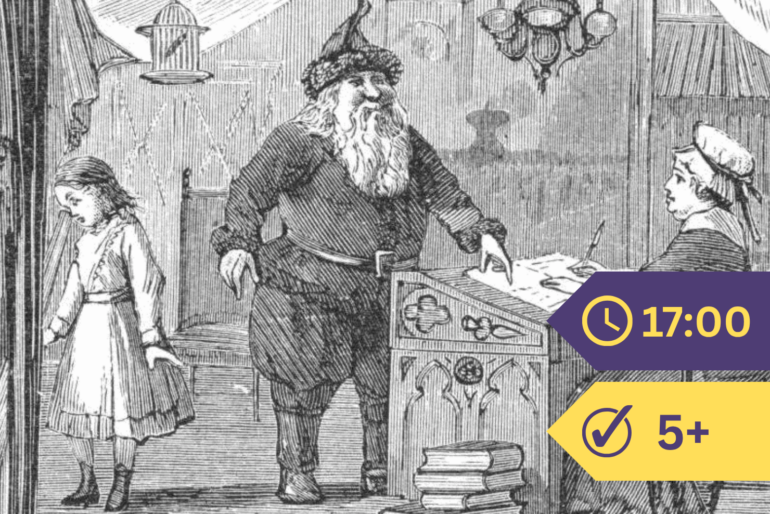
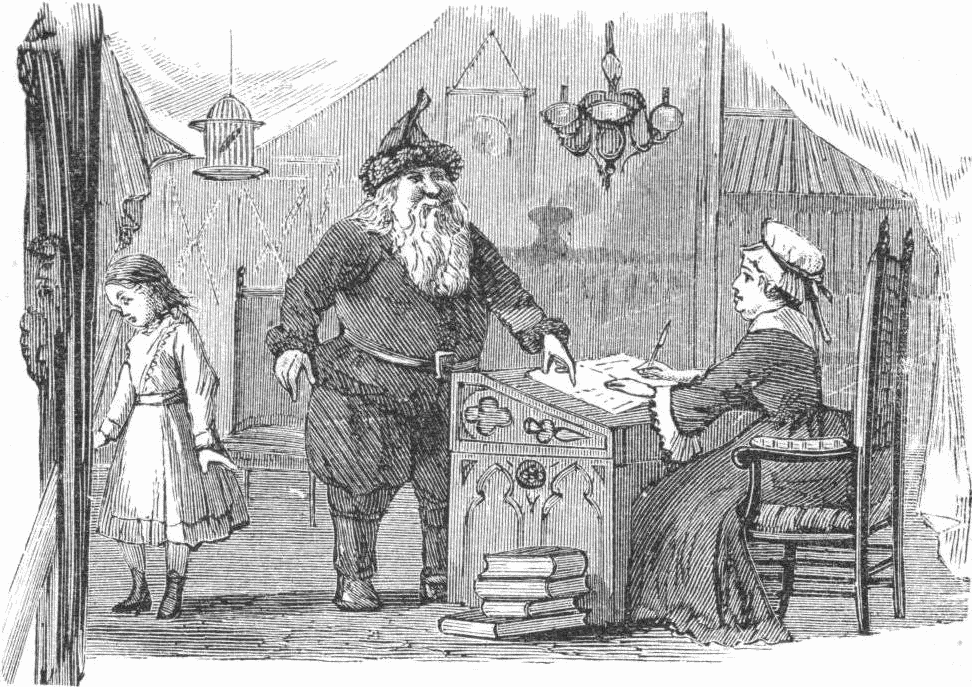
“I looked up, and right there—I wondered I hadn’t seen it before—was a tall tower. I ran to the entrance and climbed the stairs. It was a long climb, and I was quite out of breath when I reached the top. But the room there was so cozy and lovely—stuffed armchairs and little sofas, bird cages and flowers in every window, and pictures all over the walls—that it was a pleasure just to sink into a chair and rest. A lady sat at a golden writing desk, entering notes in a large book. Santa Claus stood at a great telescope, every so often pausing to put his ear to a speaking tube. While I rested, he went on with his work.
“Presently he said to the lady, ‘A good mark for Sarah Buttermilk—I can see she’s working on her temper.’
“‘Two bad ones for Isaac Clappertongue. He’ll drive his poor mother to distraction yet.’
“‘Bad marks all round for the Crossley children—they quarrel far too much.’
“‘A good one for Harry and Alice Pleasure—they mind quickly.’
“‘And give Ruth Olive ten good marks. She’s a peacemaker, that one.’
“Just then he happened to glance at me and saw I had caught my breath, so he politely asked what I thought of the country. I said it was magnificent. He said he was sorry I hadn’t stopped in the greenhouse, where he was growing wax dolls and other delicate things. I was very sorry about that too.
“Then I told him he must be very happy to own so many delightful things.
“‘Of course I’m happy,’ said Santa Claus—and then he sighed. ‘But it is an enormous responsibility to give every child exactly what they deserve. I take these observations every day. I know who is good and who is not.’
“I was very glad he’d told me, and I thought if he would only tell me what time of day he usually looked, I would have gathered truly valuable information. So I stood and made my best curtsy and said, ‘Please, sir—what time of day do you usually observe?’
“‘Oh,’ he said carelessly, ‘any time from seven in the morning until ten at night. I’m not particular about the hour. I often go without my own dinner in order to keep records of table manners. For instance: last evening, I saw you turn your spoon upside down in your mouth. That’s very bad manners for a girl of nearly fourteen.’
“‘Oh!’ I said, feeling very ashamed. ‘I didn’t know you were looking. I promise I’ll never do it again.’
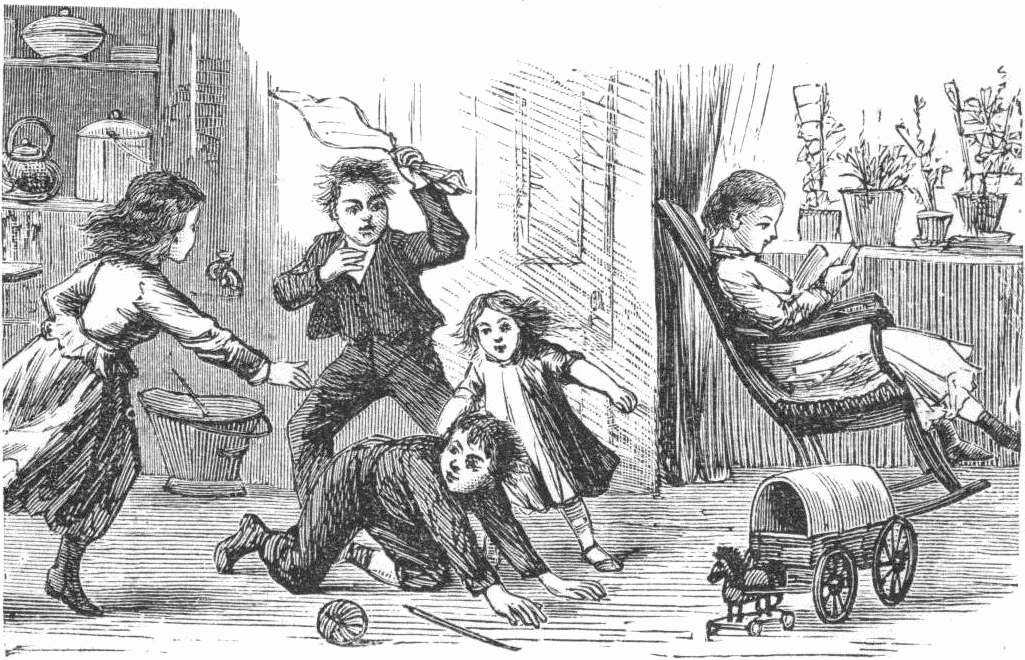
“Then he said I might have a turn at the telescope. I looked through it—and I was looking right down into our own house. There was Mother, busy and tired, and all the children making a fuss around her. It was the strangest feeling, because I was there too—and the worst behaved of any of them. Then I ran off to a quiet corner with a book, and after a minute Mamma had to put down her work and call: ‘Lilian! Lilian! It’s time for your practice!’
“‘Yes, Mamma,’ I answered. ‘I’ll come right away.’
“The moment I said that, Santa Claus whistled for Comet and Cupid, and they came clattering right up the stairs of the tower. He tucked me into a tiny sleigh, and we flew off over great snowbanks of cloud—and before I had time to think, I was back in the big armchair by the fire, and Mamma was calling, ‘Lilian! Lilian! It’s time for your practice!’—just exactly as she’s calling now. So I must go.”
And Lill said, “Yes, Mamma,” and ran to the piano.
Effie leaned back in the chair to think. She wished Lill had found out how many black marks she had, and whether the lady at the golden desk was Mrs. Santa Claus—and had, in fact, asked about a great many things more. But when she brought these questions up later, Lill said she didn’t know—for the next time she had traveled in that direction, she found that Santa Claus Land had moved.