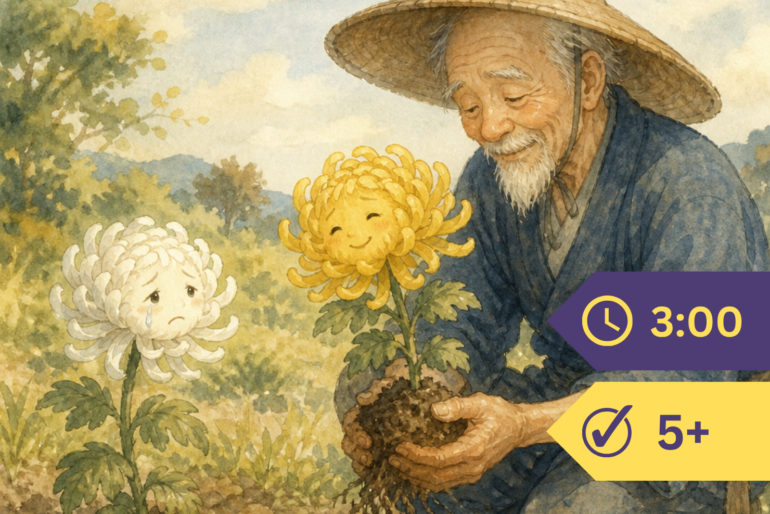
Long ago, in a meadow, a white chrysanthemum and a yellow chrysanthemum grew side by side.
One day an old gardener came across them, and he took a great fancy to Lady Yellow. “Come home with me,” he told her, “and I will make you far more beautiful. You shall have delicate food and fine clothes to wear.”
Lady Yellow was so charmed that she forgot all about her white sister. She let the old man lift her up, carry her in his arms, and plant her in his garden.
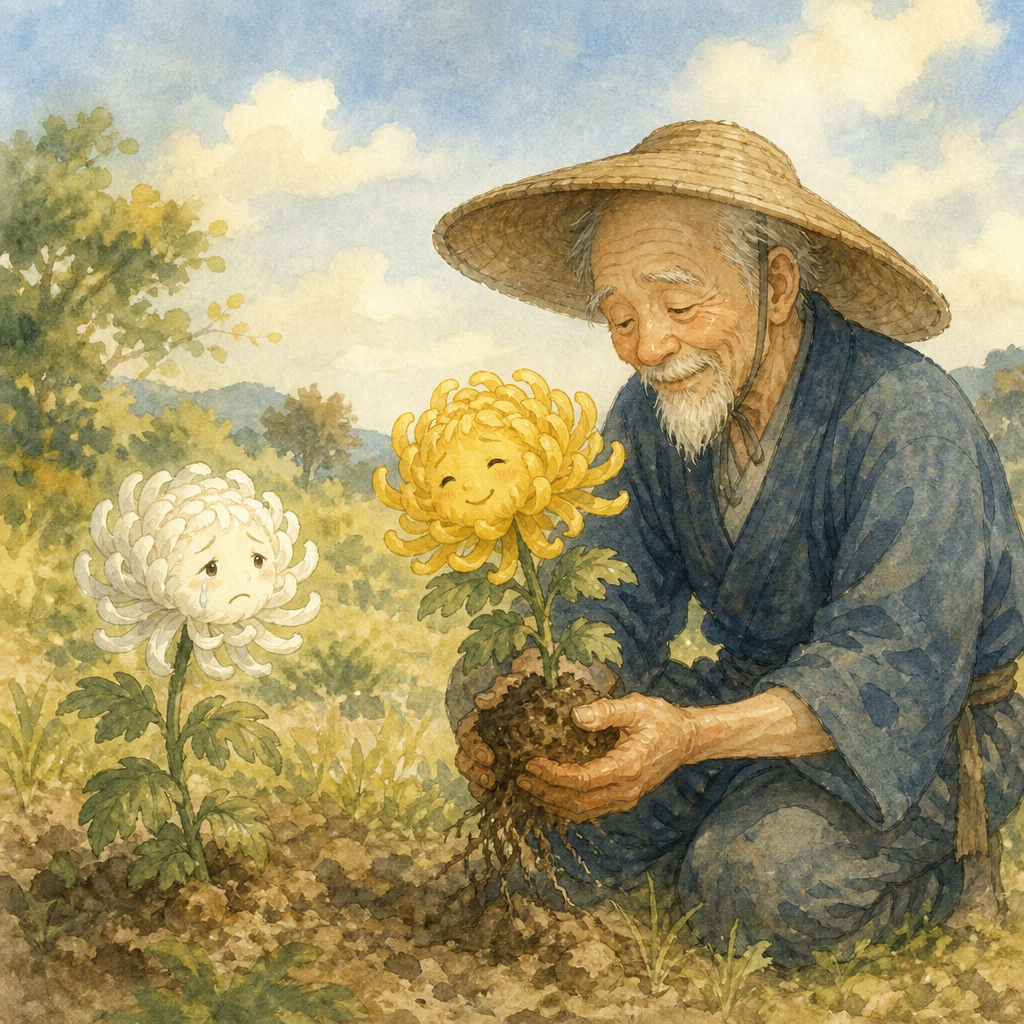
When they had gone, Lady White wept bitterly. Her simple beauty had been brushed aside, but that was not the worst of it. Worse was being left alone in the meadow, without the sister she loved so dearly.
Day by day, Lady Yellow grew lovelier in her master’s garden. No one would have known her for the common flower of the field. Her petals were long and curled, and her leaves were clean and carefully tended. Still, now and then she thought of Lady White out in the field, and wondered how she was getting through those long, lonely hours.
One day a village chief came to the old man’s garden. He was looking for the perfect chrysanthemum to carry to his lord, who wanted a flower for his crest. “I don’t want a fine chrysanthemum with long petals,” he explained. “I want a simple white one, with sixteen petals.”
The old man sent him to see Lady Yellow, but she was not what he wanted. He thanked the gardener politely and set off for home.
On the way, he crossed a meadow and found Lady White weeping. She told him her sad story of loneliness. When she had finished, the village chief said, “I have just seen Lady Yellow, and I don’t think she is half so beautiful as you.”
At these kind words, Lady White dried her eyes. And when he told her that he wanted her for his lord’s crest, she nearly jumped off her little feet!
In another happy moment, she was riding in a palanquin. When she reached the Daimyo’s palace, everyone praised her perfect shape. Great artists came from far and wide, gathered around her, and sketched her with wonderful skill. Soon she saw her own bright face on all the Daimyo’s most precious things: on his armour and lacquer boxes, on his quilts and cushions and robes. She was painted floating down a stream, and in all sorts of quaint and lovely ways. Everyone agreed that the white chrysanthemum with sixteen petals made the finest crest in all Japan.
So Lady White’s happy face lived on, drawn and painted on the Daimyo’s treasures.
Lady Yellow’s story ended differently. She had bloomed only for herself, and she had drunk in every visitor’s praise as eagerly as she drank the dew from her curled petals. Then one day she felt a stiffness in her limbs, and the bright energy of her life began to fade. Her proud head drooped forward. When the old man found her, he pulled her up and tossed her onto the rubbish heap.