Once there was a king who had two daughters, Kupti and Imani. He loved them both dearly and spent hours talking with them. One day he asked Kupti, the elder, “Are you happy to leave your life and fortune in my hands?”
“Of course,” said Kupti, surprised. “Whose hands should I leave them in, if not yours?”
But when he asked Imani the same question, she answered, “No, indeed! Given the chance, I would make my own fortune.”
The king was not pleased. “You are too young to know what you’re saying,” he said. “But so be it. I will give you the chance you want.”
He sent for an old fakir, a holy beggar, who lived in a tumbledown hut at the edge of the city and walked with a limp. “You are old and your legs trouble you,” said the king. “You would probably be glad of a young person to help you. I’ll send you my younger daughter. She wants to earn her own living, and now she can.”
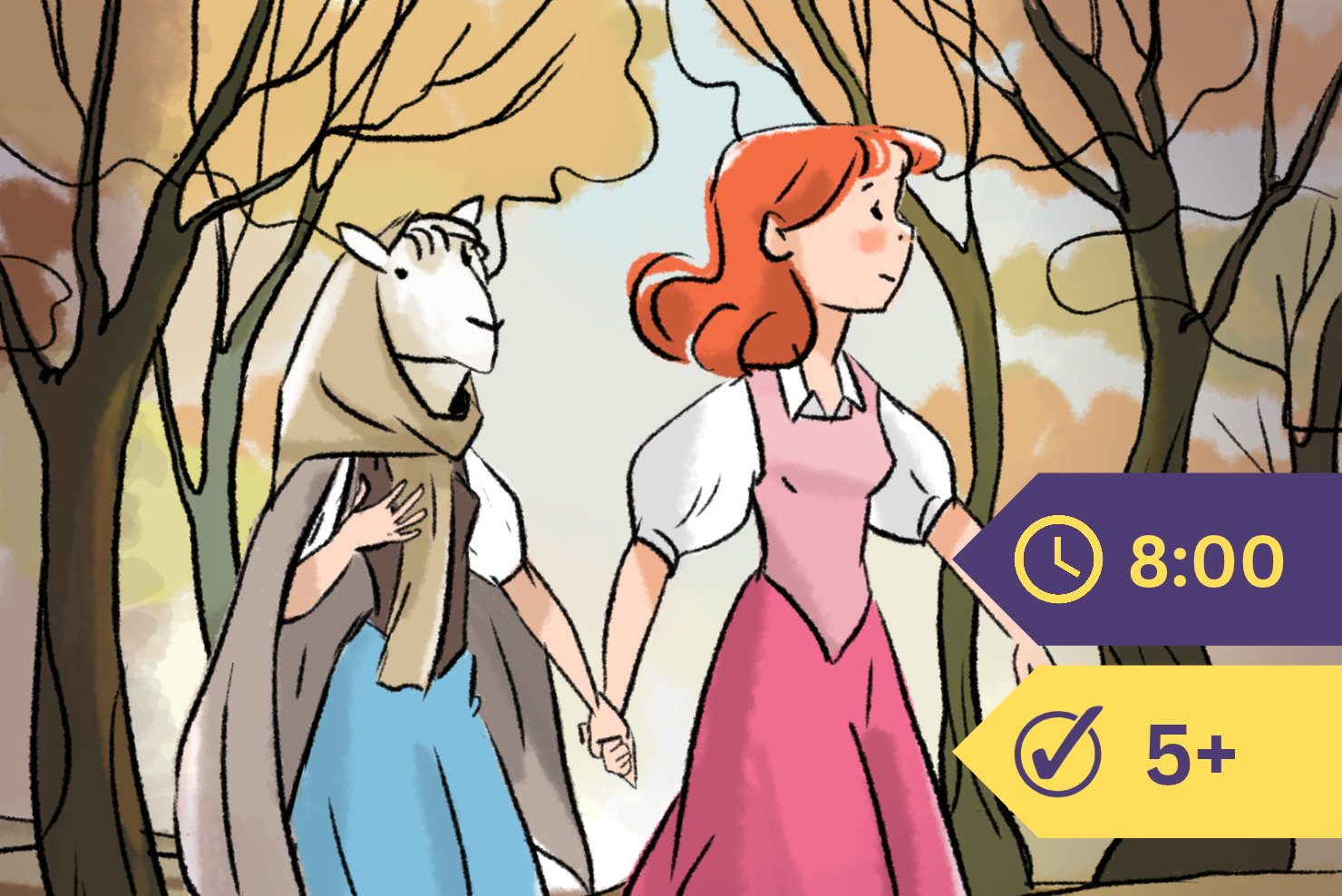
The old man hardly knew what to say. Imani went off with him quite cheerfully, skipping along while he hobbled beside her in bewildered silence.
The hut held one bedstead, two cooking pots and a water jar, and not much else. The fakir fretted over how he could possibly make a princess comfortable. Imani settled it by asking, “Have you any money?”
“I have a penny somewhere,” said the fakir.
“Good. Give me the penny, and go and borrow a spinning wheel and a loom.”
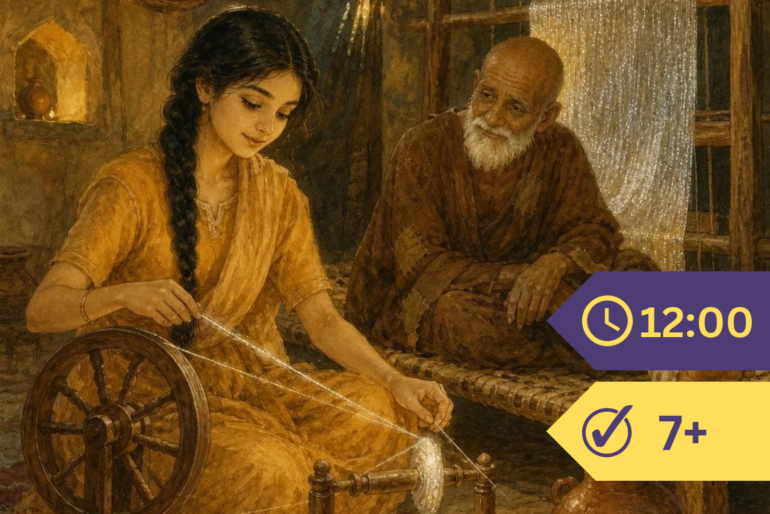
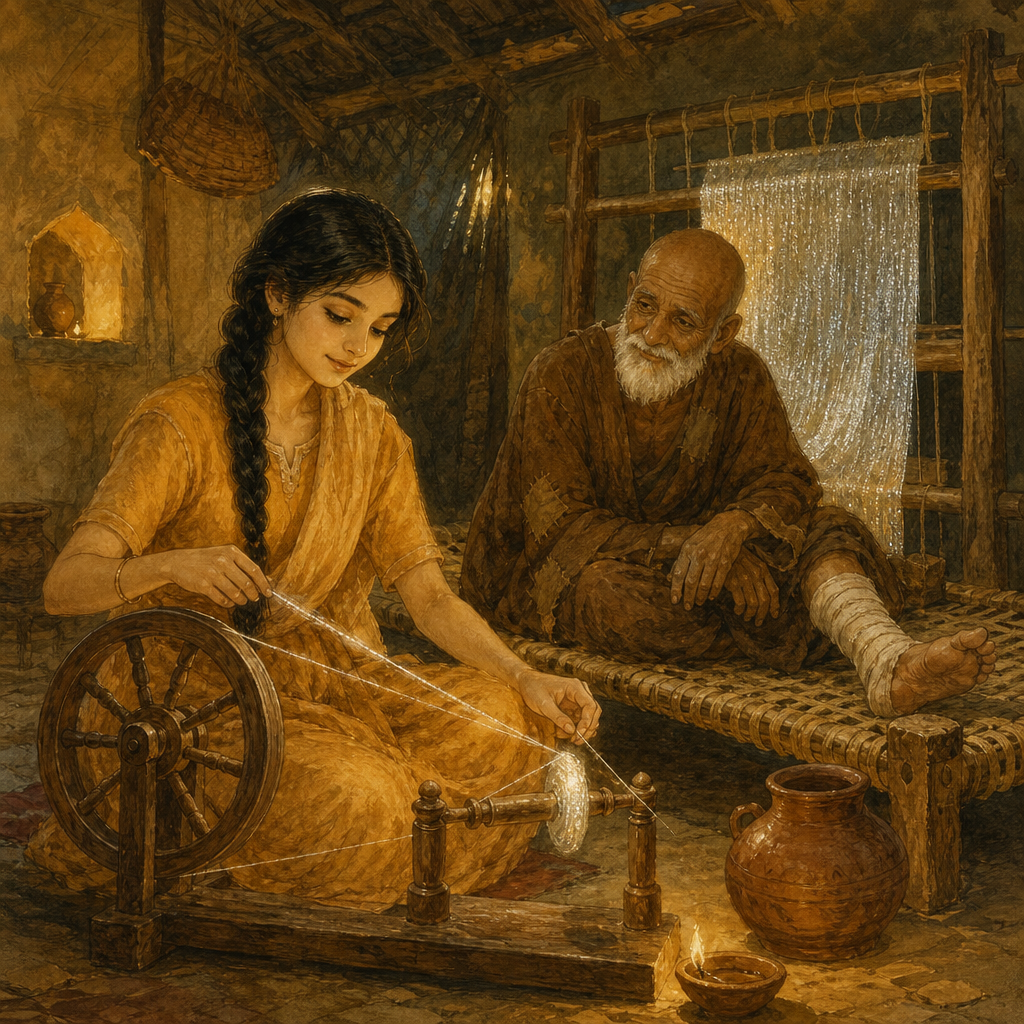
After a long search he found the penny and went off on his errand. Imani went shopping. She bought a farthing’s worth of oil and three farthings’ worth of flax. When she got home she sat the old man on the bed and rubbed his sore leg with oil for an hour. Then she sat at the wheel and spun all night while he slept. By morning she had spun the finest thread anyone had ever seen. All the next day she wove, and by evening she had made a shimmering silver cloth.
“Take this to the market and sell it while I rest,” she said.
“What shall I ask for it?”
“Two gold pieces.”
The fakir hobbled to the market and stood there with the cloth. Soon the elder princess, Kupti, drove by. She saw the cloth, stopped her carriage, and paid the two gold pieces gladly.
The next day Imani did it all again. Each day she spent a penny on oil and flax, rubbed the old man’s leg, and spun and wove more beautiful cloth. Soon the whole city was talking about her fabrics. The fakir’s leg grew straighter and stronger, and the hole under the floor where they kept their money filled up with gold. At last Imani said, “I think we can afford to live more comfortably now.” She hired builders, and they put up a house so fine that only the king’s palace could compare with it.
When the king heard about it and asked who owned it, he was told it belonged to his younger daughter. “Well!” he said. “She said she would make her own fortune, and it seems she has.”
Not long afterwards the king had to travel abroad. Before he left he asked Kupti what he could bring her. “A necklace of rubies,” she said. Then he thought he should ask Imani too and sent a messenger. The man arrived just as Imani was trying to untangle a knot in her loom without snapping the thread. When he bowed and asked what present she would like from the country of Dûr, she answered, without looking up, “Patience!” She meant that he should wait a moment.
But the messenger went away and reported to the king that all Imani wanted was patience.
“Patience?” said the king. “I’m not sure that can be bought in Dûr. I’ve never had much of it myself. But if it’s for sale, I’ll get it for her.”
He finished his business in Dûr and bought Kupti her rubies. Then he told a servant, “Princess Imani wants patience. Go to the market and ask whether anyone has some to sell.”
The servant walked up and down the market calling, “Has anyone patience to sell?” Some people laughed. Some (who had none) told him to go away. Some said, “The man’s mad! You can’t buy patience!”
News of the strange fellow reached the king of Dûr, who was curious and had him brought to the palace. “What is this you’re after?”
“Patience, Your Majesty. My master’s daughter Imani has asked for it.”
“I know where she might find some,” said the king, smiling. “But it can’t be bought.”
The king’s name was Subbar Khan, and subbar means “patience.” The servant had no idea he was hearing a joke. He just went on praising the princess as the most clever, hardworking and kind-hearted of all princesses, until the king laughed and held up a hand. “Wait a moment, and I’ll see what I can do.”
He went to his private rooms and came back with a small casket. “This has no lock and no key,” he said, “and it will open only for the person who truly needs what is inside it. Whoever opens it will find patience, though I can’t promise it will be the kind she expects.” He wouldn’t accept a penny for it.
When the king came home, Kupti got her rubies. Imani was astonished when a casket arrived for her. “I never asked for anything,” she said. “I hadn’t even time to answer before the messenger ran off!” But the servant insisted it was hers, so she took it to the fakir. He tugged at the lid until he was tired out, but it would not budge. Imani barely touched it and it sprang open. Inside lay a beautiful fan. She took it out and fanned herself, once, twice, three times.
And there, out of nowhere, stood Subbar Khan, king of Dûr!
Imani gasped. The fakir stared. At last the old man said, “Who are you, sir, if I may ask?”
“I am Subbar Khan of Dûr,” said the king, bowing to Imani. “This lady has called me, and here I am.”
“I called you?” cried Imani. “I’ve never seen you in my life.”
He explained about the man in the market, the casket and the fan. “Both are magic. Three strokes of the fan bring me to whoever uses it. Fold it and tap it on a table three times, and I’m home again. The casket opens only for the person who needs its contents. You asked for patience, and that is my name, so here I am, at your service.”
Imani, who was proud, wanted to fold the fan and send him straight home. But the fakir was delighted with their guest, and the three of them spent a lovely evening together. After that the king came often. He and the fakir both loved chess, and they played half the night. A little room in the house came to be called the king’s room, and he slept there whenever he stayed late.
Before long Kupti heard that a rich and handsome young man was visiting her sister’s house, and she was fiercely jealous. She went to see Imani, all smiles and affection, and asked to be shown the house. When she came to the king’s room she slipped in alone and scattered finely powdered glass, laced with poison, under the bedsheet. Then she hurried away, saying how sorry she was not to have visited sooner.
That night Subbar Khan played chess with the fakir until very late. When he lay down, countless tiny splinters pricked his skin and burned like fire. He could not imagine what was happening. He lay awake in agony, and he was even more hurt in his heart to think that someone had tried to poison him in Imani’s own house. In the morning, though he was near fainting, he said nothing, and used the fan to go home. All his doctors were summoned, but none could tell what was wrong with him. For weeks he lay sleepless and feverish, getting weaker and weaker.
At Imani’s house they waved the fan again and again, but no Subbar Khan came. She worried that he’d grown tired of them, or that something terrible had happened. At last she could not bear not knowing. She dressed as a young fakir and set out for Dûr alone, on foot, as a fakir should travel.
One evening she lay down to sleep beneath a great tree in a forest, but she couldn’t stop thinking about the king. Presently she heard two monkeys talking in the branches above her.
“Good evening, brother. What’s the news?”
“I’ve come from Dûr. The king is dying.”
“Sad news,” said the first monkey. “He’s a fine hunter of leopards and other creatures that make trouble. What’s wrong with him?”
“No one knows. But the birds, who see everything, say it’s poisoned glass that Kupti, the king’s own daughter, spread on his bed.”
“Terrible,” said the first. “But if only people knew! The berries of this very tree, steeped in hot water, would cure him in three days.”
“A pity we can’t tell anyone,” said the other. “Humans are so foolish. They shut themselves up in stuffy houses and miss all the best things.”
Imani had been weeping silently. Now she wiped her eyes, and when it was light she filled her cloth with berries. Two days later she reached Dûr, and walked through the market crying, “Medicine for sale! Does anyone need my medicine?”
“Look, a young fakir with medicine,” said one man. “Maybe he could help the king.”
“Please,” said another. “Gray-bearded doctors have all failed. What could a boy do?”
“He might try,” said the first. And he led Imani to the palace.
She was let into the sickroom. The king did not recognise her, and he was so wasted that she barely knew him. She asked for rooms of her own and a pot of water, steeped the berries, and told the attendants to wash him with the liquid. After the first washing he slept peacefully. After the second he asked for food. By the third day he was well, only weak. On the fourth he sat up on his throne and called for the doctor who had healed him. Everyone marvelled that so young a man could be so skilled. The king wished to give him great riches, but Imani refused them all. At last she said that if she must have a reward, she would take the king’s signet ring and his handkerchief. Then she set off for home.
A little later, after she had told the fakir the whole story, they called for Subbar Khan with the fan. When he appeared, they asked why he had stayed away so long. He told them of his illness and how a young doctor had cured him. Imani stood, opened a cabinet, brought out the ring and handkerchief, and said with a smile, “Are these the rewards you gave your doctor?”
The king looked at them, and at her, and understood everything. He jumped up, tucked the fan into his pocket, and declared that nobody would ever send him home again unless Imani came with him as his wife.
So she did. The old fakir and Imani went to Dûr, where she and the king were married, and they lived happily for the rest of their days.