There was once a man who was good at all sorts of things. He had served bravely in the war, and when it ended he was sent home with three farthings of pay in his pocket.
“This won’t do,” he said. “Let me find the right companions, and the King himself will hand over the treasures of his kingdom.”
He marched into the forest, and there he saw a man who had pulled up six trees by the roots as if they were straws.
“Will you work for me and travel with me?”
“Gladly,” said the man. “But first I’ll take this little bundle of sticks home to my mother.” He wrapped one tree around the other five, swung the bundle onto his shoulder, and carried it off. Then he came back and joined his new master. “We two should be able to travel the whole wide world,” said the master.
A little farther on they found a hunter kneeling with his gun on his shoulder, taking aim.
“What are you aiming at?”
“Two miles from here, there’s a fly sitting on an oak branch. I’m going to shoot out its left eye.”
“Come with us! Three of us together can go anywhere.”
The hunter went with them. Soon they came to seven windmills, their sails spinning fast, though there wasn’t a breath of wind and not a leaf moved. “What’s turning those mills?” said the master. They walked on, and two miles farther they saw a man sitting in a tree, holding one nostril shut and blowing out of the other.
“What are you puffing at up there?”
“Two miles from here are seven windmills. I’m blowing to make them turn.”
“Come with us! Four of us together can go anywhere.”
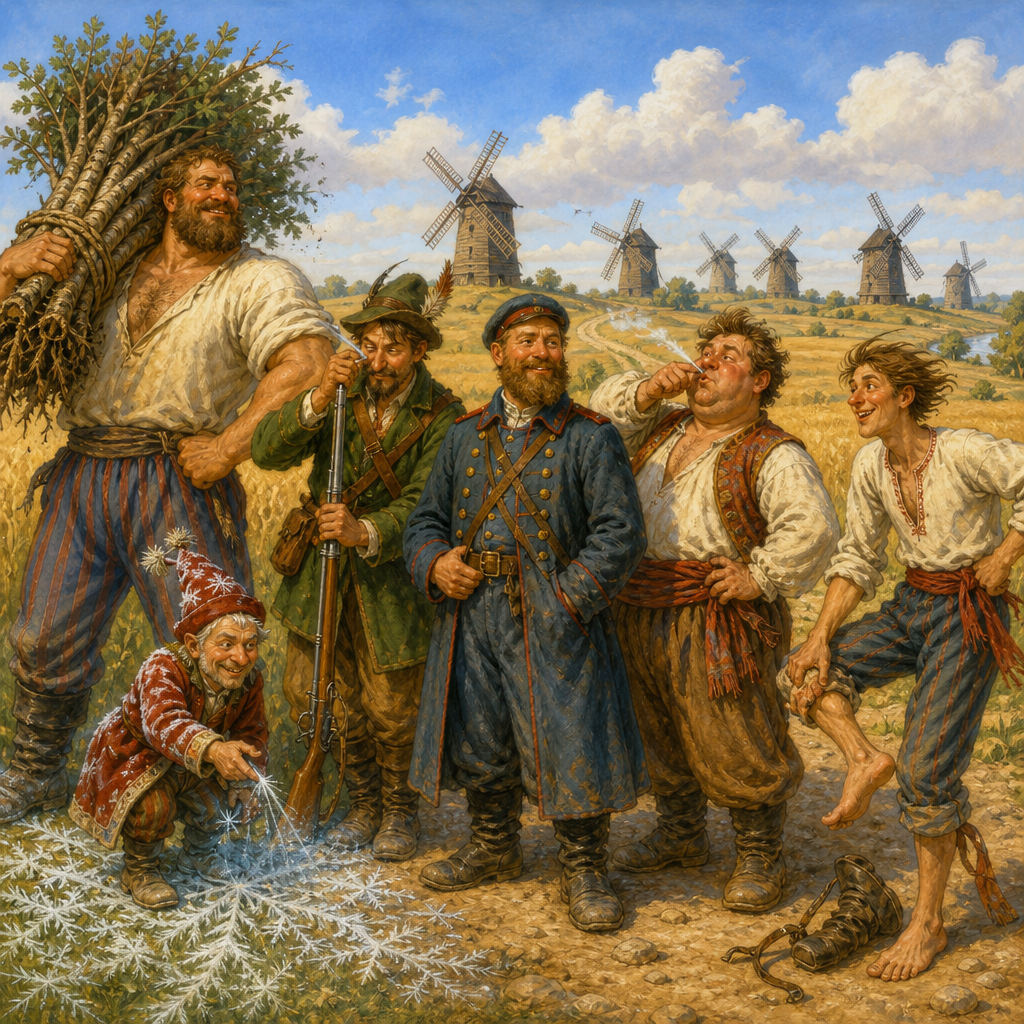
The blower climbed down, and they went on until they saw a man standing on one leg, with the other unstrapped and lying beside him.
“You’ve made yourself very comfortable!”
“I’m a runner,” said the man. “I take off one leg so I don’t go too fast. When I run on both, I’m faster than a bird.”
“Come with us! Five of us together can go anywhere.”
Not long after, they met a man with a little hat tilted over one ear.
“Manners, man! Don’t wear your hat like that. You look like a lunatic!”
“I can’t wear it straight,” said the other. “If I did, there’d be such a frost that the birds in the sky would freeze and drop dead.”
“Come with us! Six of us together can go anywhere.”
The six came to a town where the King had announced a challenge: whoever could beat his daughter in a race would marry her, and whoever lost would lose his head.
“I’ll compete,” said the master, “but my servant will run for me.”
“Then both your heads are on the line,” said the King. “Yours and his.”
It was agreed. The master strapped the runner’s second leg back on. “Now be quick, and make sure we win!” The race was to fetch water from a stream far away; the first one back with a full pitcher would win. The runner and the Princess each took a pitcher and set off at the same moment. In an instant the runner was out of sight, a gust of wind. He reached the stream, filled his pitcher, and turned back. Halfway home, a great drowsiness came over him. He put down the pitcher and lay down to sleep. (He used a horse’s skull as a pillow so he wouldn’t get too comfortable and sleep too long.)
Meanwhile the Princess, who was a fine runner for an ordinary person, reached the stream and hurried back with her pitcher. When she saw the runner asleep, she laughed. “My enemy is delivered into my hands!” She poured out his pitcher and ran on.
Everything would have been lost if the hunter hadn’t been standing on the castle tower with his sharp eyes. “The Princess won’t cheat us,” he said. He loaded his gun and shot the horse’s skull cleanly out from under the runner’s head, without hurting him. The runner woke, jumped up, saw his pitcher was empty and the Princess far ahead. He didn’t panic. He ran back to the stream, filled the pitcher again, and was home ten minutes before the Princess.
“There,” he said, “I was just stretching my legs. That wasn’t a real run.”
The King was furious, and the Princess even more. She had lost to a discharged soldier! They put their heads together to get rid of the six.
“I have a plan,” said the King. “Don’t worry. They won’t come back.” To the Six he said, “You must celebrate. Eat and drink!” He led them into a room with an iron floor, iron doors and barred windows. A table was laid with delicious food. “Go in and enjoy yourselves!” As soon as they were inside, the doors were bolted behind them. The King ordered the cook to light a huge fire beneath the room and keep it burning until the iron glowed red.
The Six sat at the table and felt it getting warmer, and thought it was the good food. But when the heat grew worse and they tried to leave and found the doors fastened, they understood that the King meant them harm.
“He won’t succeed,” cried the man in the little hat. “I’ll bring a frost that makes that fire ashamed of itself.” He put his hat on straight, and a frost swept in so fierce that all the heat vanished and the food on the dishes froze.
Hours later the King, thinking they must be dead, had the doors thrown open. There stood the Six, alive and well. “We’re glad you’ve let us out,” they said. “We were getting chilly. The cold in there froze the food solid!”
The King stormed at the cook. “Why didn’t you do as I ordered?”
“There’s plenty of heat,” said the cook. “Look for yourself.” And the King saw the fire roaring under the iron room, and knew he couldn’t hurt them that way.
He tried again. He called the master. “Give up your claim to my daughter, and I’ll pay you in gold. Take as much as you like.”
“Gladly, Your Majesty,” said the master. “Give me as much as my servant can carry, and I’ll give her up. I’ll come for it in two weeks.”
Then he called every tailor in the kingdom and had them sew day and night for fourteen days on one enormous sack. When it was finished, he sent the strong man to carry it to the King.
“What a mighty fellow!” said the King, staring at the bundle of cloth the size of a house. “How much gold will he walk off with?” He had a ton of gold brought out, which sixteen of his strongest men could barely carry. The strong man picked it up with one hand and dropped it in the sack. “Why not bring more? That barely covers the bottom!” The King sent for more, and more, and the sack was only half full. “More! This is crumbs!” So the King had seven thousand wagons of gold from across the kingdom driven up, oxen and all, and the strong man shoved them in.
“I won’t be fussy,” he said. “I’ll take what comes. It’s easy to tie a sack that isn’t full.” He hoisted it onto his back, and the Six walked off.
When the King saw one man carrying off the wealth of his whole country, he flew into a rage and sent his cavalry after them. Two regiments caught up. “You’re prisoners! Put down the sack or we’ll cut you down!”
“Prisoners?” said the blower. “You’ll dance in the air first!” He shut one nostril and blew out of the other, and the two regiments were scattered across the sky and over the mountains, this way and that. A sergeant-major begged for mercy, saying he had nine wounds and was a brave fellow who didn’t deserve this. The blower let him down gently. “Go tell the King that if he sends more cavalry, I’ll blow them all into the clouds.”
When the King got the message, he said, “Let them go. They’re bewitched.” So the Six took their treasure home, shared it out among them, and lived contentedly for the rest of their days.