There was a man who never said no to a bet. His name was Cajusse, and his particular weakness was that he could not resist a wager even when — especially when — he was not entirely sure he would win.
One evening a group of men at the inn fell to arguing about whether a certain nobleman’s daughter could be made to speak at night. She was famously silent. The servants swore she lay in her darkened room like a statue from midnight until morning, never stirring, never responding to any sound. One of the men said he would give a large sum to whoever could make her say a single word between the hours of midnight and dawn.
Cajusse said he would try.
He came back to the inn the next morning and collected the money.
“How did you do it?” they asked.
“I’ll tell you exactly,” he said.
He had gone to the nobleman’s house and gained entry — he was vague on the details of how — and crept to the door of the young woman’s room. He opened it quietly. She lay still in the dark, apparently asleep.
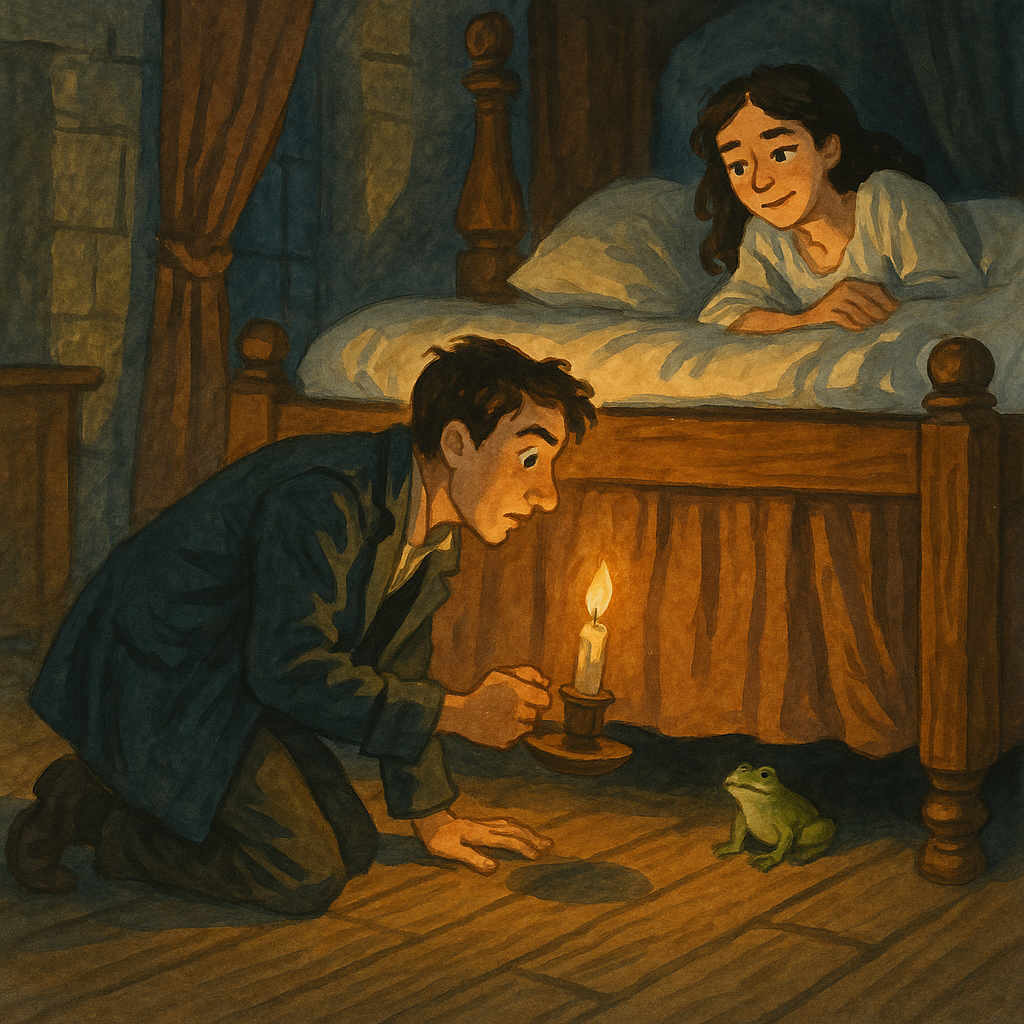
He took out a candle, lit it, and held it up. Then he reached into his coat, produced a live frog, set it down on the floor, and began following it around the room.
At first the young woman said nothing. She was accustomed to strange things, perhaps. But the frog was erratic. It hopped under the washstand. It hid behind a chair. Cajusse crawled after it on his hands and knees, holding the candle.
The frog got under the bed.
“Cajusse, you fool,” the young woman said from under the covers. “The frog is under the bed.”
Cajusse stood up, blew out the candle, picked up the frog, and left.
He had his word. He had his money. And now, of course, he also had a problem — because when the nobleman heard the story, he arrived at the inn in a towering rage and said that Cajusse would marry his daughter immediately or answer for his extraordinary impertinence.
Cajusse, who had met her in a manner of speaking, thought he could do worse.
She, for her part, was reportedly not displeased with a man inventive enough to have thought of the frog.