Highty-tighty, Paradighty,
Clothed all in green.
The King could not read it,
No more could the Queen.
They sent for a Wise Man out of the East,
Who said it had horns but was not a beast.
(Old Riddle)
Once upon a time there was a very warlike kingdom where no one had ever heard of Christmas. The men spent their days fighting, and the women spent theirs urging the warriors to further deeds of valour. This had gone on for a very long time, and no one had ever said they were tired of it — no one except the Youngest Princess, who had openly declared that war was hateful. But as she was only the Youngest Princess, nobody paid her any heed.
Then, just before our Christmas Day, the King began preparing a great campaign against a distant country. He called together his Council of War — grave old warriors in full armour — and addressed them thus:
“My friends, we are about to wage war on the kingdom of Zowega. Until now the people of that country have been our very good friends, but as we have conquered all our enemies, there seems no one left to fight but our friends — and of these, the King of the Zowegians is chief.
“You will remember that his youngest son, Prince Moldo, spent part of his boyhood at our court learning the arts of war, and that the Prince later went travelling the world. A few months ago his father sent word that the Prince had returned home, bringing news of a Pearl of Great Price — a Pearl that contained the Secret of Happiness. It is this Pearl I have used as my excuse for war. I have demanded it in payment for the instruction we gave to Prince Moldo, and declared that if the Pearl and its Secret are not brought and revealed to us within five days, our troops will descend on Zowega and wipe it from the face of the earth.”
The Council cheered loudly and long, as was their duty — though in their hearts they had no wish to fight against the King of the Zowegians, who was their very good friend. The Queen and the Princesses smiled graciously. All except the Youngest Princess, who had been Prince Moldo’s childhood playmate. She disgraced herself by bursting into passionate tears and was promptly ordered out of the Council Hall.
At the end of five days, the Council assembled again to await the messenger from Zowega.
The day was bright and cold, and snow lay on the ground. The King and Queen were wrapped in thick fur cloaks. All the Princesses were assembled, even the Youngest, who wore ermine and looked pale as death.
It was Christmas Eve — but no Christmas trees were being decorated, no presents were being wrapped, no one was thinking of hanging up their stockings. The hall was bare. There were no churches to decorate, for these people, as you will remember, knew nothing of Christmas.
The Council sat and waited.
At last the great doors were flung open. Trumpets sounded. The messenger appeared.
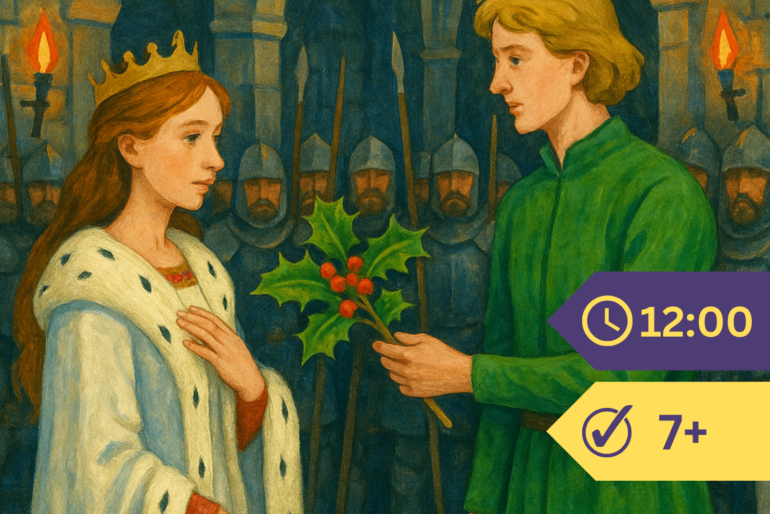
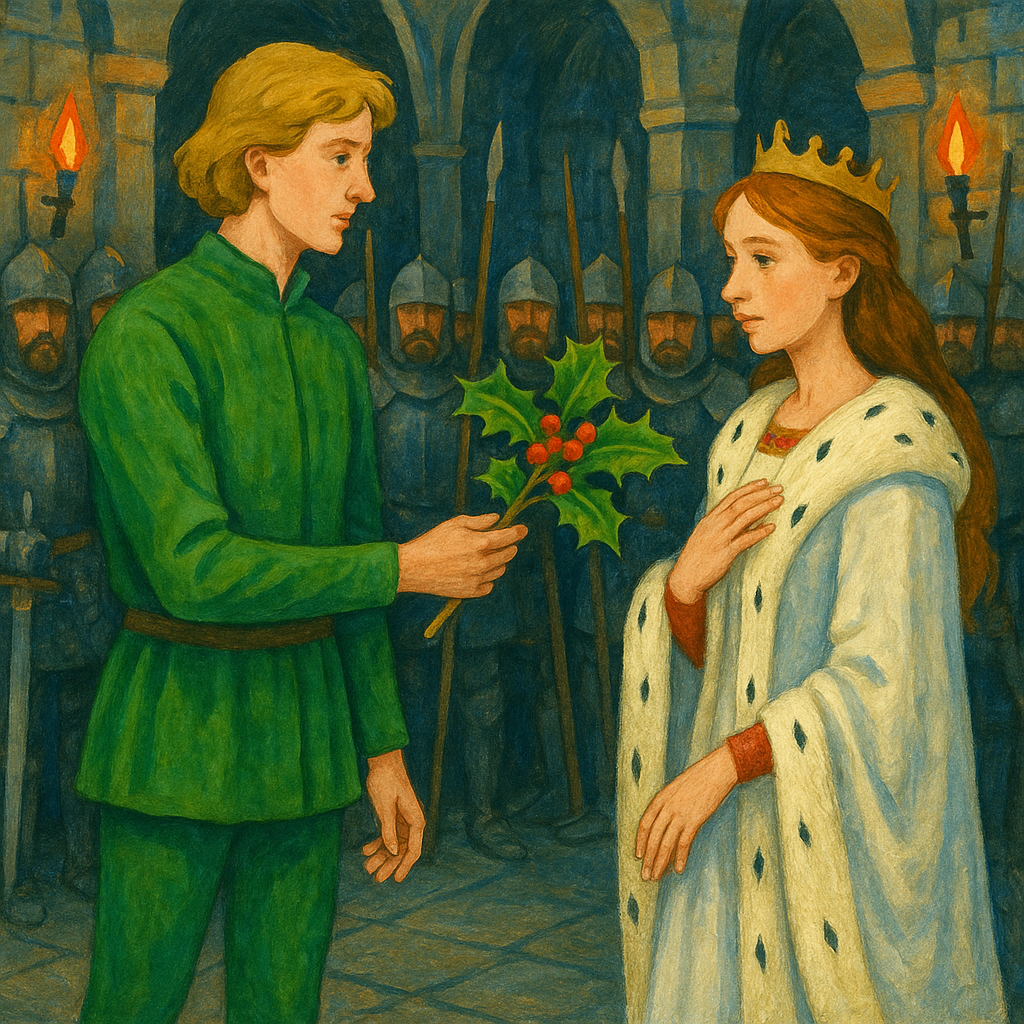
He was tall and fair, and carried himself proudly. His eyes were bright and shining and there was a smile on his face. He was dressed entirely in bright green — and the Council noticed with astonishment that he wore no armour of any kind. No breastplate, no shield, no helmet. No sword at his side, no spurs at his heels. He was bare-headed, and in his right hand he carried something green, horned and prickly, with small red dots upon it.
Looking neither right nor left, he walked with a firm and steady step up the long hall between the rows of armed warriors. As he passed the Youngest Princess she blushed deeply, but he did not seem to notice her.
When he reached the throne he bowed low before the King and Queen and laid the prickly object on the table before them.
“Your Majesty,” he said in a clear, ringing voice. “From the King of Zowega, greeting. He sends you this token. It is the symbol of the Secret of Happiness.”
The King stared. So did the Queen. They had expected a Pearl of Great Price with the Secret of Happiness written on a scroll — and the King of the Zowegians had sent them this.
Amid dead silence, the King picked up the token to examine it more carefully. He dropped it at once, for it pricked him, and small drops of blood appeared on his hand.
“Highty-tighty!” said he. “It must surely be some kind of beast — and a symbol of war at that, for it pricked me right smartly. The King of Zowega deals in riddles, and I for one cannot read them. Take it, my dear,” he added to the Queen, “perhaps your quick wits can make something of this mystery.”
The Queen picked up the token and examined it carefully. It rather resembled the branch of a tree, but the leaves were thick and stiff, edged with very sharp spikes, and it bore a cluster of round, bright red objects like tiny balls. But it pricked her as it had pricked the King, and she dropped it hastily into the lap of the Eldest Princess.
“Paradighty!” exclaimed the Queen. “It is certainly a beast — see, it has horns!” She pointed to the spikes. “But I cannot read the riddle, if riddle it be.”
So the token was passed from Princess to Princess, but none of them could make any more of it than the King and Queen had done. At last it reached the Youngest Princess. Though it pricked her little hands sorely, she took it up tenderly — and kissed it.
“It is a token of love,” she said.
The messenger turned his shining eyes full upon her.
“The Princess has read the riddle of the token aright,” he said, and he stepped forward as though to kiss her hand.
“Stay!” said the King, springing imperiously to his feet. “A token of love? But I sent the King of Zowega a Declaration of War! What does he mean by answering with a token of love? The Princess must be mistaken — and as for you,” he continued, turning fiercely on the messenger, “you shall be marched off to prison while we consult our Wise Men as to the real meaning of this extraordinary token.”
So the messenger was led away to spend the night in prison, and all the Wise Men in the kingdom were summoned to appear in the Council Chamber the very next day — especially one very old Wise Man from the East, reputed to be wiser than all the others combined.
The next day was, of course, Christmas Day. But as these people had never heard of Christmas, no bells rang, no carols were sung, and there was neither holly, ivy, nor mistletoe upon the walls.
Slowly and solemnly the Wise Men arrived. They all wore black flowing robes and tall pointed black caps covered in strange devices. The very old Wise Man from the East wore a red pointed cap, but was otherwise dressed like the rest.
They gathered round a large circular table at one end of the hall, the token placed in the middle. At the other end of the hall stood the warriors, and above them on the double throne sat the King and Queen, with the Princesses grouped on either side of the dais.
The Wise Men examined the token in silence.
“A curious beast,” said one of them at last.
“Of a new and quite unheard-of species,” said another.
“It has neither legs nor tail,” said a third.
“Yet it has a number of globular red eyes,” said a fourth.
“And it certainly has horns,” said a fifth.
And so said they all — until it came to the very old Wise Man from the East. He looked at the token for a long time.
“It has horns,” he said at last, “but it is not a beast.”
“Not a beast!” said the others to one another. “Then what is it?”
“It is a token of love,” said he.
“Highty-tighty,” interrupted the King. “Then read us the full meaning of this token.”
“I cannot,” said the very old Wise Man. “But let the youth who carried it be brought here. He will be able to explain it far better than I.”
“Paradighty!” said the Queen. “Why did we not think of that yesterday? Fetch him back at once!”
So two of the warriors fetched the youth from prison, and he stood before the Assembly with his head as high and his eyes as bright and shining as before.
“Read us the token!” commanded the King.
The youth bowed low. “The Princess read it aright yesterday. It is a token of love.”
“Explain yourself!” said the King. “How can a beast with horns be a token of love?”
The youth drew himself up to his full height.
“It is not a beast,” he said. “It is a branch of the holly tree. On this day of the year, which in my country we call Christmas Day, our people decorate their houses with branches of holly as a token of love, peace, and goodwill. This is the message I have brought you — a message my people know very well, but which you have never heard before.”
The King, the warriors, the Wise Men, the Queen, and all the Princesses listened in silence.
When he had finished, there was a long pause.
“And in what particular way does your message concern us?” said the King at last.
“In this way, Your Majesty,” answered the youth. He approached the Youngest Princess and took both her hands in his. “On this day, I — Prince Moldo — would make peace and goodwill between my kingdom and yours, and seal it for ever by taking the Youngest Princess home with me as my bride. You did not recognise me, for I have changed greatly since I was her childhood playmate at your court. But in all my wanderings across the world, I found no Pearl of greater price than this — and I would proclaim to all the world that the Secret of Happiness is Love.”
So on that very Christmas Day they were married, amid great rejoicing, and war ceased throughout the kingdom. And on every Christmas Day from that time forward, the people of that land decorated their houses with holly — the symbol of love, peace, and goodwill — and wished each other a Merry Christmas, even as I do now to you.