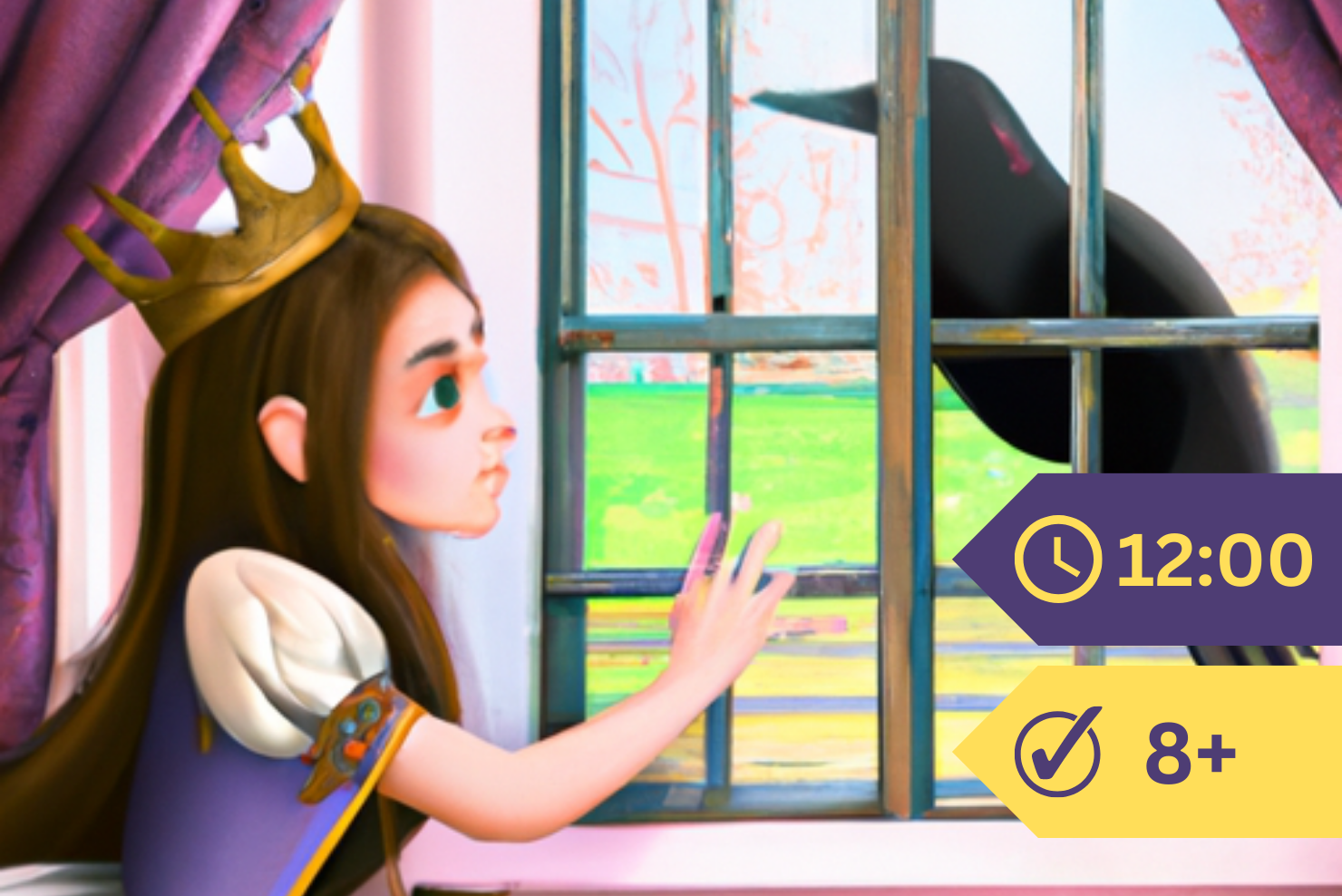
Once upon a time a king had an only daughter. She had been spoiled by everyone since birth, and besides being beautiful she was clever and headstrong. When she was old enough to marry, she refused to have anything to do with the prince her father favoured and declared that she would choose a husband for herself. Long experience had taught the king that once she made up her mind there was no use hoping she would change it, so he meekly asked what she wanted him to do.
“Summon all the young men in the kingdom to appear before me a month from today,” said the princess. “The one I give this golden apple to will be my husband.”
“But, my dear…” began the king in dismay.
“The one I give this golden apple to will be my husband,” she repeated, in a louder voice. The king understood the signal and, with a sigh, did as she said.
The young men arrived, tall and short, dark and fair, rich and poor. They stood in rows in the great courtyard in front of the palace, and the princess, in green robes with a golden veil flowing behind her, walked past them all, holding the apple. Once or twice she paused and hesitated, but in the end she always walked on, until she came to a young man near the end of the last row. There was nothing special about him, the onlookers thought; nothing likely to catch a girl’s fancy. A hundred others were handsomer, and all were better dressed. But he met the princess’s eyes frankly and smiled, and she smiled too, and held out the apple.
“There’s some mistake!” cried the king, who had watched her anxiously and hoped none of the candidates would please her. “She can’t possibly want to marry the son of a poor widow who hasn’t a penny to his name! Tell her I won’t hear of it and she must go down the rows again and choose someone else.” The princess went down the rows a second time and a third, and each time she gave the apple to the widow’s son. “Well, marry him if you must,” said the furious king, “but you won’t stay here.” The princess said nothing, but threw up her head, took the widow’s son by the hand and left the castle.
They were married that evening and afterward went to the house of the bridegroom’s mother, which, in the princess’s eyes, looked hardly bigger than a hen-coop.
The old woman wasn’t at all pleased when her son came in with his bride.
“As if we weren’t poor enough already,” she grumbled. “I dare say she’s some fine lady who can’t do anything to earn her living.” But the princess stroked her arm and said softly:
“Don’t be upset, dear mother. I’m a famous spinner, and I can sit at my wheel all day without breaking a thread.”
And she kept her word. But in spite of all three of them working, they grew poorer and poorer, and after six months they agreed that the husband should go to the nearest town to find work. There he met a merchant who was about to set out on a long journey with a train of camels laden with all sorts of goods, and needed a man to help. The widow’s son begged to be taken on as a servant, and the merchant agreed and paid him a whole year’s wages in advance. The young man took the news home, and the next day said goodbye to his mother and his wife, who were very sad to see him go.
“Don’t forget me while you’re away,” the princess whispered, throwing her arms around his neck. “And when you pass the well near the city gate, stop and greet the old man you’ll find sitting there. Kiss his hand and ask him what advice he can give you for your journey.”
The young man set out, and when he came to the well and the old man sitting there, he asked the question his wife had told him to.
“My son,” said the old man, “you’ve done well to come to me. In return, remember three things: The one whom the heart loves is always the most beautiful. Patience is the first step on the road to happiness. He wins who waits.”
The young man thanked him and went on his way. Early next morning the caravan set out, and before sunset it reached the first halting place, a group of wells, where another company of merchants had already camped. But no rain had fallen for a long time in that rocky country, and both men and animals were dying of thirst. There was another well about half a mile away that always had water, but to get it you had to be lowered deep down, and no one who had ever gone down that well had been known to come back.
Until they could fill their goatskin bags with water, the caravans dared not go farther into the desert. The night the widow’s son and his master arrived, the merchants had decided to offer a large reward to anyone brave enough to go down into the enchanted well and bring water up. At sunrise the young man was woken by a herald going round the camp announcing that every merchant present would give a thousand piastres to the man who would risk his life to bring water for them and their camels.
The young man hesitated for a while. The story of the well had spread far and wide, and had long ago reached his ears. The danger was great, he knew. But if he came back alive, he’d have eighty thousand piastres. He turned to the herald as he passed the tent.
“I’ll go,” he said.
“What madness!” cried his master, who was standing nearby. “You’re too young to throw your life away. Run after the herald and tell him you’ve changed your mind.” But the young man shook his head, and the merchant saw that it was no use arguing.
“Well, it’s your own affair,” he said at last. “If you must go, you must. But if you ever come back, I’ll give you a camel-load of goods and my best mule.” And he touched his turban in farewell and went into his tent.
As soon as he’d gone, a crowd of men came pouring out of the camp.
“How can we thank you!” they cried, pressing around the young man. “Our camels and we ourselves are nearly dead of thirst. Look, here’s the rope we’ve brought to lower you.”
“Come, then,” said the young man, and they all set out.
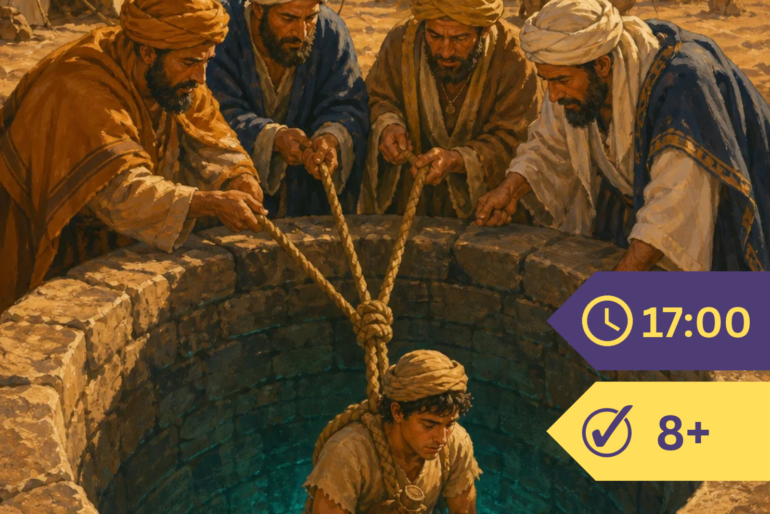
At the well they tied the rope firmly under his arms, handed him a big goatskin bottle, and gently lowered him to the bottom. There a clear stream bubbled over the rocks. He knelt to drink, but a huge stranger appeared before him and said in a loud voice:
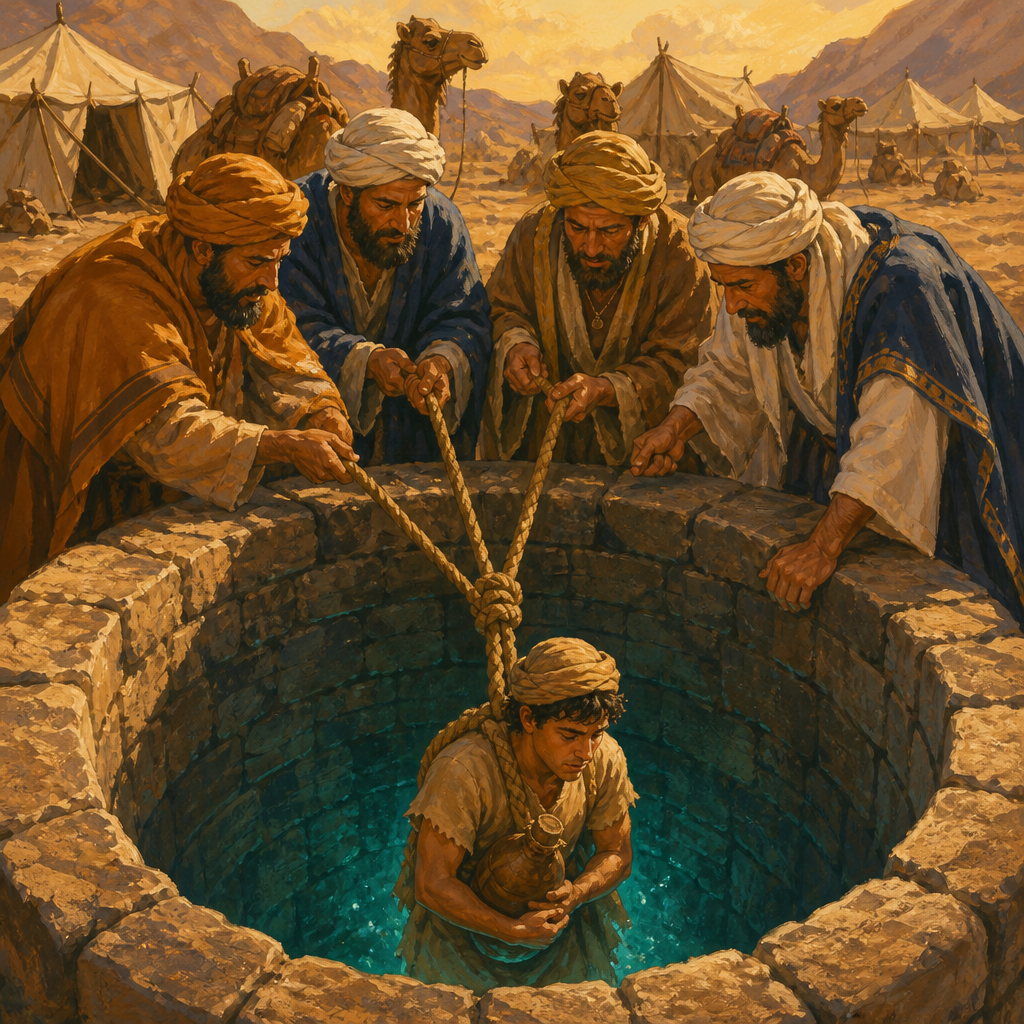
“Come with me!”
The young man stood, certain his last hour had come. But there was nothing he could do, so he followed the stranger into a brilliantly lit hall on the other side of the little river. There his guide sat down, drew two boys to him, and said to the visitor:
“I have a question for you. If you answer it correctly, your life will be spared. If not, you will lose your head, as many others have before you. Tell me: which of my two children do I think is the more handsome?”
It didn’t seem a hard question. One boy was as beautiful as a child could be, with shining eyes and a face like a painting. The other was plain and sullen, with a crooked nose and a squint. But just as the young man was about to speak, the old man’s advice flashed into his mind, and he said: “The one we love best is always the most handsome.”
“You’ve saved me!” cried the stranger, jumping up and hugging him. “If only you knew what I’ve suffered from the stupidity of everyone I put that question to! I was condemned by a wicked genie to stay here until it was answered. But what brought you here, and how can I repay you?”
“By helping me draw enough water for my caravan of eighty merchants and their camels, who are dying of thirst,” said the young man.
“That’s easily done,” said the stranger. “Take these three apples. When you’ve filled your skin and are ready to be pulled up, put one on the ground. Halfway up, let a second fall, and at the top, drop the third. If you follow my directions, no harm will come to you. And take these three pomegranates too, green, red and white. One day you’ll find a use for them.”
The young man did as he was told and stepped out onto the rocky ground, where the merchants were anxiously waiting. How thirsty they were! But even after the camels had drunk, the skin seemed as full as ever.
Full of gratitude, the merchants pressed money into his hands, and his own master told him to choose whatever goods he liked and a mule to carry them.
So the widow’s son was rich at last. When the merchant had sold his goods and returned to his own city, his servant hired a man to take the money and the mule back to his wife.
“I’ll send the pomegranates too,” he thought, “because if I leave them in my turban, they might fall out some day.” He took them out. But the fruit had vanished, and in their place were three precious stones, green, white and red.
He stayed with the merchant for a long time. The merchant trusted him with more and more of his business and gave him a big share of the profits. When the merchant died, the young man wanted to go home, but the widow begged him to stay and help her, and one day he woke with a start, remembering that twenty years had passed since he left.
“I want to see my wife,” he said to his mistress the next morning. “If I can ever be of use to you, send a messenger to me. Meanwhile I’ve told Hassan what to do.” And he mounted a camel and set out.
Soon after he’d taken service with the merchant, a little boy had been born to him. The princess and the old woman had both worked hard all day to feed and clothe the baby. When the money and the pomegranates arrived, they didn’t have to work any more, and the princess saw at once that the pomegranates weren’t fruit at all but precious stones of great value. The old woman, not used to seeing jewels as her daughter-in-law was, took them for ordinary fruit and wanted to give them to the child to eat. She was very angry when the princess snatched them and hid them in her dress and went to the market to buy the three finest pomegranates she could find for the old woman to give the boy.
Then she bought beautiful new clothes for all of them, and when they were dressed they looked splendid. Next she took one of the stones her husband had sent, put it in a small silver box, wrapped it in a handkerchief embroidered in gold, and filled the old woman’s pockets with gold and silver coins.
“Go, dear mother, to the palace, and give the jewel to the king. If he asks what he can give you in return, say you want a paper with his seal on it, announcing that nobody is to interfere with anything you choose to do. Before you leave the palace, share out the money among the servants.”
The old woman took the box and set off for the palace. No one there had ever seen a ruby so beautiful, and the most famous jeweller in the town was called to say what it was worth. All he could say was:
“If a boy threw a stone as high as he possibly could, and you piled gold as high as the stone flew, it wouldn’t be enough to pay for this ruby.”
At this the king’s face fell. Having seen the ruby, he couldn’t bear to part with it, but all the money in his treasury wasn’t enough to buy it. For a while he sat silent, wondering what offer to make, and then said:
“If I can’t give you its worth in money, will you take something in exchange?”
“A paper signed by your hand and sealed with your seal, saying I may do what I like, without hindrance,” she answered promptly. The king, delighted to get what he wanted at so small a price, gave it to her at once. The old woman took her leave and went home.
The fame of the wonderful ruby soon spread, and envoys arrived at the little house to ask whether there were more stones for sale. Each king was so eager to have the treasure that he told his messenger to outbid all the rest, and so the princess sold the other two stones for so much money that if the gold pieces had been laid out end to end they would have reached the moon. The first thing she did was build a palace next to the cottage, raised on pillars of gold set with great diamonds that blazed night and day. Of course the first thing the king her father heard on his return from the wars was news of this palace, and he hurried to see it. In the doorway stood a young man of twenty, who was his grandson, though neither of them knew it. The king liked the look of the young man so much that he took him back to his own palace and made him commander of the whole army.
Not long afterward the widow’s son came back to his own country. There, sure enough, was the tiny cottage where he’d lived with his mother, but the magnificent building beside it was quite new to him. What had become of his wife and mother, and who lived in that other wonderful place? These were his first thoughts, but he didn’t want to give himself away by asking passing strangers, so he climbed into a tree opposite the palace and watched.
After a while a lady came out and began to gather some of the roses and jasmine hanging round the porch. The twenty years since he’d last seen her vanished in an instant and he knew her for his own wife, looking almost as young and lovely as on the day they parted. He was about to jump down and run to her when she was joined by a young man who put an arm affectionately around her neck. At the sight, the angry husband drew his bow, but before he could let fly the arrow, the old man’s counsel came back to him: Patience is the first step on the road to happiness. He laid it down.
Just then the princess turned and, drawing her companion’s head down to hers, kissed him on each cheek. A second time blind rage filled the watcher’s heart and he snatched up the bow from the branch where it hung, when words he’d heard long ago seemed to sound in his ears: He wins who waits. The bow dropped to his side. Then through the quiet air came the young man’s voice:
“Mother, can you tell me nothing about my father? Is he still alive? Will he never come home?”
“Alas, my son, how can I answer?” said the lady. “Twenty years have passed since he left us to make his fortune, and in all that time I’ve heard of him only once. But what has put him in your mind just now?”
“Last night I dreamed he was here,” said the young man. “And then I remembered what I’ve long forgotten, that I had a father, though even his history was strange to me. Now tell me, please, all you can about him.”
Standing under the jasmine, the son learned his father’s story, and the man in the tree listened too.
“Oh,” said the young man when it was finished, twisting his hands in pain, “I’m commander of the army, you’re the king’s daughter, and we have the most splendid palace in the world, yet my father is alive somewhere we don’t know, and for all we can tell he may be poor and miserable. Tomorrow I’ll ask the king for soldiers and search the whole earth until I find him.”
Then the man came down from the tree and held his wife and son in his arms. All that night they talked, and when the sun rose it found them still talking. As soon as it was proper, he went up to the palace to pay his respects to the king and tell him everything and who they all really were. The king was overjoyed to learn that his daughter, whom he had long since forgiven and sorely missed, was living at his gate, and was the mother of the young man he was so fond of. “It was written beforehand!” the king cried. “You are my son-in-law before the whole world, and you will be king after me.”
The man bowed his head.
He had waited, and he had won.