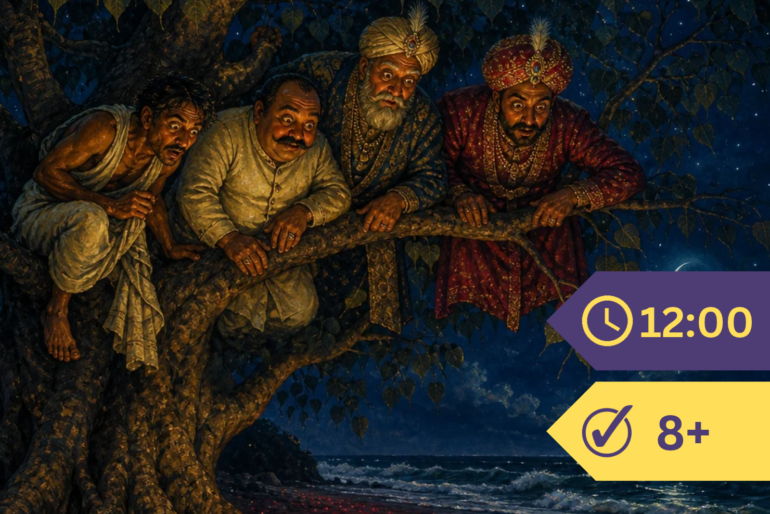
Long ago, in a city in India, there lived a poor oil-seller named Déna, who never could keep a coin in his pocket. When this story begins, he had borrowed a hundred rupees from a banker named Léna, and with the interest Léna always charged, the debt had grown to three hundred. Business was bad, and Déna couldn’t pay. Léna was furious. Every evening he came round to Déna’s house to shout at him until the poor man could hardly bear it. He always chose the moment when Déna’s wife was cooking supper, and made such a scene that the oil-seller, his wife and their daughter all lost their appetites and couldn’t eat. This went on for weeks, until one day Déna decided he could stand it no longer and would run away. Since a man can’t easily run with a wife and daughter, he decided to leave them behind. That evening, instead of going home after work, he slipped out of the city without knowing where he was going.
At about ten that night he came to a well beside the road, with a giant peepul tree growing next to it. He was very tired, so he climbed the tree to rest before continuing in the morning. He settled so comfortably among its great branches that he fell fast asleep. While he slept, some spirits who roam such places on certain nights picked up the whole tree and flew away with it to a faraway shore where no creature lived, and set it down long before sunrise.
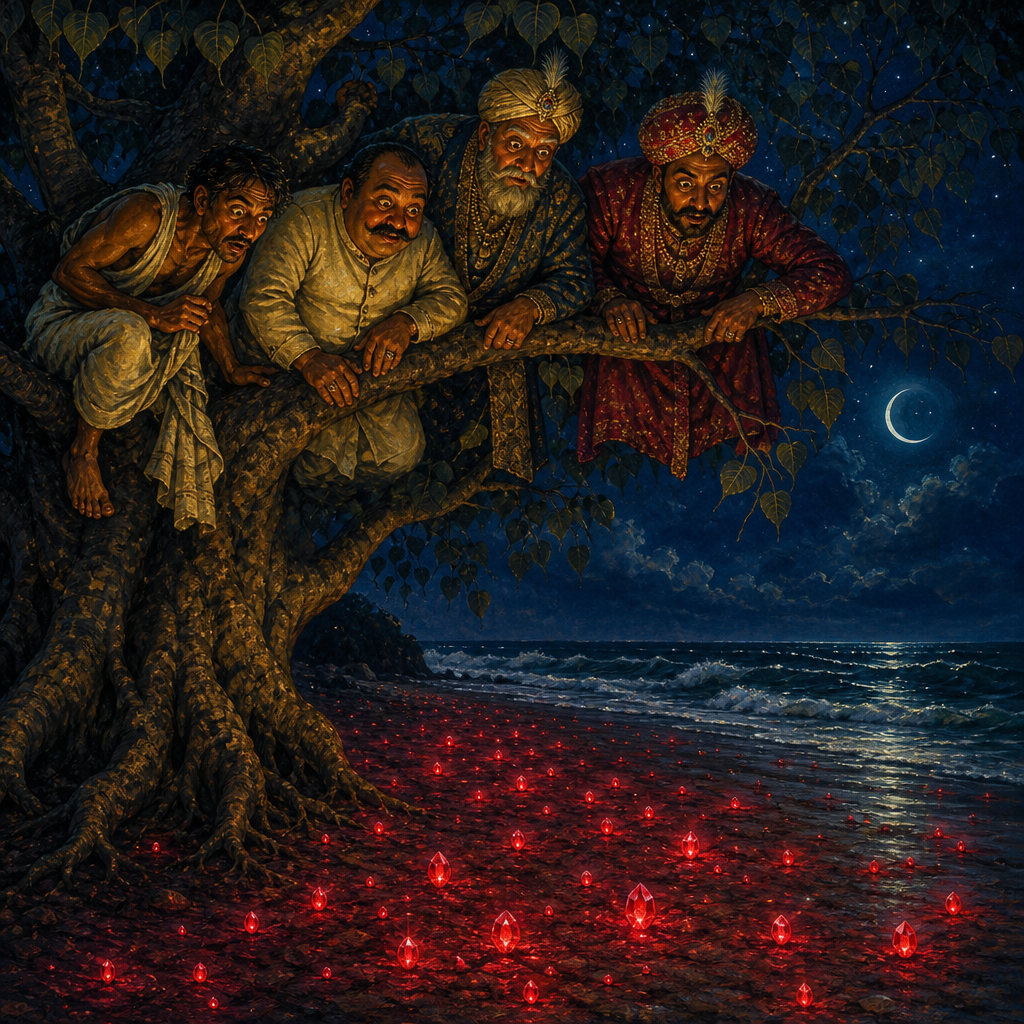
Déna woke up. Instead of a forest, he saw nothing but empty beach and wide sea, and he was speechless with astonishment and terror. While he was trying to collect his wits, he began to notice twinkling, flashing lights here and there, like little fires, moving and sparkling all around. One came so close that he reached out and grabbed it, and found it was a sparkling red stone, hardly smaller than a walnut. He tied it in the corner of his cloth. Then he got another, and a third, and a fourth, tying each away carefully. Just as dawn was breaking, the tree rose into the air and flew swiftly back, and set him down by the well where it had stood the evening before.
Once he’d got over the shock, Déna thanked his lucky stars that he was alive, and, his taste for wandering quite cured, he walked back to the city and his own house. His wife scolded him soundly and fired off a hundred questions. When she stopped for breath, Déna said:
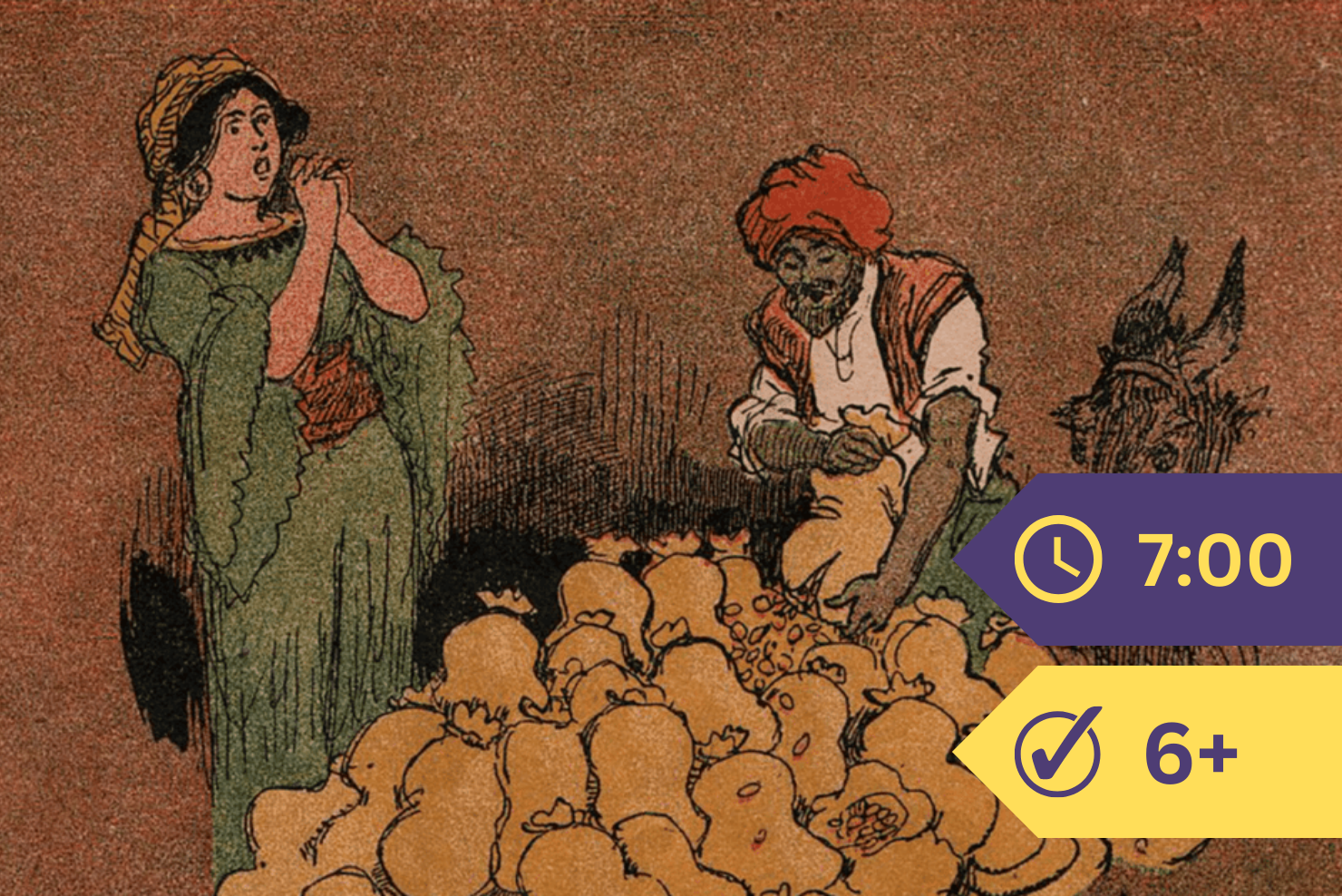
“I have only one thing to say. Look what I’ve got!” He carefully shut all the doors, opened the corner of his cloth, and showed her the four stones, which glittered and flashed as he turned them in his hand.
“Pooh,” said his wife. “Silly pebbles! If it were something to eat, now, there’d be some sense in it. What good are they?” And she turned away with a sniff.
The night before, when Léna had come round as usual to shout, he’d been a little disturbed to find his victim gone, and had frightened Déna’s wife with threats. As soon as he heard that Déna was home, he appeared at the door and talked at the top of his voice for some minutes, until he was tired. Then Déna said:
“If your honour would be kind enough to step inside, I’ll tell you something.”
Léna went in. Déna shut the doors, untied the corner of his cloth and showed him the four great flashing stones.
“This is all I have in the world to set against my debt,” he said. “As you know, I haven’t a penny. But the stones are pretty!”
Léna took one look and knew at once that they were magnificent rubies, and his mouth watered. But he mustn’t show what he was thinking, so he went on:
“What do I care about your stupid stones? I want my money, my lawful debt, and I’ll get it out of you somehow, or it will be the worse for you.”
Déna answered nothing, but sat with his hands pressed together, begging for patience and mercy. At last Léna pretended that, rather than have a bad debt on his books, he would take the stones as payment. While Déna nearly wept with gratitude, he wrote out a receipt for the three hundred rupees, wrapped the four stones in a cloth, tucked them inside his coat and went home.
“How do I turn these into money?” Léna wondered as he walked. “I daren’t keep them. They’re worth a fortune, and if the rajah hears I have them, he’ll probably find an excuse to put me in prison and take the stones and everything else I own. But what a bargain! Four rubies worth a king’s ransom, for a hundred rupees! I must be careful not to give away my secret.” By the time he got home he had a plan. He put on his cleanest clothes and went to the house of the chief wazir, whose name was Musli, asked for a private meeting, and laid the four rubies before him.
The wazir’s eyes sparkled. “Splendid,” he murmured. “I can’t pay their true value, but if you like, I’ll give you ten thousand rupees for the four.”
The banker agreed, very gratefully. He handed over the stones, took the rupees, and hurried home, thanking his stars for such a reasonable deal and such an enormous profit.
After Léna left, the wazir thought hard about what to do with the gems and decided the best thing was to present them to the rajah, whose name was Kahré. That very day he went to the palace, asked for a private meeting, and laid the four jewels before his master.
“Ho!” said the rajah. “Priceless gems! You’ve done well to give them to me. In return, I grant you and your heirs the income of ten villages.”
The wazir was overjoyed, though he only bowed deeply. While the rajah tucked the rubies into his turban, he hurried away glowing with happiness at the thought that, for ten thousand rupees, he’d become lord of ten villages. The rajah was equally pleased. He strolled to the women’s quarters and showed the rubies to the queen, who was nearly out of her mind with delight. As she turned them over and over in her hands, she said, “If only I had eight more like these, what a necklace they’d make! Get me eight more, or I shall die!”
“Most unreasonable woman,” cried the rajah. “Where am I to get eight more? I gave ten villages for these, and you still aren’t satisfied!”
“What does that matter? Do you want me to die? Surely you can get more from wherever these came from.” And she wept and wailed until he promised that in the morning he would make arrangements to get more, and that if she’d be patient she would have her wish.
In the morning the rajah sent for the wazir and told him to get eight more rubies like the ones he had brought, or else. The poor wazir protested that he had no idea where to find them, but the rajah wouldn’t listen.
“You must. The queen will not be left without rubies! Get more from wherever those came from.”
The wazir left the palace deeply worried and ordered his servants to bring Léna. “Get me eight more rubies like the ones you brought yesterday,” he commanded the moment the banker arrived. “Eight, and be quick, or I’m a ruined man.”
“But how?” wailed Léna. “Rubies like those don’t grow on bushes!”
“Where did you get them?”
“From Déna the oil-seller.”
“Then send for him and ask where he got them,” said the wazir. “I’m not going to lose everything over twenty Dénas!” More servants were sent to bring Déna.
When Déna arrived, he was questioned closely, and then all three went to see the rajah, and Déna told the whole story.
“What night did you sleep in the peepul tree?” the rajah asked.
“I can’t remember,” said Déna. “But my wife will know.”
His wife was sent for. She said it was the last Sunday of the new moon.
Everyone knows that on the Sunday of the new moon, spirits have special power to play tricks on mortals. So the rajah ordered them all to keep the matter secret, and declared that on the next such Sunday the four of them (Kahré, Musli, Léna and Déna) would go and sit in the peepul tree and see what happened.
The days dragged by until the appointed Sunday, and that evening the four met in secret and went into the forest. They reached the peepul tree without trouble and climbed into it, as the rajah had planned. At midnight the tree began to sway, and presently it lifted into the air.
“See, sire,” whispered Déna, “the tree is flying!”
“Yes, yes. You told the truth,” said the rajah. “Now sit quiet and let’s see what happens.”
Away and away flew the tree with the four men clinging to its branches, until it was set down on the lonely seashore where a wide sea tumbled onto a desert beach. As before, little points of light began to glitter around them like fires. And Déna thought, “Last time I took only the four that came close, and that cleared my whole debt. This time I’ll take all I can and be rich!”
“If four stones fetched ten thousand rupees,” thought Léna, “forty will make me so wealthy they’ll probably make me a wazir!”
“For four stones I got ten villages,” Musli was thinking. “Now I’ll get enough stones to buy a kingdom and be a rajah myself, with wazirs of my own!”
And Kahré thought, “Why settle for eight stones? There are enough here for twenty necklaces. Wealth is power!”
Full of greed, each scrambled down from the tree, spread out his cloth and darted here and there, picking up the precious stones and glancing over his shoulder to see whether his neighbour was doing better. They were so busy grabbing that the dawn caught them by surprise. Suddenly the tree rose into the air and flew away, leaving them on the shore, staring after it, each with a cloth heavy with priceless jewels.
Back in the city, morning came and there was great alarm in the palace when the chamberlains found that the rajah had gone out the evening before and not returned.
“It’s all right,” said one. “Musli the wazir will know where he is. He was with the king.”
They went to the wazir’s house and learned that the wazir had left the evening before and not come back. “But Léna the banker will know,” said a servant. “Musli went with him.”
They went to Léna’s house and heard that the banker had gone out the evening before and hadn’t returned. The porter said that Déna the oil-seller had gone with him, so Déna would know.
They went to Déna’s house, where his wife met them with a torrent of complaints and wails, because Déna too had gone off to Léna’s house the evening before and hadn’t come home.
They waited and searched in vain. None of the four was ever seen in his home again, and Déna’s wife’s confused story was the only clue to what had become of them.
To this day in that country, when a greedy man overreaches himself and loses everything by grabbing at too much, people say:
“All has he lost! Neither Déna, nor Léna, nor Musli, nor Kahré remain.”
And not five men in a hundred know how the saying began, or what it really means.