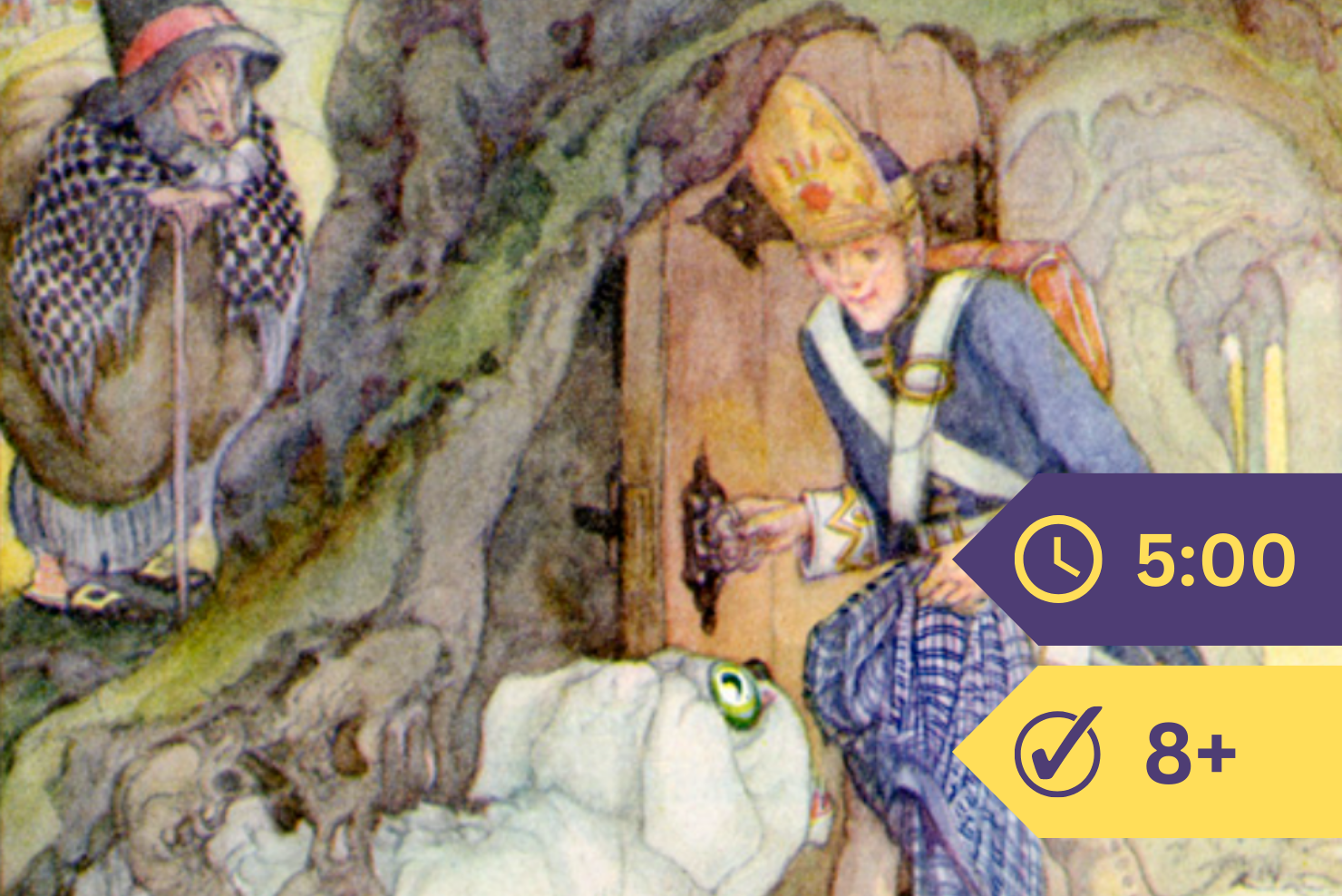
One day a powerful king and his queen were sitting in the palace gardens, talking about the future of their baby son, who slept beside them in a golden cradle. They had been married for many years without a child, and they thought themselves the happiest people in the world. They were so wrapped up in their plans that they never noticed a huge dark shadow creeping over the grass, until a horrible head with gleaming teeth reached over them and, in an instant, their baby was snatched away.
The king and queen stood frozen with horror. Then the king led his weeping wife into the palace, and for many days nobody saw them.
The dragon flew high into the air with the cradle in his teeth, and the baby slept on. He crossed into another kingdom, where he saw another king and queen sitting in a garden with a little girl in a cradle of white satin and lace. He swooped down from behind, but this king sprang up and struck him with his golden staff. The dragon reeled back in pain, let the boy fall, and fled.
“That was a narrow escape,” said the king. His pale wife clutched their daughter. “Look,” she said. “What is that glittering thing on the grass?” The king walked over and found, to his astonishment, another cradle and another baby.
“The monster must have stolen him from somewhere else,” he said, and he read the words stitched on the linen: Grethari, son of Grethari the King. Sadly, this king had quarrelled with the boy’s father years before and the two were not on speaking terms. Instead of sending word that the child was safe, he adopted him, and the boy grew up with Geirlaug, the princess.
The children were happy together. But as the years passed, the queen could no longer play hide-and-seek with them. She lay on cushions and watched, and then she did not even do that. People spoke in low voices, and the children learned to tiptoe near her room. One morning the king, his eyes red from weeping, told them that she had died.
The children missed her terribly. But the kind lady-in-waiting who looked after them in their tower made sure they were happy and well taught. Two or three years went by. Then, one day, a herald galloped into the courtyard to announce that the king was on his way home with a new wife.
There was nothing strange about a king marrying again. But the old lady-in-waiting soon saw that the new queen, for all her beauty, was a witch, and a jealous one, who hated anyone her husband might love. A few months after the wedding war broke out across the sea and the king rode off to fight. That night the faithful lady-in-waiting, who normally slept lightly, slept deeply, and later she was sure her supper had been drugged. In the morning the beds of Geirlaug and Grethari were empty.
At dawn the queen summoned her guards. She told them she’d had a dream that some wild beast would bring her doom, and she ordered them to kill every animal within two miles of the palace. The guards found nothing but two beautiful black foals, and it seemed a shame to harm them. They let them run away and went back to the palace.
“You saw nothing at all?” asked the queen.
“Nothing, Your Majesty.”
She didn’t believe them. She had them given strong drink at supper, so their tongues would loosen, and told her steward to listen. He came back late that night to report that they had told the truth: nothing but two black foals. The look in the queen’s blazing eyes frightened him so much that he backed out of the room without saying more.
A week later the king came home, to the delight of the courtiers. “At last she will have somebody else to scream at,” they whispered. But that night the queen told the king about her dream and begged him to ride out the next morning and kill every living creature within two miles of the city. The king, who always believed her, agreed. But as he rode through the garden, he heard two little blue birds singing in a holly tree with scarlet berries. Their song made him think of everything lovely he had ever known. He listened hour after hour without knowing it, and he never guessed that the birds were Geirlaug and Grethari. When darkness fell and they stopped, he woke as if from a dream. His promise to the queen had gone unkept.
“Did you see anything?” she asked.
“I’m almost ashamed to tell you,” he said. “Two blue birds were singing, and I forgot everything else. But tomorrow nothing will stop me.”
“There will be no tomorrow,” the queen muttered, with a strange glitter in her eyes. The king didn’t hear.
That night the king gave a feast to celebrate his victory. The three officers who had failed to kill the foals sat beside him, as they always did when the court feasted, and it was easy for the queen to slip slow poison into their cups, and into the king’s. Before dawn the palace woke to the news that the king was dead and the three officers were dying. No one wept louder than the queen. After the funeral she announced that she would mourn in a distant castle for a year, appointed a regent, and left with one maid who knew all her secrets. Once she was gone, she began working spells to find out what shapes the children were hiding in.
Luckily, Geirlaug had studied magic with a former governess, and she saw through her stepmother’s plan. She turned herself into a whale and Grethari into its fin. The queen became a shark and gave chase.
The battle in the sea was long and fierce, and the little fish gathered to watch. At last it became clear that the whale would win. When the shark floated dead on the water, the whale was so worn out she could barely drag herself to a quiet bay, where she lay still for three days. Then her wounds were healed.
“Let’s go back to your father’s kingdom,” Geirlaug said, when they had changed back and were sitting on a cliff above the sea.
“How clever you are,” said Grethari. “I’d never have thought of that.” Grethari was not clever at all.
Geirlaug took a small box of white powder from her dress and sprinkled some over him and some over herself. Quick as lightning, they were in the palace grounds from which he had been carried off as a baby.
“Now tie this band with the golden letters round your forehead,” she said, “and walk boldly up to the castle. But no matter how thirsty you get, you must not drink anything until you’ve spoken to your father. If you do, we’ll both be sorry.”
“Why should I be thirsty?” said Grethari. “It’s five minutes to the gate.” Geirlaug said nothing, but her eyes were sad. She kissed him goodbye.
It did look like five minutes. But the open door, so close he could see the colour of the curtains inside, never seemed to get any nearer, and the sun burned hotter and hotter, and his tongue dried out. “What’s wrong with me? Why haven’t I got there?” he muttered, as his knees shook. Then he heard rushing water. In a little wood by the path a stream fell over a rock. He forgot his promise, fought through the brambles, seized the golden cup hanging from a tree and drank deeply.
When he stood up, he had forgotten Geirlaug and everything that had happened to him. All he felt was a vague stir at the sight of a white-haired man and woman standing in the doorway with open arms.
“Grethari! Grethari! You’ve come home at last!”
Geirlaug waited three hours where he had left her. Then she understood. Her heart was heavy, but she made up her mind quickly. She went along the wall of the royal park until she came to the forester’s cottage, where he lived with his two daughters.
“Do you need a girl to sweep and milk the cows?” she asked.
“We do,” said one sister. “And you look strong and clean. What’s your name?”
“Lauphertha,” said Geirlaug, who didn’t want anyone to know who she was.
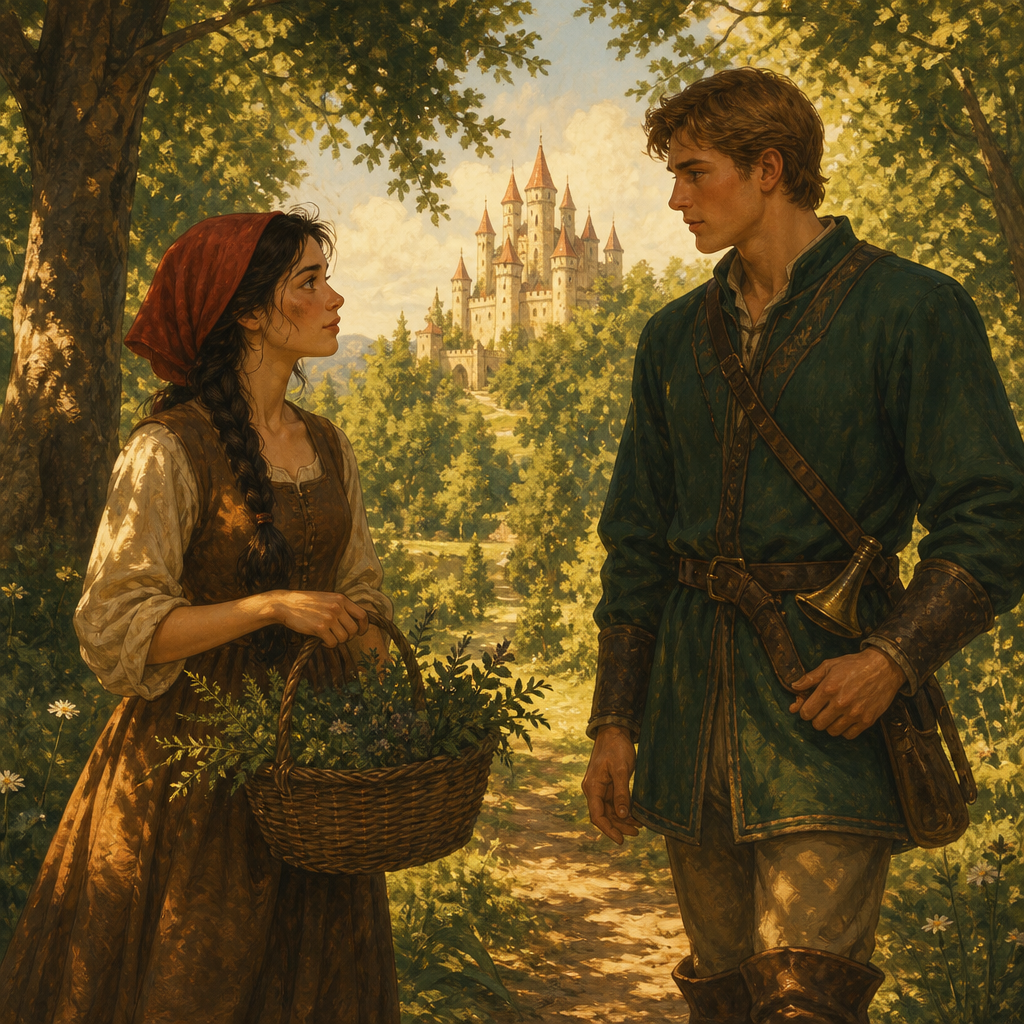
She learned the work quickly, and soon people were saying that there was no girl in the kingdom with greater skill and beauty than the forester’s new maid. The years went by and Geirlaug grew up. Now and then she saw Grethari riding to the hunt, and she hid behind the trees, because it still hurt that he had forgotten her. One day, picking herbs, she was caught before she could hide. She had smudged her face and hands with earth and tucked her hair under a scarlet cap, so he did not recognise her.
“What’s your name, pretty girl?”
“Lauphertha,” she said, with a curtsey.
“I’ve heard of you,” he said. “You’re too lovely to wait on a forester’s daughters. Come to the palace, and my mother the queen will make you a lady-in-waiting.”
“That would be a great stroke of luck,” she answered. “If you mean it. How can I know you’re not teasing?”
“Give me something to do for you,” he said eagerly, “and I’ll do it.”
She lowered her eyes. “Go to the stable and tie up the calf, so it can’t wander off in the night. The forester and his daughters have been good to me, and I won’t leave anything of my work undone.”
Grethari went to the stable and tied the rope to the calf’s horns. But when he had fastened it to the wall, a loop of the rope wound itself round his wrist, and however he pulled he couldn’t get free. He struggled all night. At sunrise the rope fell away, and he stumbled back to the palace, furious. “She’s a witch,” he grumbled. “I’ll have nothing more to do with her.” And he threw himself on his bed and slept the whole day.
Soon afterwards the king and queen sent their son to a neighbouring country to find a bride among seven princesses. He chose the most beautiful, and they sailed home with a fair wind. When they reached the harbour nearest the castle a splendid carriage was waiting, but there were no horses. They had all been taken to a great review the king was holding in honour of the wedding.
“I’m not staying here all day,” said the princess crossly. “Find something to pull this carriage, even if it’s a donkey, or I’ll sail home to my father.”
Grethari was unhappy. He wasn’t truly in love with her, because he’d seen on the voyage how vain and bad-tempered she was, but he was a bridegroom and couldn’t bear to see her slighted. He sent his men to find any animal at all.
The princess sat wrapped in her blue velvet cloak, embroidered with silver bees, with not even the tip of her nose showing. At last a girl came leading a young ox, with one of the prince’s messengers talking eagerly at her side.
“Will you lend me your ox, fair maiden?” asked Grethari. “Name your price. I’ll pay it gladly. I’ve never been in such a fix.”
“My price is seats for me and my two friends behind you and your bride at the wedding feast,” she said. He agreed at once.
Six horses could not have drawn the carriage as fast as that one ox. Fields and trees flew past and the princess grew dizzy and was sure they would overturn, but they reached the palace safely, to the amazement of the king and queen. By the end of the week the wedding was ready. The princess was so busy with her clothes and jewels that Grethari almost forgot how rude she had been.
The old people of the town said that no bridal procession had ever been so grand. The princess smiled and bowed at the crowds and swept down the hall to her place at the head of the table. As she did so, three strange ladies in shining gowns of blue, green and red slipped in and sat on a bench right behind the bridal couple. The one in red was Geirlaug. She had brought the forester’s daughters with her, and she carried a wand of birch bark in one hand and a covered basket in the other.
They sat silently while the feast went on, and hardly anyone noticed them. Then, at the height of the merriment, Geirlaug opened the basket and out flew a cock and a hen. They circled in front of the bridal pair while the cock pulled the feathers from the hen’s tail, and she tried in vain to escape.
“Will you treat me as badly as Grethari treated Geirlaug?” cried the hen.
Grethari heard her and sprang to his feet. Everything came rushing back. The princess beside him was forgotten. All he saw was the face of the girl he had played with as a child.
“Where is Geirlaug?” he cried, looking around the hall, and his eyes fell on the lady in red. Smiling, she held up the ring he’d given her on her twelfth birthday.
“You, and no one else, will be my wife,” he said, and he took her hand and led her to the middle of the room.
You can imagine the uproar. No one understood what was happening, and the king and queen thought their son had lost his mind. The princess was beside herself with rage. The guests hurried out so the royal family could sort it out in private, and in the end it was agreed that the jilted princess should have half the kingdom as compensation. She sailed home and soon got engaged to a young nobleman she liked much better than Grethari. That same evening Grethari married Geirlaug, and they lived happily until they died, and made their people happy too.