Once upon a time there was a poor woman who had a great longing for parsley. To her it was the finest luxury in the world, and since she had no garden of her own and no spare money for anything beyond bare necessities, she had taken to slipping into other people’s gardens to satisfy her craving.
Near her cottage stood a great palace with a walled garden, and in that garden grew the finest parsley she had ever seen. To reach it she brought a ladder to scale the wall, then lowered it on the far side to climb down to the parsley bed. There was so much of it growing that she was sure it could never be missed, and this boldness grew with habit until she was going over every day and taking as much as she pleased.
But the garden belonged to a witch who lived in the palace. Though she rarely walked in that corner of the garden, she knew by her powers that someone was eating her parsley — and so one day she came near and lay in wait. The moment the poor woman appeared and began pulling at the leaves, the witch pounced.
“What do you think you’re doing here?” she demanded, in her roughest voice.
Terrified as she was, the poor woman thought honesty her best chance. She confessed the whole truth: that she had come over the wall by a ladder, that she had taken nothing but the parsley, and she begged forgiveness.
“I know nothing about forgiveness,” said the witch. “You have eaten my parsley and must take the consequences. The consequences are these: I must be godmother to your first child, boy or girl; and as soon as that child is old enough to dress itself without help, it must come to me.”
When the poor woman’s first child was born — a fine little girl — the witch came as she had promised, and gave the child the name Filagranata. Then she went away, and the poor woman saw her no more until the day her daughter was old enough to dress herself. On that day the witch came to fetch her, and no tears or pleading could move her.
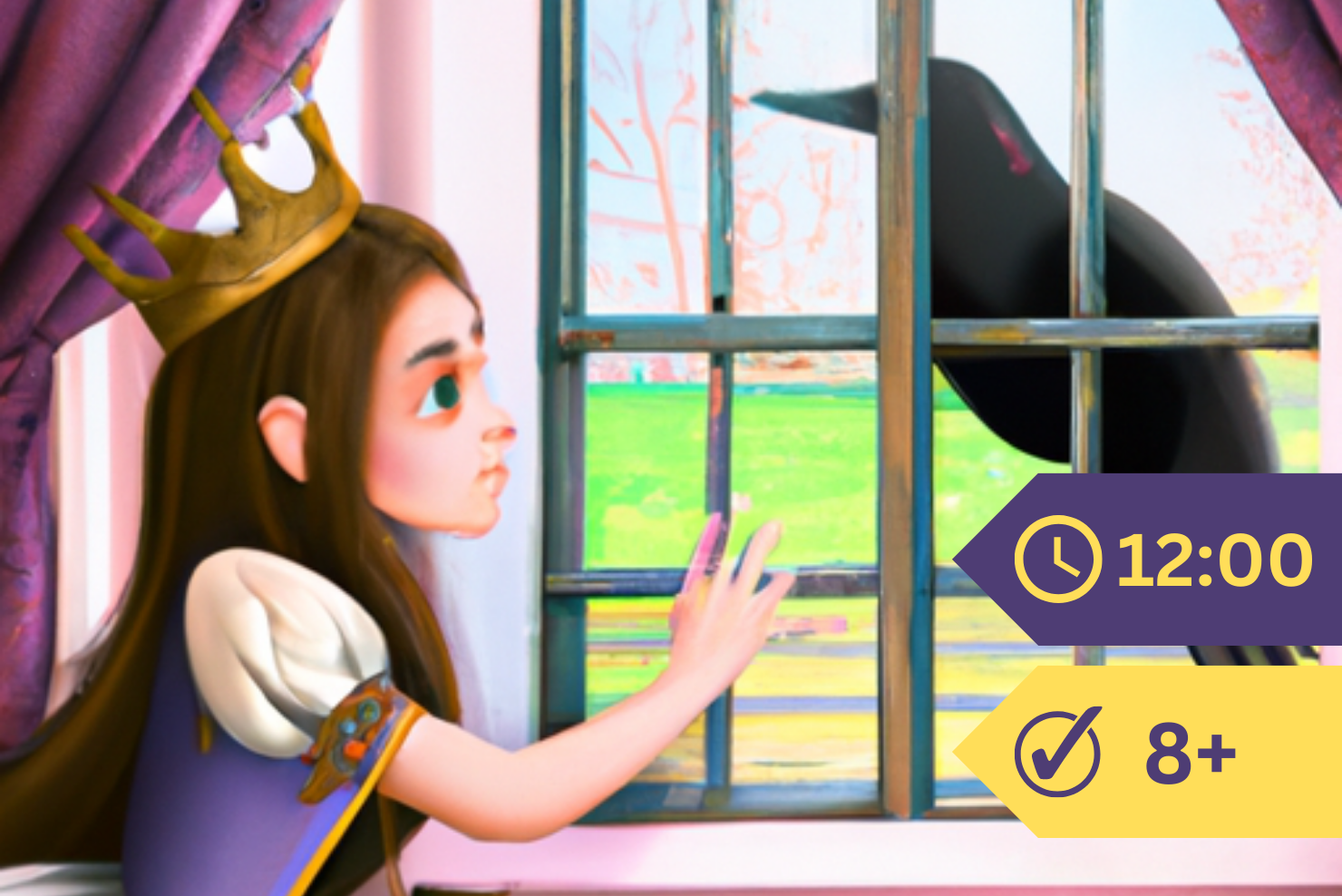
So Filagranata went to live in the witch’s palace, in a small room at the top of a tower, where she was set to feed the pigeons. She grew fond of her birds and did not complain of the work — but as time passed she became quietly sad, for she had no one to talk to but the witch, who was no delightful companion. Worse still, the tower had no door and no staircase: the witch had seen to that. Each day, the witch would stand at the base of the tower and call up:
Filagranata, so fair, so fair,
Unloose thy tresses of golden hair:
I, thy old grandmother, am here.
And at those words, Filagranata would let her long golden hair fall from the window, and by it the witch would climb up into the room.
Now it happened that around this time a prince was travelling through the land in search of a wife, as princes will. He came by the witch’s palace one evening just as the witch was singing her verse below the tower. He was startled by the sight of the old witch — but when Filagranata appeared at the window, he was enchanted. So struck was he by her beauty and gentle manner that he stayed on his horse watching until she drew the witch up and the window closed.
The prince’s mind was made up: he would find a way to speak to her. He rode around and around the tower looking for a door or staircase — there was none. At last, driven to desperation, he resolved to try the same means the witch had used. He came back the next day a little earlier, and though he could hardly hope to imitate the witch’s rough old voice, he tried his best:
Filagranata, thou maiden fair,
Loose thy tresses of golden hair:
I, thy old grandmother, am here.
Filagranata heard the words, but the voice was soft and young — quite unlike anything she had heard from that tower window before. She ran to look, and her face lit with surprise and pleasure.
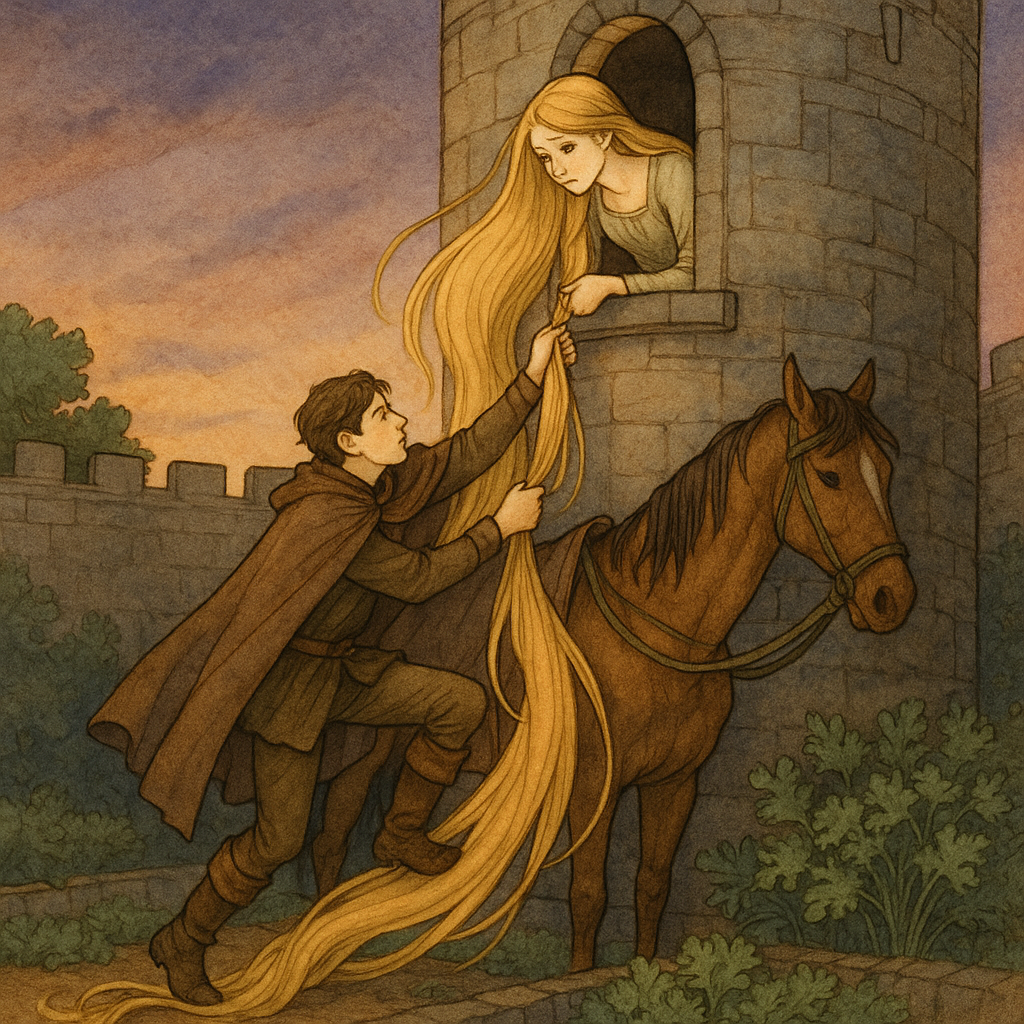
The thought came to her swiftly: I’ve always been taught to let down my hair when those words are said. Why shouldn’t I let it down for such a pleasant-looking young man as readily as for that ugly old witch? And without waiting for a second thought, she untied her tresses and let them fall. The prince caught hold and climbed — and being quick-witted, he pressed his horse up with him, so that the animal couldn’t be left below to betray him.
Filagranata stood blushing, not knowing what to say. But the prince had plenty of words for her: admiration, indignation at her captivity, and a great desire to be her deliverer. They talked until the tower seemed to grow warm, and only when Filagranata felt herself drawn toward the window by the pull of the witch’s magic call did they remember the danger they were in.
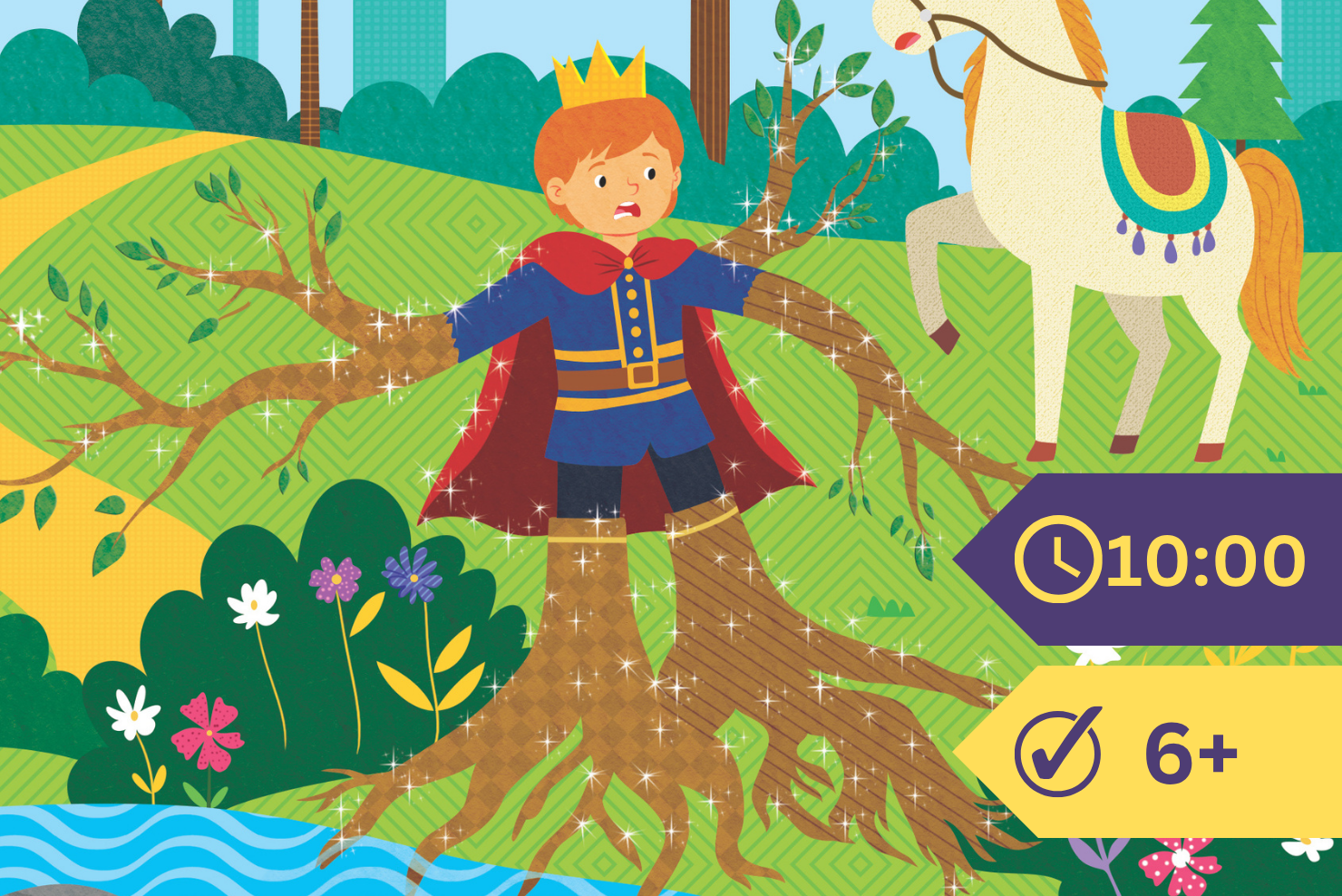
Another girl might have cried out or fallen into despair. But Filagranata kept her wits. She caught up a wand she had seen the witch use for wonderful things, gave the prince a quick tap — and he became a pomegranate. She tapped his horse — and it became an orange. Both she set on the shelf, quite naturally, and then went to the window and drew the witch up as usual.
The old witch sniffed the moment she was inside.
“What a stink of Christians! What a stink of Christians!” she muttered, poking her nose into every corner. But she found nothing to reproach. As for the handsome pomegranate and the bright orange sitting on the shelf, even the devil himself wouldn’t have suspected anything wrong with those. Baffled, the witch inspected the pigeons, said what she had to say, and climbed back down.
The moment she was gone, Filagranata tapped the fruits with the wand and restored the prince and his horse to their proper shapes.
“This is how your life goes, every single day?” the prince exclaimed. “No — I cannot leave you here. My horse will be glad to carry you. Come with me to my kingdom, and you shall live in the palace with my mother and be my queen.”
Filagranata found this prospect far preferable to remaining a prisoner in a doorless tower. She raised no argument, the prince set her up behind him on the horse, and away they rode.
On, on, on they rode for a long time, until they reached a wood. The witch had discovered the escape quickly enough and set out in pursuit, and was nearly upon them when they saw a little old woman standing at the roadside, gesturing urgently for them to stop. Their anxiety to press on was great — but her appeal was so urgent that they pulled up. It was lucky they did, for the little old woman was a fairy, and she had stopped them not for her own sake, but to help them.
To the prince she said: “Take these three gifts. When the witch comes close, throw down the mason’s trowel. When she nearly catches you again, throw down the comb. When she nearly catches you a third time, throw down this jar of oil. After that she will trouble you no more.” And to Filagranata she whispered some words, and let them go.
The witch was already close behind. The prince threw down the trowel — and instantly a high stone wall rose up between them. The witch had to find her way over it, which cost her time. But her powers were strong, and soon she was gaining on them again. The prince threw down the comb — and a dense hedge of thorns sprang up behind them, and the witch had to tear her way through it, scratched and bleeding. Even so, she was back on their heels before long. The prince threw down the jar of oil. The oil spread and spread, flooding the whole countryside; and as you cannot walk through a pool of oil without your feet sliding back beneath you, the witch could never get out of it — and the prince and Filagranata rode on safely toward the palace.
“Tell me,” said the prince, when they could breathe freely at last, “what was it the old woman in the wood whispered to you?”
“This,” said Filagranata. “That when you arrive home, you must kiss no one — not your father, not your mother, not your sisters, no one at all — until after our wedding. Because if you do, you will forget everything: our meeting, all you have promised me, all you have felt for me, and we will become strangers to each other.”
“How dreadful!” said the prince. “Then you may be quite sure I shall kiss no one. It will seem strange — coming home after such a long journey and not even kissing my own mother — but I’ll explain, and they won’t mind. Be quite easy.”
And so they rode on in love and confidence, and the good horse brought them home.
On the palace steps the chancellor came out to meet them. He saluted Filagranata as the chosen bride, informed the prince that the king his father had died during his absence, and that he was now king. He led the new king in to the queen-mother, who heard of the journey and the escape and understood why her son could not yet kiss her. She was so taken with Filagranata’s beauty and gentleness that she accepted this without complaint, and that same evening it was announced throughout the kingdom that the new king had come home and the wedding day was set.
Then all in the palace went to their bedchambers. But the king, as had been his habit since childhood, slipped into his mother’s room to press a goodnight kiss to her brow while she slept. And when he saw her lying there in peace — her soft white hair parted gently, her loving eyes now resting in sleep — he could not help himself. He bent down and kissed her forehead.
In that instant, everything vanished from his mind. The witch’s tower, the escape, the long road, and most of all the face of Filagranata — all of it gone, as if it had been a dream. When he woke and was told he was king, it came as news to him. When Filagranata was brought before him, he looked at her as a stranger.
“Since I am king,” he said, “there must be a queen.” And he sent for a suitable princess and arranged the betrothal. The queen-mother, who had grown fond of Filagranata, was grieved — but nothing she said could bring back a single memory of what her son had promised, or felt.
Filagranata understood what had happened. She went quietly to the queen-mother and said: “Give me a great deal of fine flour and a large bag of sweetmeats, and I will see if I cannot set this right.” The queen-mother ordered it brought. Filagranata locked herself in her room, worked the flour into a smooth paste, and shaped it into two pigeons. She filled each one with sweetmeats inside, and asked the queen-mother to have them placed on the banquet table at the betrothal feast — one at each end.
When the guests were seated and the feast was about to begin, the two paste pigeons began to speak to each other across the length of the table. Everyone fell still in wonder.
“Do you remember,” said the first pigeon, “or have you truly forgotten, when I was locked in that doorless tower, and you came beneath the window and called up —
Filagranata, thou maiden fair,
Loose thy tresses of golden hair:
I, thy old grandmother, am here —
until I drew you up to me?”
And the second pigeon answered: “Sì, signora — yes, I remember it now.”
And as the young king heard those words, something stirred in him: the image of a tower, a verse sung beneath a window, a girl’s surprised and happy face.
“Do you remember,” the first pigeon continued, “how happy we were together in that little room, and how you swore that if I came with you we would never be parted?”
“Ah yes,” said the second pigeon. “I remember it now.”
And with those words there rose up in the king’s mind the memory of a gentle face, and all that he had vowed to the girl who wore it.
“Do you remember,” said the first pigeon, “how frightened we were as we fled and the witch pursued us, how we clung to each other and said that if she caught us we would die together — until a fairy gave us three gifts to stop her, and warned you to kiss no one, not even your own mother, before our wedding?”
“Yes — ah yes,” said the second pigeon. “I remember it now.”
And at those words, the whole of the past came flooding back to the king, and with it all his love for Filagranata. He rose and reached out to touch the pigeons that had restored him — but the moment his fingers brushed them, they melted away, and sweetmeats scattered across the table, and the guests gathered them up. The king went in haste to find Filagranata and brought her back to take her place at his side. The other bride was sent home with kind wishes and generous gifts.
“And so it all came right at last,” said the old woman who told this tale, long ago. “Lackaday — that there are no fairies now to make things come right. There are plenty of folk who seem to have the devil in them for doing you a mischief, but there are no fairies left to set things straight again, alas!”