I. Werner and Anna
In the last house of the village, just where the great forest begins, lived a poor widow with her two children, Werner and Anna. The little that grew in her garden and on their single acre of ground, the milk of their one goat, and the small sum she was able to earn were just enough to keep the family going. The children were never idle. They enjoyed helping, and their work took them in all directions through the beautiful forest.
In early spring they gathered yellow cowslips and blue anemones to sell in the city, and later the fragrant lilies of the valley from the beech wood. Then came strawberries glistening red beneath the leaves, blueberries and coral-tinted bilberries from the moor, and beautiful mosses and lichens—all of these the children gathered cheerfully and sent to town.
With autumn came new work. Day after day they went to the woods, picking up dry branches blown down by the wind, carrying them home and stacking them beside the hut. They gathered nuts too, put them in a bag, and hung them in the chimney against Christmas time.
Ah, Christmas! That was a magic word, and at its sound the children’s eyes would sparkle. And yet the great day brought them very little—a wee tree with a few candles, some apples and nuts, and two gingerbread men; under the tree for each one a warm article of clothing, and if times were especially good, a cheap toy or a new slate. That was all. And yet from those little candles and the golden star at the top of the tree there came a glorious light that shed its rays throughout the whole year—a light that shone in their eyes whenever Christmas was spoken.
Winter had come, and one evening as they sat cozily around the stove, their mother told them a beautiful Christmas story. When she had finished, Werner, who had been looking very thoughtful, suddenly asked: “Mother, where does the Christmasman live?”
The mother answered, letting the fine thread slip through her fingers while her spinning wheel hummed merrily: “The Christmasman? Behind the forest, in the mountains. But no one can find him. Whoever seeks him wanders about in vain, and the little birds in the trees hop from branch to branch and laugh at the foolishness of trying. In the mountains the Christmasman has his gardens, his workshops, and his mines. There his busy workers labour day and night, making lovely Christmas things. In the gardens grow silver and golden apples and nuts, and the most delicious fruits of marzipan. In the workshops are heaped up thousands and thousands of the most wonderful toys in the world. There are halls filled with beautiful dolls, dressed in calico, in wool, in silk, and in velvet—”
“Ah!” said little Anna, and her eyes shone.
“—and other halls filled with drums and swords and guns, cannon and toy soldiers—”
“Oh!” cried Werner, and his eyes sparkled.
The story stayed with him. He could not forget it, and he thought how happy he would be if only he could find the way to that wonderland. Once he got as far as the mountains and wandered there for a long time, but saw nothing but valleys and hills and trees. The brooks murmured and babbled as brooks always do, but did not betray their secret. The woodpeckers hammered away and then flew off, and the squirrels leaping up the trees were just like any other squirrels he had ever seen.
He longed for a glimpse of the wonderful Christmasland. If someone would only show him the way, he would surely go. The people he asked laughed at him, and when he told his mother she laughed too, and told him to think no more about it—the story had been only a fairy tale.
But little Werner could not forget, though he did not speak of it again. Only to his sister Anna did he confide his thoughts from time to time, and together they dreamed of that wondrous country—Christmasland.
II. The Little Bird
One morning shortly before Christmas, Werner set off alone into the forest with his axe on his shoulder. The forester, who liked the well-behaved boy, had again this year allowed him to cut down a small pine tree for their Christmas Eve. The graceful little tree the children had chosen stood in a quiet spot, deep in the woods, sheltered by a kindly old beech. It was a beautiful, mild winter’s day, and when Werner reached the spot at last, he sat down on a tree stump to rest.
All around him was as still as an empty church. Only a little brook murmured softly, and from somewhere far off came the shrill cry of a jay. Again he fell to dreaming of Christmasland, and the longing grew so strong that he called out: “Oh, if only someone could show me the way!”
From the brook came sounds like rippling laughter. A wood mouse peeped from her hole and laughed a tiny laugh. The old beech swayed at the top, as though shaking her head at such folly. But from the little pine tree directly in front of him came a sweet, clear chirping—a blue titmouse, hopping gaily from branch to branch, crying over and over: “I know! I know!”
“What do you know?” asked Werner.
The little bird threw herself backwards off a branch, turned a somersault in the air in the most comical way, and landed again, crying: “I know the way! I know the way!”
“Then show me the way!” said Werner at once.
Again the bird chirped softly, and the boy understood everything she said. “You were good to me! You saved my little children, my ten little children! I know the way—I’ll show you! Quick! Quick!”
And the small creature flew to the nearest bush, then farther, and Werner followed. As he went, it came back to him—last spring, it had been a titmouse whose frightened cries had drawn him to this very old beech tree. He had found a jay crouching at the entrance to the hollow where the bird had built her nest, about to snatch the naked nestlings. The poor mother had been hovering desperately around, trying to protect them. Werner had picked up a stone and thrown it so true that the jay fell dead to the ground.
Now the titmouse wanted to repay him. She flew ahead from bush to bush, leading him upstream along the brook, toward the mountains. The ground began to rise, the brook grew louder underfoot, and he came to a narrow valley that grew narrower still, its walls on either side growing steeper, until the brook vanished behind a jutting rock—and there before him stood a smooth wall of stone, towering high, crowned with great pine trees. The bird vanished. But far above, faint in the distance, he heard her voice: “Soon! Soon!”
Werner sat on a rock and studied the stone wall. It was smooth and solid, covered with mosses and bright lichens. He could see nothing more. So he waited. Then he heard a flutter above him, and a hazelnut fell at his feet.
“Take! Take!” cried the bird. “Crack! Crack!”
He picked up the nut and shook it—something hard rattled inside. He cracked it open and found a tiny golden key. Meanwhile the titmouse had flown to the stone wall and, clinging there with her delicate feet, pecked furiously at the lichens until the pieces flew. At last she cried: “Here! Here!”
Werner came close and saw a small, silver-rimmed keyhole. The golden key fitted perfectly, and when he turned it, a fine ringing sound came from deep within the stone—and a heavy door, cut so precisely it had been invisible, swung slowly open.
Warm air drifted through the opening, blue-tinted and fragrant with the smell of pine needles and just-blown-out wax candles.
“Oh,” said Werner softly. “It smells of Christmas.”
“Go in! Go in!” cried the bird. “Quick! Quick!”
Barely had he stepped into the dark passage when a draft swept past him and the door silently closed behind him. The dark was total. He felt a flutter of panic—there was no going back—but he told himself that a faint heart would get him nowhere, and walked on, groping his way along the black corridor.
III. Christmasland
Gradually the darkness gave way to a soft glow, and Werner stepped out into the strangest country he had ever seen.
The air was warm—not summer-warm, but warm like a heated room—and fragrant with many sweet smells. No sun shone in the sky, yet everywhere was an even, tempered brightness. Tall bushes laden with the most peculiar fruits hemmed in his view on all sides, but as he walked through them, wondering, he came out onto a broad avenue leading toward a distant building.
On either side of the avenue stood great apple trees, their branches heavy with golden and silver apples. Gnome-like old men with long gray beards, and pretty little children, moved busily among the trees, picking the apples and heaping them into large baskets, many of which already overflowed with their glittering load. No one paid any attention to Werner, who made his way, astonished, toward the building at the end of the avenue.
It proved to be a great castle, with towering spires and gilded domes. In the fields on either side, bright-coloured figures busily loaded two-wheeled carts drawn by shaggy golden ponies.
As Werner drew nearer, he noticed an extraordinary smell—honey cake, warm and sweet, growing stronger with every step. Looking closely at the walls, he realised the castle was built entirely of the stuff. The foundation was great blocks of it; the walls smooth cake, decorated with strips of citron and slivers of almond. Everywhere were marzipan carvings, balconies of sugar, statues of chocolate standing in gilded niches, and glittering windows made of transparent boiled sweets. Here was a castle good enough to eat.
The doorbell handle was made of transparent sugar. Werner took heart and pulled it hard. No bell rang—instead a voice from inside shrieked “Kikeriki!” so loud and sharp that the boy leaped back in fright. The cry echoed again and again, growing fainter and fainter as it travelled into the depths of the building. Then silence.
The door swung softly open and a most extraordinary creature stood before Werner. Had it not moved and spoken, he would certainly have taken it for a large, painted jumping-jack toy.
“By leaf-gold and honey cake!” it exclaimed. “A visitor? Why, that is a most remarkable event!” And then—whether from delight or astonishment—it flung its arms and legs repeatedly over its head in a way that was almost alarming to see. At last it settled, swinging its limbs back and forth, and asked: “Well, my boy, what is it you want?”
“Does the Christmasman live here?” asked Werner.
“He does,” said the jumping-jack, “and his Honour is at home—but very busy. Very busy indeed.”
It bade Werner follow, moving sideways in a strange shuffling manner, through an entrance hall whose walls were marzipan and whose ceiling rested on pillars of polished chocolate. At a far door, two enormous nutcrackers stood guard in full uniform. The jumping-jack told Werner to wait, then disappeared. The nutcrackers stared at him with their great painted eyes, then grinned at each other with a stiff wooden grin—and from somewhere inside them came a sound suspiciously like laughter.
Presently the jumping-jack returned, made a beautiful sideways bow, and announced: “My gracious master begs you to enter.”
The two nutcrackers snapped to attention, raised their swords, and beat a thunderous roll with their teeth.
IV. The Christmasman
Werner had expected a great red-robed figure, round and jolly, like the pictures he had seen. What he found was quite different.
The Christmasman had a beautiful long white beard, as was proper. But he wore a blue, gold-embroidered skullcap and a dressing gown of yellow silk, and he sat before a large book, writing. The dressing gown, though, was astonishing—covered all over with embroidery so detailed it was like a picture book. Soldiers and dolls and clowns, and all the animals of Noah’s ark; drums and fifes, violins and trumpets, swords and guns; flowers and cakes; sun and moon and stars.
The Christmasman laid down his pen. “How did you get here, my boy?”
“The little bird showed me the way.”
“A hundred years since anyone has been here,” said the Christmasman, studying him, “and now this small fellow manages it. Well—your reward is that you may see everything. I am too busy to guide you myself, but my daughter will. Come, little Goldflame!” he called. “We have a guest.”
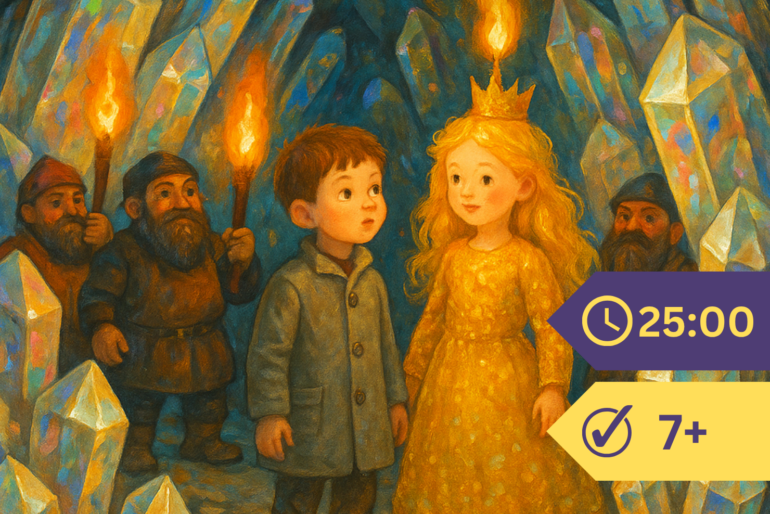
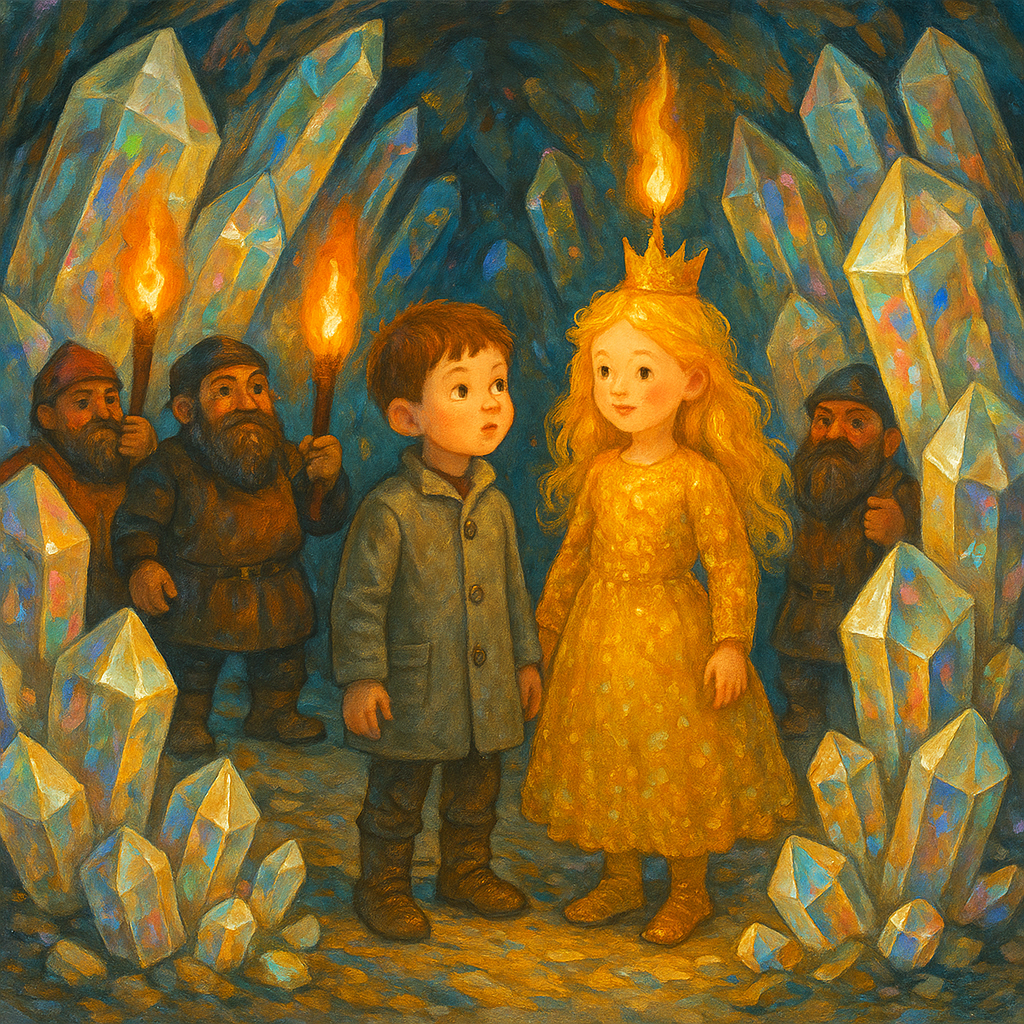
From the next room came a rustling and a fluttering, and in ran a beautiful little girl dressed all in leaf-gold, glittering and sparkling from head to toe. On her head sat a small golden crown, and at its very tip burned a tiny, steady flame.
“Oh, how nice!” she said, and took Werner’s hand. “Come along, strange boy!” And she pulled him running from the room.
V. The Christmas Warehouse
They came to a long corridor where rows of wooden horses stood tied—grey and brown and chestnut and black.
“You may choose one,” said Goldflame.
Werner chose a fine dapple-grey. Goldflame mounted a coal-black steed. “Hoy!” she cried—and with a whirr the little horses shot forward so fast that Werner’s hair streamed behind him and the flame on Goldflame’s crown trailed like a banner in the wind. At the far end of the corridor a door flew open and they burst through into a great hall.
“The Hall of Lead,” announced Goldflame.
From floor to ceiling, open shelves lined every wall, packed with boxes—and in every box, tin soldiers, hunters, shepherds, sleighing parties, menageries, and every other thing that could be fashioned from lead. Small black-bearded dwarfs climbed busily up and down ladders, loading the boxes into carts and rolling them out, where larger wagons waited to carry the toys away.
When the dwarfs spotted Werner and Goldflame, they scurried to bring two gold-brocaded armchairs, and Goldflame settled into hers with an air of pleased anticipation. “The parade is about to begin.”
They had barely sat down when music swelled from beneath one of the shelves, and rank after rank of splendid toy soldiers marched past—the lieutenants saluting smartly with tiny swords. Behind them came the white cuirassiers in gleaming armour, the red hussars, the lancers with their bright flags, the blue dragoons, and finally the cannon. When the last gun had rolled past—
Trari, trara!
Deer and rabbits and foxes burst from beneath the shelves, a hunting pack baying at their heels, and horseback riders with cracking whips and sounding horns galloping behind.
Then something glittered in the air, and fine snow began to fall. When the floor lay white, a sleighing party swept past with merry jingling bells—swan-prowed and dragon-prowed sleighs, their passengers in beautiful furs, who laughed and threw snowballs at Werner and Goldflame. Each snowball, if you looked closely, contained a tiny sweet wrapped in tissue paper.
The snow melted away as suddenly as it had come. Shepherds and shepherdesses followed with their flocks, then peasants carrying fruits and flowers, then gypsies, musicians, acrobats, and rope walkers. Last of all came a great menagerie—giraffes, elephants, rhinoceroses, zebras, and antelopes; and behind them, in little wagons, lions and panthers in cages, roaring indignantly at the whole proceedings.
After the parade they mounted their horses again and rode on through marvel after marvel: the great Hall of Dolls, which Werner did not particularly care about though he wished Anna could see it; a theatre warehouse where at Goldflame’s request a thousand tiny stages opened at once and performed a thousand different plays, making an extraordinary din; a storeroom for musical instruments; a warehouse of wooden animals; a picture department; a paint-box warehouse; a hall of wax candles, tier upon tier, in every colour and size imaginable.
Werner was quite dazed with wonders when at last they reached the great sweet-shop.
“Now we must eat,” said Goldflame.
Six little confectioner’s apprentices appeared instantly, set up a table, and served them a feast Werner could never have imagined. There were Leipzig larks made of marzipan filled with nut cream; sausages of quince; ham of rosy sugar; pastry filled with strawberry jam; candied fruits of every kind. To drink, pineapple lemonade with vanilla cream. The six waiters hovered eagerly, running to fill every wish.
For dessert, Goldflame announced with great ceremony that they were to have something quite superlatively fine. Out came two plates of dry black bread with a little hard cheese.
“In this country,” she explained, “such ordinary things are so rare and so difficult to obtain that they are considered the greatest delicacies.”
Werner ate his bread and cheese with sincere appreciation.
VI. The Mines
They rode out beyond the sweet-shop, over fields where sugar-plums grew on low bushes and chocolate fruits hung from trees, along stately avenues, toward the mountains that rose in the distance. Some gleamed white as chalk; others were dark and dull, almost black. But the peaks of even the black mountains were dusted white.
“You think that is snow,” said Goldflame. “But here it only ever snows powdered sugar.”
Before them rose a high white cliff swarming with workers. They dismounted. “The great sugar quarry,” said Goldflame. “This entire cliff is the finest white sugar.”
Miners came forward with torches and led them into a cave. They went deep into the mountain, whose walls shimmered and sparkled in the torchlight. Presently they entered a magnificent chamber lined with huge crystals of transparent rock candy, glittering like a cathedral of ice.
They went further, into passages where miners knocked and hammered, digging new tunnels. “They are searching for pockets of liquid sugar,” explained Goldflame. “When they find one, they scoop it out with great ladles.”
The mountains changed as they rode on—no longer white, but dark and brown, and now richly scented with vanilla. “The chocolate mines,” said Goldflame.
Here workers tunnelled deep into the mountains, for the best vanilla chocolate lay hidden inside. They rode through vast underground chambers, the ceilings held up by pillars of chocolate left standing. When they finally emerged into the open air again, Werner heard a rushing brook that came roaring out of a mountain ravine and thundered into the valley below, where it turned the mills that sawed the great chocolate blocks into slabs.
“Would you like a drink?” said Goldflame. “It is very good—pure liqueur.”
Werner was desperately thirsty after so many sweets. The brook smelled so fresh and tempting. An obliging miner handed him a cup, and he drained it in one long draught.
Scarcely had he set down the cup when the world began to turn in the most peculiar way. He saw two Goldflames, then four, then a hundred, all glittering and shimmering before him, then swirling together into one shining sea of light—and he knew nothing more.
VII. The End, and the Beginning
The first sound Werner heard on waking was the chirp of a titmouse.
He was sitting on his tree stump beneath the old beech, the little pine tree standing before him exactly as he had left it. The titmouse hopped from branch to branch and chattered, but Werner could no longer understand a word she said. He scrambled up, suddenly aware of how late it must be—his mother would be frantic.
But when he looked up at the sun, barely a quarter of an hour had passed since he had sat down to rest.
He cut down the pine tree, shouldered it, and hurried home as fast as he could. He told his story with shining eyes and breathless haste. His mother listened—then grew quite stern, and told him never to fall asleep in the winter woods again; another time the cold might be his death. Afterwards she shook her head, murmuring to herself: “Where does the boy get all his strange ideas?”
Werner went away in tears. But Anna followed. She never tired of hearing about Goldflame and the hall of dolls, and in the days that followed he told her the story over and over until he felt comforted at last. One day they went together to look for the valley and the stone wall with its silver keyhole. They followed the brook all the way to the mountains—but they never found anything that matched Werner’s description, and he was so embarrassed and puzzled that he didn’t know what to say.
And so Christmas drew near.
Snow had been falling for two whole days, and the world was beautiful, wrapped in white. Night had come. The children sat in their dark room, whispering and waiting, listening to their mother moving back and forth in the lit-up Christmas room, arranging their small gifts.
Then from far off they heard the jingling of sleigh bells, coming nearer. A whip cracked merrily. The sleigh drew up before the house; they could hear the horses stamping, the bells swaying softly as the animals turned their heads.
“The Christmasman!” cried Werner. “The Christmasman!”
Doors opened. A man’s voice spoke. Then their mother called: “Come in, children—your uncle is here.”
Werner and Anna ran in. A man in a great fur coat held out his arms to them. He kissed each one and said: “You shall come with me to the city and live in my large house. I will be a father to you. I will take care of you.” While he spoke, an enormous coachman with a fur cap, a long white beard, and a cloak with seven capes was carrying great packages in from the sleigh. When the packages were opened they held so many beautiful gifts that the little house had a Christmas that evening such as it had never known before.
Later, when Werner and Anna were in bed, he leaned close and whispered very mysteriously: “Do you know who the coachman was? The one with the fur cap and the long white beard and the seven-caped cloak? That was the Christmasman. I recognised him. And he looked at me—and winked.”
As for what had happened to the rich old uncle—who had always lived alone, unsociable and miserly, never giving his poor sister and her children a thought—something had occurred in the night following Werner’s visit to Christmasland.
A figure had appeared to him in his sleep: a man in a blue velvet cap and a long white beard, wrapped in a golden robe, with great blue eyes that seemed to see everything. The figure looked at him for a long moment, then spoke, slowly and quietly: “Konrad Borodin. Have you a sister?”
Fear gripped the uncle so completely that he could not answer. The apparition faded, only the eyes lingering, watching him.
Three nights in a row he had the same dream. By day a restlessness unlike anything he had ever known drove him from room to room of his cold, empty house, and always in his ear sounded that quiet, reproachful voice: Have you a sister?
On the morning after the third night, he could bear it no longer. He drove into the city, bought armloads of beautiful things—to the astonishment of everyone who knew him—ordered a sleigh, filled it with his purchases, and drove directly to his sister’s door.
Werner grew up to be a celebrated and well-respected man. He himself told me this story.