It was a beautiful, fruitful season. Rain and sunshine came by turns, exactly when the corn needed them. Whenever the farmer began to think it was a little dry, it would rain the very next day. And when he decided he’d had rain enough, the clouds cleared at once, as if they took their orders from him.
So the farmer was in a good mood, and for once he didn’t grumble. He walked across the field with his two boys, looking pleased and cheerful.
“It’s going to be a splendid harvest,” he said. “My barns will be full, and I’ll make a pretty penny. Then Jack and Will can have new trousers, and I’ll take them with me to market.”
“If you don’t cut me soon, farmer, I’ll end up sprawled on the ground,” said the rye, and she bowed her heavy ears down toward the earth.
The farmer couldn’t hear her, but he could see what she meant, so he went home to fetch his scythe.
“It’s a fine thing to be in the service of man,” said the rye. “I can be sure all my grain will be looked after. Most of it will go to the mill. That’s not the most enjoyable process, but it will be turned into lovely new bread, and one must put up with something for the sake of honour. The rest the farmer will save and sow in his field next year.”
At the edge of the field, along the hedge and the bank above the ditch, stood the weeds. There were thick clumps of thistle and burdock, poppy and harebell, and dandelion, and every one of their heads was full of seed. It had been a fruitful year for them too, because the sun shines and the rain falls just as much on the poor weed as on the rich corn.
“Nobody comes to mow us down and carry us off to a barn,” said the dandelion, shaking his head, very carefully, so the seeds wouldn’t fall too soon. “So what is to become of all our children?”
“It gives me a headache just thinking about it,” said the poppy. “Here I stand with hundreds and hundreds of seeds in my head, and not the faintest idea where to drop them.”
“Let’s ask the rye for advice,” said the burdock.
So they asked the rye what they should do.
“When one is well off, one shouldn’t meddle in other people’s business,” said the rye. “I’ll give you just one piece of advice: don’t you dare throw your silly seeds into this field, or you’ll have me to answer to.”
That was no help at all to the wildflowers. They stood thinking all day long. When the sun set, they folded up their petals and went to sleep, and all night they dreamed about their seeds. By morning, they each had a plan.
The poppy woke first. Very carefully, she opened some little trapdoors at the top of her head so the sun could shine in on her seeds. Then she called to the morning breeze, who was running and playing along the hedge.
“Little breeze,” she said sweetly, “would you do me a favour?”
“Of course,” said the breeze. “I’d be glad of something to do.”
“It’s the merest trifle,” said the poppy. “Just give my stalk a good shake, so my seeds fly out of the trapdoors.”
“All right,” said the breeze.
And the seeds flew out in every direction. The stalk snapped, it’s true, but the poppy didn’t mind that one bit.
“Goodbye,” said the breeze, and was about to run on.
“Wait a moment,” said the poppy. “Promise me first that you won’t tell the others. They might get the same idea, and then there’d be less room for my seeds.”
“I’m as quiet as the grave,” said the breeze, and off she ran.
“Ho there!” said the harebell. “Haven’t you time to do me a teeny, tiny favour?”
“Well,” said the breeze, “what is it?”
“I just want you to give me a little shake,” said the harebell. “I’ve opened some trapdoors in my head, and I’d like my seeds sent a good way out into the world. But you mustn’t tell the others, or they might think of doing the same thing.”
“Oh, of course not,” said the breeze, laughing. “I’ll be as silent as a stone wall.” And she gave the flower a good shake and went on her way.
“Little breeze, little breeze,” called the dandelion, “where are you off to in such a hurry?”
“Is something the matter with you, too?” asked the breeze.
“Nothing at all,” said the dandelion. “I only wanted a word with you.”
“Make it quick,” said the breeze, “because I’m thinking seriously of lying down for a rest.”
“You must have noticed,” said the dandelion, “what trouble we’re all in this year, trying to get our seeds out into the world. One wants to do the best one can for one’s children, after all. What will happen to the harebell and the poppy and the poor burdock, I really can’t say. But the thistle and I have put our heads together, and we’ve come up with a plan. We only need your help.”
“That makes four of them,” thought the breeze, and she couldn’t help laughing out loud.
“What are you laughing at?” asked the dandelion. “I saw you whispering with the harebell and the poppy just now. But if you breathe a word of this to them, I won’t tell you anything.”
“Why, of course not,” said the breeze. “I’m as mute as a fish. What do you need?”
“We’ve made a pretty little umbrella for the top of each seed. It’s the sweetest little plaything you can imagine. If you’ll just blow on me, the seeds will float up into the air and come down wherever you like. Will you?”
“Certainly,” said the breeze.
And hush! she swept over the thistle and the dandelion and carried all their seeds off into the cornfield.
The burdock was still standing there, thinking. Its head was rather thick, which was why it took so long. But that evening a hare came leaping over the hedge.
“Hide me! Save me!” he cried. “Trusty, the farmer’s dog, is after me!”
“Creep in behind the hedge,” said the burdock, “and I’ll hide you.”
“You don’t look like much of a hiding place,” said the hare, “but in a pinch one has to take what one can get.” And he slipped safely in behind the hedge.
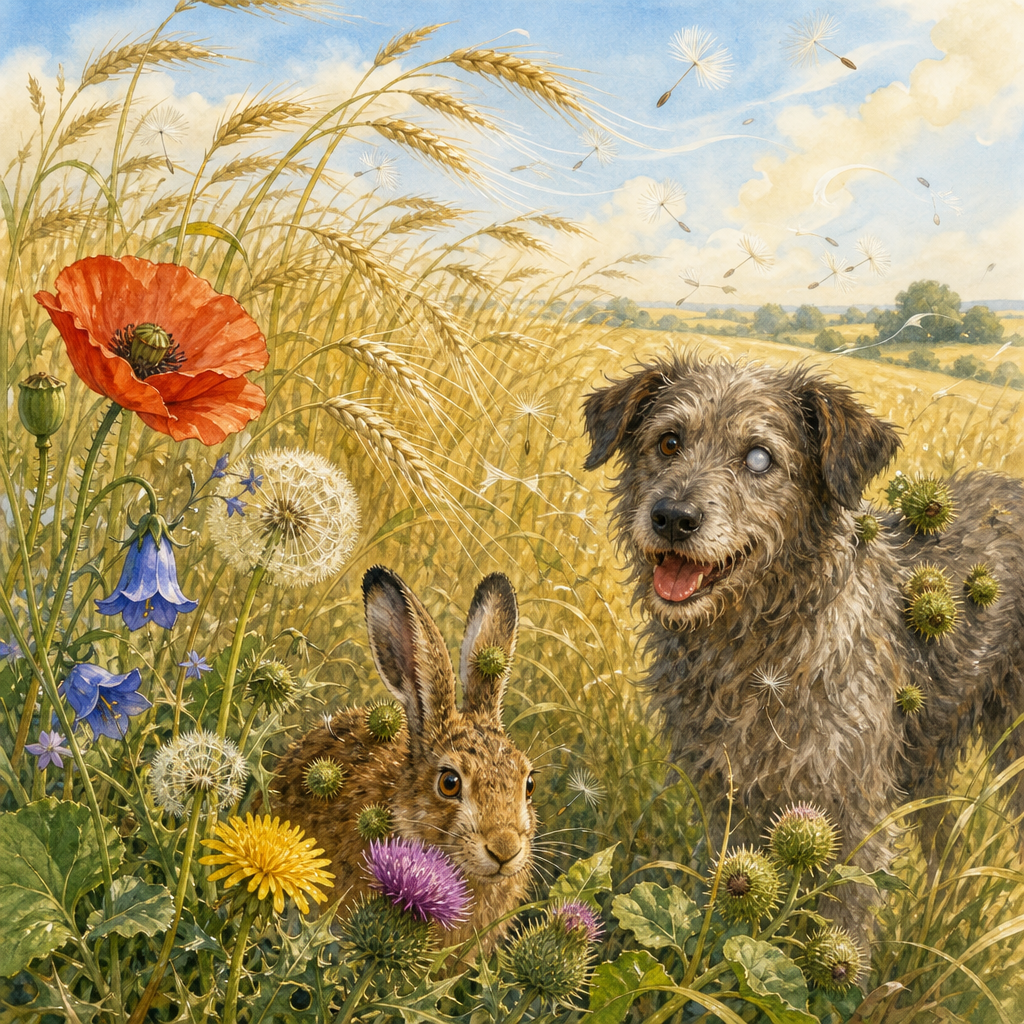
“Now you can repay me by carrying some of my seeds over into the cornfield,” said the burdock, and it broke off some of its many burrs and stuck them on the hare.
A little later, Trusty came trotting up to the hedge.
“Here comes the dog,” the burdock whispered, and the hare sprang over the hedge and into the rye.
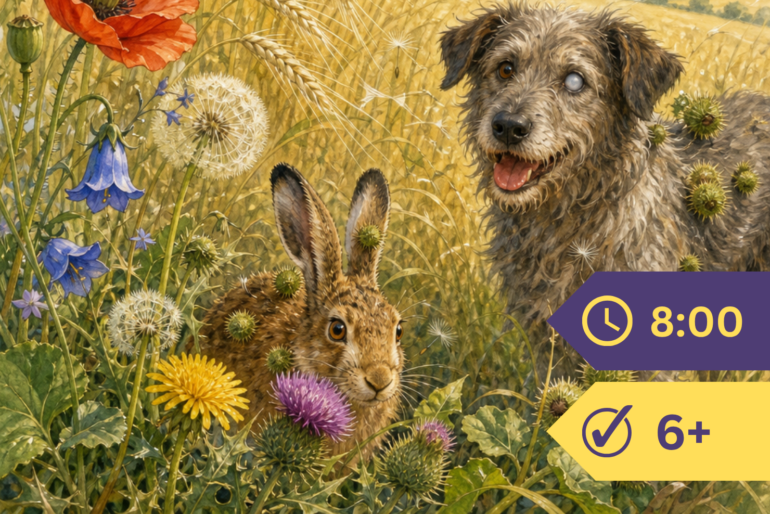
“Haven’t you seen a hare, burdock?” Trusty asked. “I’m getting too old for hunting, I’m afraid. I’m blind in one eye, and I’ve lost my sense of smell completely.”
“Yes, I saw him,” said the burdock, “and if you’ll do me a favour, I’ll tell you where he went.”
Trusty agreed. The burdock fastened some burrs to his back and said, “Just rub yourself against the stile in the cornfield, and my seeds will fall off. But don’t bother looking for the hare there. A little while ago, I saw him run into the woods.”
Trusty shook the burrs off in the field and trotted away toward the woods.
“Well, I’ve sent my seeds out into the world just fine,” said the burdock, laughing, very pleased with itself. “But who knows what will become of the thistle and the dandelion and the harebell and the poppy?”
Spring came round again, and the rye was already standing tall.
“We’re doing pretty well, all things considered,” said the rye plants. “Here we stand in one big company, every one of us from the same noble family, and we never get in each other’s way. It’s a grand thing to be in the service of man.”
But one fine day, a crowd of little poppies, thistles, dandelions, burdocks and harebells poked their heads up out of the ground, right in the middle of the flourishing rye.
“What is the meaning of this?” said the rye. “Where in the world did you spring from?”
The poppy looked at the harebell and asked, “Where did you come from?”
The thistle looked at the burdock and asked, “Where in the world did you come from?”
They were all equally astonished, and it took an hour before they had explained. But the rye was the angriest of all, and when she’d heard the whole story about Trusty and the hare and the breeze, she was beside herself.
“Don’t get in such a state, you green rye,” said the breeze, who had been lying behind the hedge, listening to every word. “I don’t ask anyone’s permission. I do as I please. And now I’m going to make you bow to me.”
Then she swept over the young rye, and the slender blades swayed back and forth.
“You see,” she said, “the farmer looks after his rye, because that’s his business. But the rain and the sun and I look after all of you, without picking favourites. To our eyes, the poor weed is every bit as pretty as the rich corn.”