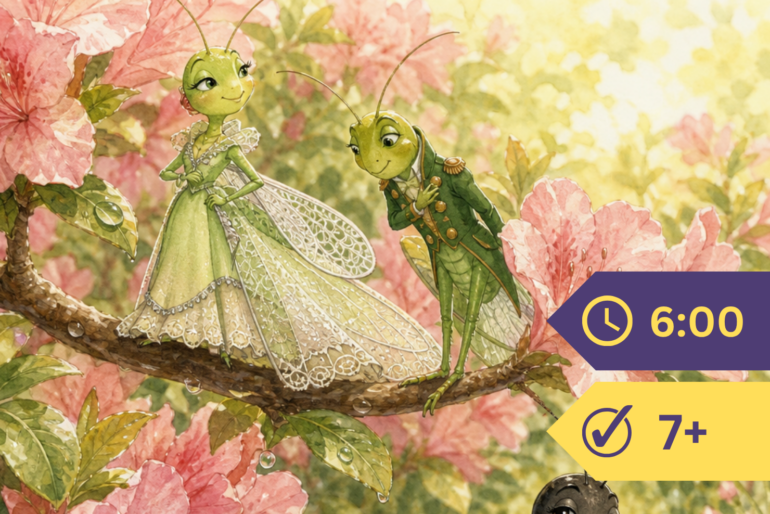
Miss Katy-Did sat on the branch of a flowering azalea in her best suit of fine green and silver, with wings of point-lace spun from Mother Nature’s finest web. Her gallant cousin, Colonel Katy-Did, had dropped by to pay her a morning call.
“Certainly I am a pretty creature,” she said to herself, as the Colonel murmured something about being dazzled by her beauty.
“The fact is, my dear Colonel,” she said aloud, “I am thinking of giving a party, and you must help me make out the list.”
“My dear, you make me the happiest of Katy-Dids.”
“Now,” said Miss Katy, pulling an azalea leaf toward her, “let us see. Whom shall we have? The Fireflies are a little unsteady, but they’re so brilliant that everybody wants them, and they move in the best circles.”
“Yes, we must have the Fireflies,” said the Colonel.
“Then the Butterflies and the Moths. Now, there’s the trouble. There are so many Moths, and they’re so dull. But if you have the Butterflies, you can’t leave out the Moths.”
“Old Mrs. Moth has been ill lately. That may keep two or three of the Misses Moth at home,” said the Colonel.
“I thought she was never sick!”
“I understand she and her family ate up a whole fur cape last month, and it disagreed with them.”
“Oh, how can they eat such things as wool and fur?” sneered Miss Katy.
“One can see by your fairy-like delicacy that you couldn’t,” smiled the Colonel.
“Mamma says she doesn’t know what keeps me alive. Half a dewdrop and a little bit of the nicest part of a rose petal will last me a whole day. But back to our list: Fireflies, Butterflies, Moths. I suppose the Bees must come.”
“The Bees are a worthy family,” nodded the Colonel.
“Yes, but dreadfully humdrum. They never talk about anything but honey and housekeeping.”
“Then there are the Bumblebees.”
“Oh, I dote on them! General Bumble is one of the most dashing fellows of the day.”
“He’s shockingly fat!”
“Well, he is a little stout,” Miss Katy admitted, “but his manners are so elegant. There’s something soldierly and breezy about him.”
“If you invite the Bumblebees, you must have the Hornets.”
“Ugh, they’re spiteful. I detest them.”
“Nevertheless, one mustn’t offend the Hornets. And what about the Mosquitoes?”
“They’re so common. Can’t we just leave them out?”
“I think not, my dear. Young Mosquito writes for some of our leading papers, and he carries a sharp pen. It would never do to offend him.”
“And I suppose we must ask all his dreadful relations, too,” sighed Miss Katy.
Just then they saw Miss Keziah Cricket coming up the path, her workbag on her arm. She was collecting donations for a poor family of Ants whose house had just been dug up by someone clearing the garden walks.
“How stupid of the Ants,” said Katy, “not to know better than to build in a garden walk.”
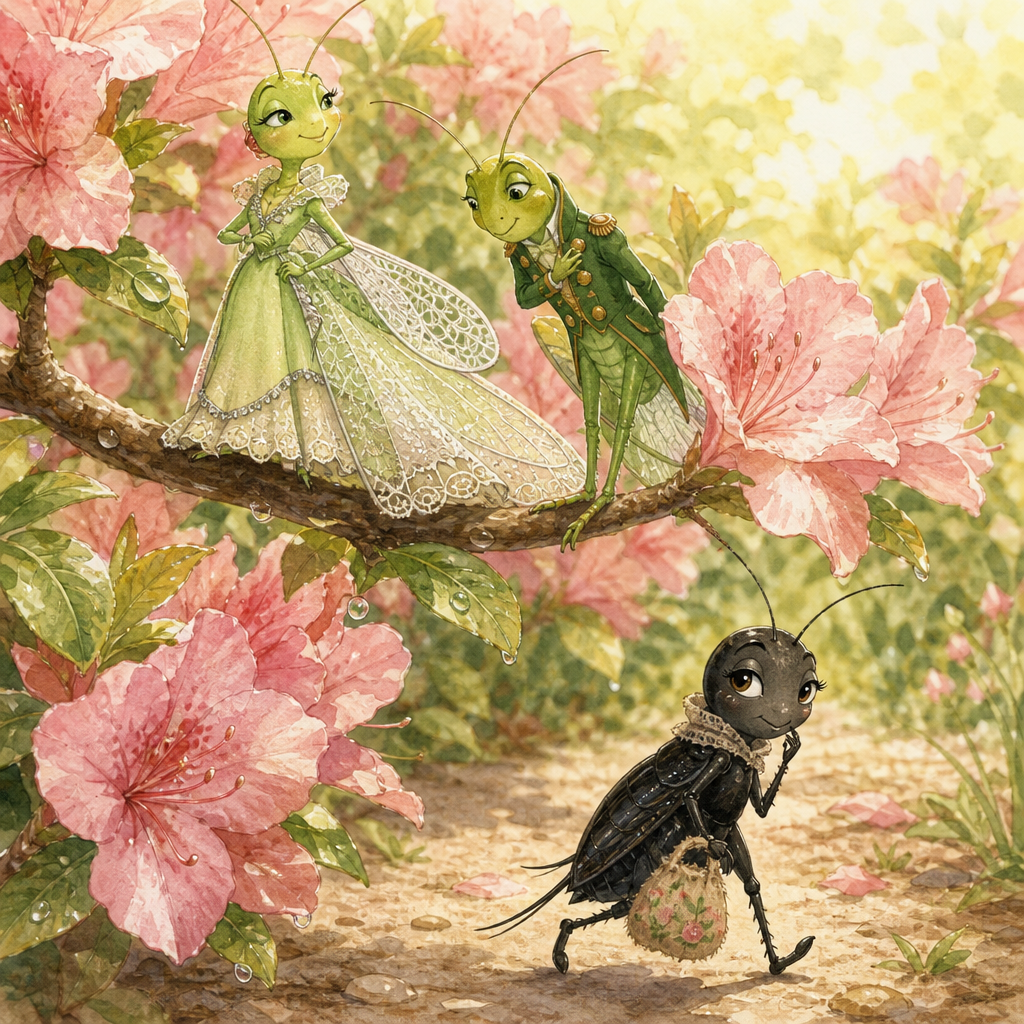
“They’re in great trouble,” said Miss Cricket. “Their stores are all destroyed, and their father was badly hurt by the hoe.”
“How shocking! I really don’t like to hear such disagreeable things. And I have nothing to give. Mamma said just yesterday that she didn’t know how our bills were to be paid, and my green satin with the point lace still has to come home,” said Miss Katy, with a shrug.
Little Miss Cricket hopped briskly away. “Poor, extravagant little thing,” she said to herself.
“Will you invite the Crickets?” asked the Colonel.
“Why, Colonel, what a question! Invite the Crickets? No, indeed.”
“And the Locusts and the Grasshoppers?”
“The Locusts, of course. A very old and fine family. And the Grasshoppers are well enough, and ought to be asked. But one must draw the line somewhere, and the Crickets! I can’t think of it.”
“I thought they were very nice, respectable people.”
“Oh, perfectly nice and respectable, but…”
“Do explain, my dear Katy.”
“Why, their color, of course. Don’t you see?”
“Oh,” said the Colonel. “That’s it, is it? And who decides which color is the reigning color?”
“What a question! The only true color, the only proper one, is ours. A lovely pea green is the shade on which to found an aristocratic distinction. Of course, we’re liberal. We mix with the Moths, who are gray, and the Butterflies, who are blue and gold, and the Grasshoppers, who are yellow and brown. Society would become dreadfully muddled if it weren’t for the fortunate fact that the Crickets are black as jet. A class to be looked down upon is necessary to all elegant society, and if the Crickets weren’t black, we couldn’t keep them down. Everybody knows they’re often a great deal cleverer than we are. They have a real talent for music and dancing, and they learn very quickly, and they’d be at the very top of the ladder if we let them climb. But so long as we are green and they are black, we have a superiority that can never be taken from us. Now do you see?”
“Oh, yes, I see exactly,” said the Colonel. “That Keziah Cricket, who just left, is quite a musician, you know. And her old father plays the violin beautifully. By the way, we might hire him for our orchestra.”
And so Miss Katy’s ball came off. It lasted from sundown to daybreak, and it seemed as if every leaf in the forest were alive. The Katy-Dids, the Mosquitoes, the Locusts, and a full orchestra of Crickets made the very air tremble.
Old Parson Too-Whit, the owl, was shocked at all the dancing, which the pleasure-loving Katy-Dids kept up night after night.
But around the first of September, the famous Jack Frost epidemic broke out. Poor Miss Katy, in her flimsy green satin and point lace, was one of the first to go, and she fell from the bough in a sad shower of last year’s leaves.
The sensible Cricket family, however, escaped Jack Frost by moving, just in time, to the chimney corner of a snug little cottage that had been built in the woods. There good old Mr. and Mrs. Cricket, with sprightly Miss Keziah and all her brothers and sisters, found a warm welcome. And when the storm howled outside and lashed the bare trees, the Crickets chirped from the hearth to the happy family inside.