
Percy Bysshe Shelley
Dive into Percy Bysshe Shelley’s poetry and discover the passionate voice of one of English Romanticism’s greatest poets — read free online, filter to find your favorites, and learn more about the author.
Percy Bysshe Shelley (1792–1822) was an English Romantic poet, widely regarded as one of the most significant lyric poets in the English language. Born in Sussex, England, he was a contemporary of Lord Byron and John Keats, and together they formed the second generation of Romantic poets. Shelley’s work is characterized by its radical political philosophy, intense idealism, and extraordinary command of poetic form. He died by drowning in the Gulf of Spezia, Italy, at the age of twenty-nine, leaving behind a body of work that punches far above its chronological weight.
Shelley was deeply engaged with questions of power, tyranny, freedom, and the relationship between humanity and the natural world. His poetry frequently challenges authority — political, religious, and social — and envisions a world transformed by love, reason, and imagination. He wrote across a wide range of forms, from the short lyric to the extended philosophical poem, always with a restless intellectual energy and a command of imagery that made the abstract feel viscerally present.
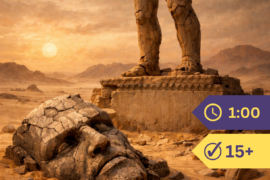
Among his most celebrated works is Ozymandias, a fourteen-line sonnet that delivers one of literature’s most concise and devastating meditations on the hubris of power. In it, a traveller describes the ruins of a colossal statue in a vast desert — a shattered visage, a pedestal bearing a boastful inscription — and nothing else but empty sand stretching in all directions. The poem dismantles the pretensions of earthly rulers with quiet, ironic precision, and its final image of desolation has become one of the most quoted passages in the English poetic tradition.
Beyond this single poem, Shelley’s broader catalogue includes major works such as Prometheus Unbound, a lyrical drama imagining liberation from tyranny; Ode to the West Wind, which uses the force of autumn wind as a metaphor for revolutionary and creative power; and Adonais, an elegy written in response to the death of John Keats. His prose work A Defence of Poetry remains an important document in the theory of literary imagination, arguing that poets are “the unacknowledged legislators of the world.”
Shelley’s place in literary history is secure not only because of the formal brilliance of individual poems but because his work consistently grappled with the largest questions of human existence. His influence extended well into the Victorian era and beyond, shaping later poets, political thinkers, and anyone who has wrestled with the question of what endures when power collapses into ruin.