
Lord Byron
Dive into Lord Byron’s complete poems and stories, read them online for free, filter to discover your favorites, or explore our article to learn more about the poet.
Lord Byron (1788–1824) was an English poet and one of the most prominent figures of the Romantic movement. Born George Gordon Byron in London, he inherited his title at the age of ten and went on to become one of the most celebrated — and controversial — literary figures of the nineteenth century. His work influenced poets and writers across Europe, and his personal reputation for rebellion and adventure made him as famous in his lifetime as his verse.
Byron studied at Harrow and Trinity College, Cambridge, before publishing his early collection Hours of Idleness in 1807. The sharp critical response to that volume prompted him to write the satirical English Bards and Scotch Reviewers, which established his combative literary voice. His longer works, including Childe Harold’s Pilgrimage and the unfinished epic Don Juan, brought him wide fame and cemented his place in the Romantic canon alongside Shelley and Keats.
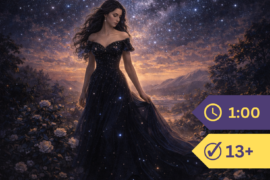
Byron’s lyric poems are perhaps his most immediately striking work, combining technical elegance with deep emotional clarity. She Walks in Beauty is one of the finest examples of this quality — written in 1814, it describes a woman of extraordinary grace, using the contrast of light and shadow as a metaphor for the harmony of her inner and outer character. The poem’s opening image, comparing her movement to “the night / Of cloudless climes and starry skies,” demonstrates Byron’s gift for finding grandeur in intimate observation.
Thematically, Byron’s poetry frequently explored beauty, desire, mortality, exile, and the tensions between liberty and constraint. His heroes — often brooding, defiant, and self-aware — gave rise to the literary archetype known as the “Byronic hero,” a figure whose influence extended well into Victorian fiction and beyond, shaping characters from Heathcliff in Brontë’s Wuthering Heights to Rochester in Jane Eyre.
Byron died in 1824 in Missolonghi, Greece, where he had travelled to support the Greek War of Independence — a cause he championed with both his pen and his fortune. He was thirty-six years old. His relatively short life produced a body of work that remains central to any study of English Romantic literature, and his lyric poems in particular continue to be read and anthologised worldwide.