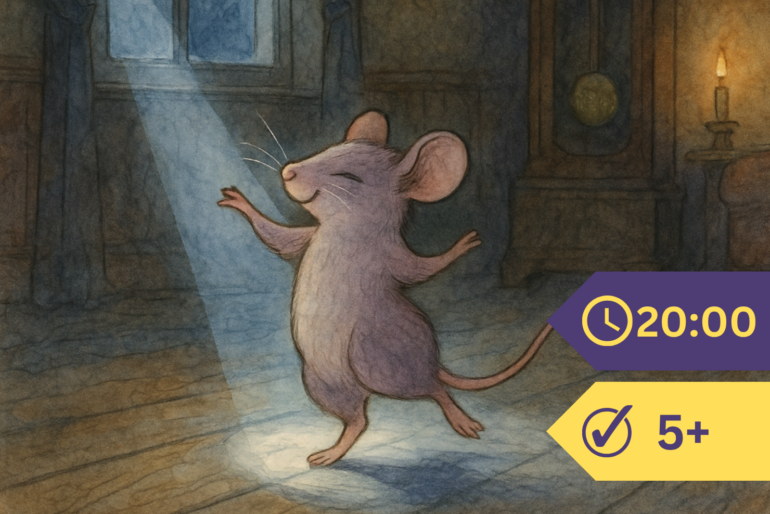
Whilst you were sleeping, little Dear-my-Soul, strange things happened; but had I not seen and heard them myself, I should never have believed them. The clock stood, of course, in the corner, a moonbeam floated idly on the floor, and a little mauve mouse came from the hole in the chimney corner and frisked and scampered in the moonlight. She was particularly merry — sometimes dancing on two legs and sometimes on four, but always very daintily and always very merrily.
“Ah, me!” sighed the old clock. “How different mice are nowadays from the mice we used to have in the good old times! Now there was your grandma, Mistress Velvetpaw, and your grandpa, Master Sniffwhisker — how grave and dignified they were! Many a night have I seen them dancing on the carpet below me, but always the stately minuet, never this crazy frisking you’re executing now, to my surprise — yes, and to my horror, too.”
“But why shouldn’t I be merry?” asked the little mauve mouse. “Tomorrow is Christmas, and this is Christmas Eve.”
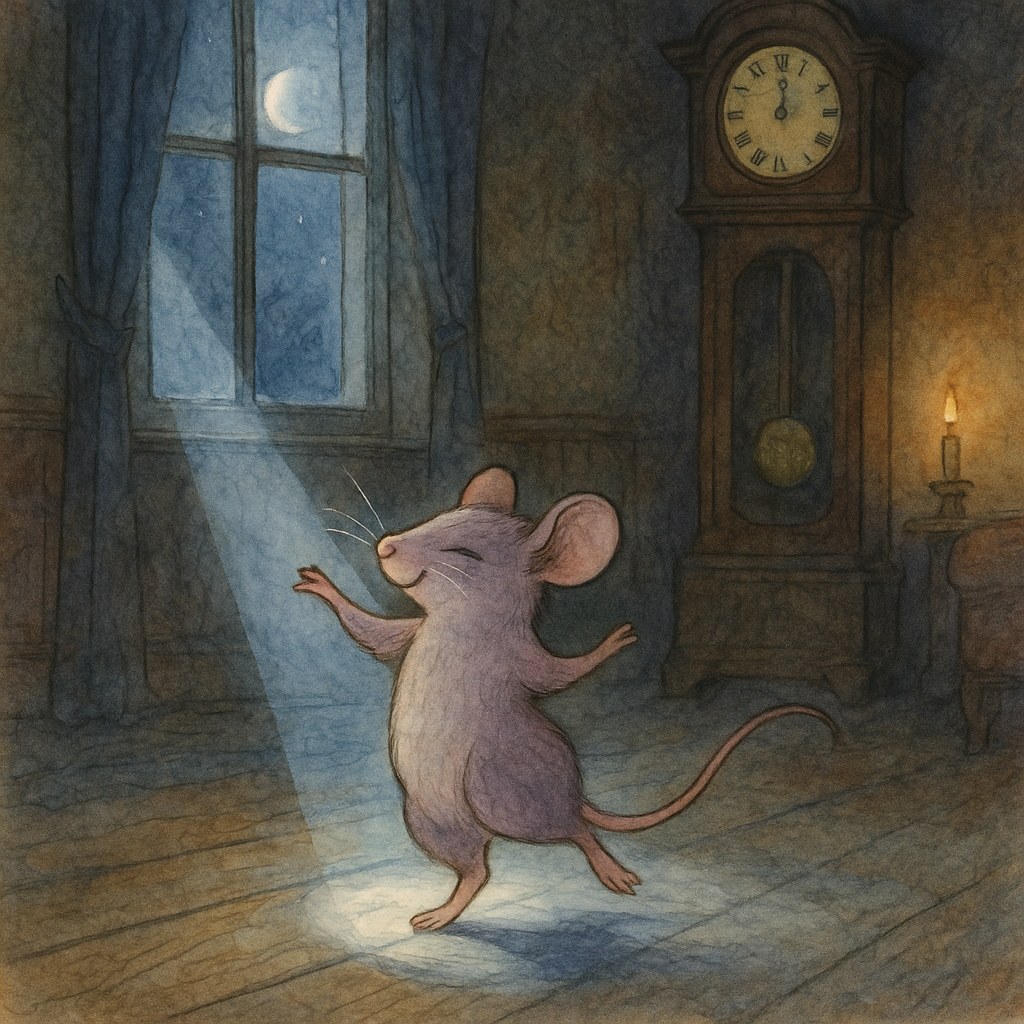
“So it is,” said the old clock. “I had quite forgotten. But tell me — what is Christmas to you, little Miss Mauve Mouse?”
“A great deal!” cried the little mauve mouse. “I have been very good for a very long time. I have not used any bad words, nor gnawed any holes, nor stolen any canary seed, nor worried my mother by running behind the flour barrel where that horrid trap is set. In fact, I have been so good that I’m quite sure Santa Claus will bring me something very pretty.”
This seemed to amuse the old clock mightily. She laughed so heartily that in an unguarded moment she struck twelve instead of ten, which was exceedingly careless and not to be commended.
“Why, you silly little mauve mouse,” said the old clock, “you don’t believe in Santa Claus, do you?”
“Of course I do,” answered the little mauve mouse. “Believe in Santa Claus? Why shouldn’t I? Didn’t Santa Claus bring me a beautiful butter cracker last Christmas, and a lovely gingersnap, and a delicious rind of cheese, and — and — lots of things? I should be very ungrateful to stop believing in him, and I certainly shan’t disbelieve at the very moment I’m expecting him to arrive with a bundle of goodies for me.
“I once had a little sister,” continued the little mauve mouse, “who did not believe in Santa Claus, and the very thought of her fate makes my blood run cold and my whiskers stand on end. She died before I was born, but my mother told me all about her. Her name was Squeaknibble, and she was one of those long, low, rangy mice that are seldom found in well-stocked pantries. Mother says Squeaknibble took after our ancestors who came from New England, where the cunning of the people and the ferocity of the cats made life very precarious indeed. Squeaknibble seemed to inherit their most conspicuous trait: a disposition to sneer at the most respected beliefs in mousedom. From her very infancy she doubted, for example, the widely accepted theory that the moon was composed of green cheese — and this was the first intimation her parents had of the sceptical turn of her mind.
“For a long time Squeaknibble would not believe there was any such thing as a cat; but she was convinced one memorable night, when she lost two inches of her beautiful tail and received so terrible a fright that her little heart beat so violently for a full hour afterward that it lifted her off her feet and bumped her head against the ceiling of our domestic hole. The cat that took those two inches was the same brindled creature that nowadays steals into this very room, crouches behind the sofa, and pretends to be asleep — hoping that one of us, forgetting her dreadful presence, will venture within reach of her claws. So furious was she at Squeaknibble’s escape that she ground her fangs together and vowed to take no pleasure in life until she held in her jaws the rest of the mouse to whom that mangled scrap of tail had belonged.”
“Yes,” said the old clock, “I remember it well. I was here in this very corner, and I laughed at the cat and chided her for her clumsiness. She told me that a clock’s duty was to run itself down, not to be criticising others! That cat’s tongue is quite as sharp as her claws.”
“Be that as it may,” said the little mauve mouse, “from that very moment the cat lived only to catch Squeaknibble. She waited and watched and hunted and schemed — everything a cruel cat could devise toward her murderous ends.
“One night — one fatal Christmas Eve — our mother had tucked the children into bed and urged them to sleep early, since Santa Claus was sure to come before morning. The little dears whisked their cunning tails, pricked up their beautiful ears, and began telling one another what they hoped he’d bring. One asked for Roquefort, another for Neufchâtel, another for Sap Sago, a fourth for Edam; one favoured Brie, another hoped for Parmesan; one clamoured for imperial blue Stilton, and another craved Caprera. There were fourteen little ones with fourteen opinions, yet complete unanimity on one point: the gift should be cheese.
“‘My dears,’ said our mother, ‘what does it matter whether Santa Claus brings English cheddar or Vermont sage or Herkimer County skim-milk? We should be content with whatever he bestows — so long as it is cheese, free from traps, unmixed with poison, and untainted with glass or any other harmful ingredient. As for myself, a cut of nice fresh Western Reserve will do very well. So off to sleep with you, that Santa Claus may find you dreaming.’
“The children obeyed — all but Squeaknibble. ‘Let the others think what they please,’ she said, ‘but I don’t believe in Santa Claus. I’m not going to bed either. I’m going to creep out and have a quiet romp by myself in the moonlight.’ Oh, what a vain, foolish little mouse! But I will not reproach the dead — her punishment came all too swiftly.
“Now: who do you suppose overheard her speaking so disrespectfully of Santa Claus?”
“Why, Santa Claus himself,” said the old clock.
“Oh, no,” answered the little mauve mouse. “It was that wicked cat. Just as misfortune lurks for bad children, the cruel cat lurks for naughty little mice. And when she heard Squeaknibble mock the coming of Santa Claus, her eyes glowed with joy, her sharp teeth watered, and her bristling fur crackled with electricity. Then — what did that crafty monster do but scuttle into Dear-my-Soul’s room, leap into the crib, and walk off with the pretty little white muff Dear-my-Soul used to wear when she visited the little girl next door! What could a cat possibly want with a little white muff? Ah, the cunning of it! Listen.
“That wretched cat crawled through the muff just far enough to leave her four cruel legs free.”
“Yes, I understand,” said the old clock.
“Then she put on the boy doll’s fur cap,” said the little mauve mouse, “and when she was dressed in the fur cap and the white muff, she didn’t look like a cat at all. But whom did she look like?”
“Like the boy doll,” suggested the old clock.
“No, no!” cried the little mauve mouse.
“Like Dear-my-Soul?” asked the old clock.
“How slow you are!” exclaimed the little mauve mouse. “Why, she looked like Santa Claus, of course!”
“Oh — yes, I see now,” said the old clock. “Go on.”
“Alas,” sighed the little mauve mouse, “not much remains to be told; but there is more of my story left than there was of Squeaknibble when that horrid cat crept back out of her disguise. Squeaknibble, you see, had ignored her mother’s good advice and come gambolling out across this very carpet, in this very moonlight.”
“I do not know,” said the moonbeam faintly. “I am so very old, and I have seen so many things — I do not know.”
“She had just turned a double back somersault,” continued the little mauve mouse, “when all of a sudden she saw, looming up like a white ghost, a figure all in white fur! Oh, how her little heart did beat! ‘Purr, purr-r-r,’ said the figure. ‘Oh, please don’t hurt me!’ pleaded Squeaknibble. ‘No, I’ll not hurt you,’ said the ghost in white fur. ‘I’m Santa Claus, and I’ve brought you a beautiful piece of savory old cheese, you dear little mousie, you.’
“Poor Squeaknibble was deceived. A sceptic all her life, she was finally taken in by the most fatal of frauds. ‘How kind of you!’ said Squeaknibble. ‘I didn’t believe there was a Santa Claus, and—’ but before she could say more, two sharp claws seized her and conveyed her to the murderous jaws of mousedom’s most malignant foe. I cannot dwell longer on that harrowing scene. Suffice it to say that before the next morning’s sun rose over the spot where the tragedy had occurred, poor Squeaknibble had passed to that realm where two inches of her beautiful tail had preceded her by exactly three weeks and a day. As for Santa Claus, when he came that Christmas Eve bringing morsels of Brie and Stilton for the other little mice, he heard with sorrow of Squeaknibble’s fate — and ere he departed he said that in all his experience he had never known of a mouse or a child that had come to any good after saying there was no Santa Claus.”
“Well, that is a remarkable story,” said the old clock. “But if you believe in Santa Claus, why aren’t you in bed?”
“I shall be presently,” answered the little mauve mouse, “but I must have my scamper, you know. It is very pleasant to frolic in the moonlight — only I cannot understand why you are always so cold and so solemn and so still, you pale, pretty little moonbeam.”
“I do not know that I am so,” said the moonbeam. “But I am very old, and I have travelled many, many leagues, and I have seen wondrous things. Sometimes I toss upon the ocean, sometimes I fall upon a sleeping flower, sometimes I rest upon a dead child’s face. I see the fairies at their play and hear mothers singing lullabies. Last night I swept across the frozen bosom of a river, and a woman’s face looked up at me — the picture of eternal rest. ‘She is sleeping,’ said the frozen river. ‘I rock her to and fro and sing to her. Pass gently by, O moonbeam, lest you waken her.'”
“How strangely you talk,” said the old clock. “Now, I’ll warrant you know many a Christmas tale. Tell us one, to pass this night of Christmas watching.”
“I know but one,” said the moonbeam. “I have told it over and over again, in every land and every home, yet I never weary of it. It is very simple. Shall you like to hear it?”
“Indeed we should,” said the old clock, “but let me first strike twelve, so I needn’t interrupt you.”
When the old clock had performed this duty with somewhat more than usual alacrity, the moonbeam began its story:
“Once upon a time — so long ago that I cannot tell you how long — I fell upon a hillside in a far distant country. Although it was Christmas time, there was no snow: flowers bloomed all year round, and at all times the lambs found pleasant pasture on the slopes. The night wind was warm and fragrant with cedar. There were violets on the hillside, and I fell among them and lay there. I kissed them, and they woke. ‘Ah, is it you, little moonbeam?’ they said, and they nestled in the grass the lambs had left uncropped.
“A shepherd lay asleep upon a broad stone; above him spread an old gnarled olive tree, swaying its dark branches in the night air. The shepherd’s name was Benoni. Wearied with long watching, he had fallen into a deep sleep; his crook had slipped from his hand. The flock slept too, all across the hillside, and I had counted them again and again, stealing across their gentle faces to bring them pleasant dreams of green pastures and cool streams. I had kissed old Benoni as well, and in his dreams he seemed to see Israel’s promised King come to earth — and in his dreams he murmured the Messiah’s name.
“‘Ah, is it you, little moonbeam?’ said the violets. ‘You have come in good time. Nestle here with us, and see wonderful things come to pass.’
“‘What wonderful things?’ I asked.
“‘The old olive tree was telling us of them,’ said the violets. ‘Do not sleep tonight, little violets, for this is Christmas night, and the Master shall walk upon the hillside at the midnight hour.’ So we waited and watched; one by one the lambs fell asleep; one by one the stars came out; the shepherd nodded and crooned, and crooned and nodded, and at last he too slept, and his crook slipped from his hand. Then we called to the old olive tree, asking how soon midnight would come; but all it answered was ‘Presently, presently,’ and at last even we fell asleep, lulled by the rocking of the old olive’s branches.
“‘But who is this Master?’ I asked when I woke.
“‘A child — a little child,’ said the violets. ‘He is called the little Master by the others. He comes here often and plays among the flowers of the hillside. Sometimes the lambs, gambolling carelessly, have crushed and bruised us so that we lay bleeding and were like to die; but the little Master heals our wounds and refreshes us again.’
“I marvelled much at this. ‘The midnight hour is at hand,’ said I, ‘and I will stay with you to see this little Master.’ So we nestled among the grass and wildflowers, and sang songs to one another.
“‘Come away!’ called the night wind. ‘I know a beautiful sea not far from here, and I will carry you out over the waves into the mist and clouds, if you will come with me.’
“But I hid under the violets and the tall grass, that the night wind might not tempt me away. ‘Ho, there, old olive tree!’ cried the violets. ‘Do you see the little Master coming? Is not the midnight hour at hand?’
“‘I can see the town yonder,’ said the old olive tree. ‘A star burns bright over Bethlehem, the iron gates swing open, and the little Master comes.’
“Two children came to the hillside. The elder was Dimas, the son of Benoni — rugged and strong, a goatskin over his brown shoulders, his long dark curly hair loose under a leather cap. The other child was he they called the little Master; his slender form was wrapped in raiment white as snow, and around a face of heavenly innocence fell curls of golden yellow. So beautiful a child I had not seen before, nor have I since. And as they came together to the hillside, a soft white light seemed to glow about the little Master’s head, as if the moon had sent her tenderest beams to kiss those golden curls.
“‘What sound was that?’ cried Dimas, for he was very frightened.
“‘Have no fear, Dimas,’ said the little Master. ‘Give me your hand, and I will lead you.’
“Presently they came to the rock where Benoni lay sleeping, and they stood under the old olive tree. The old olive swayed no longer in the night wind but bent its branches reverently in the presence of the little Master. The wind too seemed to stop just then; a solemn hush fell over everything, and the only sound was the shepherd murmuring the Messiah’s name in his dreams.
“‘Your father sleeps,’ said the little Master, ‘and it is well; for because I love you, Dimas, and because you shall walk with me in my Father’s kingdom, I would show you the glory of my birthright.’
“Then all at once sweet music filled the air, and a light greater than daylight blazed across the sky and fell upon the whole hillside. The heavens opened, and angels, singing joyous songs, walked down to earth. More wondrous still, the stars themselves fell from their places and clustered upon the old olive tree, swinging like coloured lanterns from its branches. The flowers of the hillside all awakened, and they too danced and sang. The angels came and hung gold and silver and jewels upon the old olive among the stars, until the glory of that sight was beyond anything I have ever seen, before or since. When Dimas heard and saw all this, he fell upon his knees; and catching the hem of the little Master’s garment, he kissed it.
“‘Greater joy than this shall be yours, Dimas,’ said the little Master. ‘But first must all things be fulfilled.’
“All through that Christmas night did the angels come and go with their sweet anthems; all through that night did the stars dance and sing; and when it came my time to steal away, the hillside was still beautiful with the glory and the music of heaven.”
“Well — is that all?” asked the old clock.
“No,” said the moonbeam, “but I am nearly done. The years went on. Sometimes I tossed upon the ocean, sometimes I crossed a battlefield, sometimes I lay upon a dead child’s face. I heard the voices of darkness and mothers’ lullabies and sick men’s prayers — and so the years went on.
“I fell one night upon a hard and furrowed face, of ghostly pallor. A man was dying on a cross, and this was his face. About the cross stood men with staves and swords and spears, but none paid heed to him. A little beyond, another cross was raised, and upon it a body my light fell not upon. But I heard a voice I had heard somewhere before — though where, I could not say — and this voice blessed those who mocked and jeered and shamefully ill-used him. And suddenly the voice called out: ‘Dimas, Dimas!’ And the man whose face I shone upon made answer.
“Then I saw that it was Dimas — yet to this wretched man there remained little of the shepherd boy I had seen in all his innocence upon the hillside. Long years of hard and sinful living had left their marks on him. Yet now, at the sound of that familiar voice, something of the old boyish look returned, and in the yearning of those anguished eyes I seemed to see the shepherd’s son once more.
“‘The Master!’ cried Dimas, and he stretched his neck to see who spoke.
“‘O Dimas, how art thou changed!’ cried the Master — yet there was in his voice no reproach, only the grief that comes of love.
“Then Dimas wept, and in that hour he forgot his pain. And the Master’s presence there, and his consoling voice, worked such a change in the dying man that when at last his head fell upon his chest and the men about the cross said he was dead, it seemed to me that I shone not upon a criminal’s face but upon the face of the gentle shepherd boy, Benoni’s son.
“And shining on that dead and peaceful face, I remembered what the little Master had said long ago under the old olive tree on the hillside. ‘Your eyes behold the promised glory now, O Dimas,’ I whispered. ‘For with the Master you walk in Paradise.'”
Ah, little Dear-my-Soul, you know — you know what the moonbeam meant. The shepherd’s bones are dust, the flocks are scattered, the old olive tree is gone, the hillside flowers are withered, and none knows where the grave of Dimas was made. But last night, again, a star shone over Bethlehem, and the angels came down from the sky to earth, and the stars sang together in glory. And the bells — hear them, little Dear-my-Soul, how sweetly they are ringing — the bells bring us the good tidings of great joy this Christmas morning: that Christ is born, and that with him he brings peace on earth and goodwill toward all people.