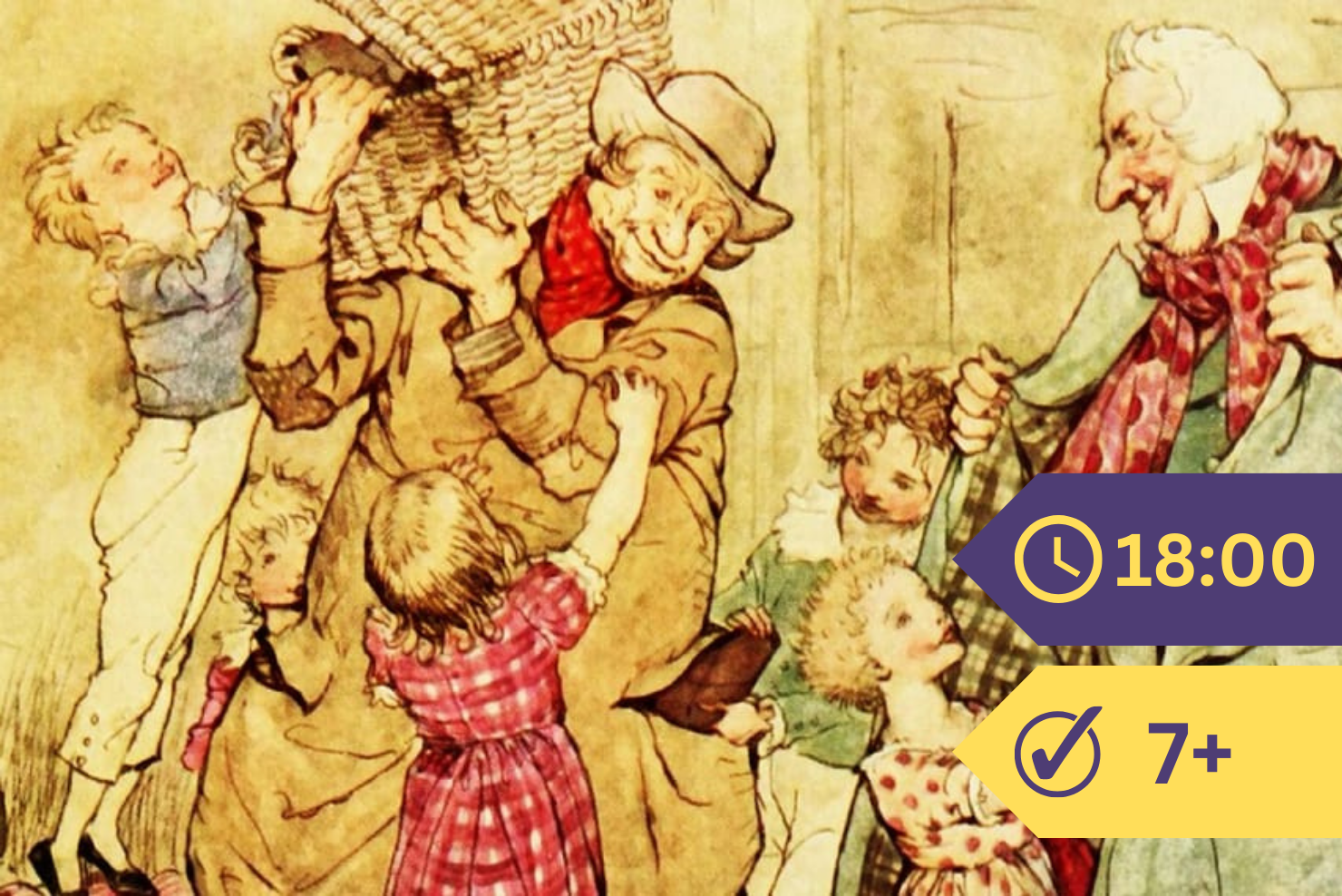
Henrietta, Roland, and Frank were spending the holidays at Grandmother’s house. Among the many gifts the children had received was a book full of pictures for Henrietta, and her brown head was bent over it very earnestly. After studying one picture for a good ten minutes, she looked up.
“‘Bringing in the Yule log’ — what does that mean, Grandmother?”
“It was an old English custom,” Grandmother said. “On the last day of the Christmas holidays, a log would be cut from the largest tree in the park. Then, the following Christmas Eve, it was dragged inside and laid across the great iron rests on either side of the wide hearth. The people who carried it in would sing a carol as they came:
Come bring, with a noise,
My merry, merry boys,
The Christmas log to the firing.
“Then it was lit with a piece of wood saved from last year’s Christmas fire, and by the glow of that huge Yule log the whole hall would fill with a warm, rosy light.”
“How perfectly lovely!” cried Roland, scrambling up onto Grandmother’s lap and giving her a quick hug, while Henrietta and Frank drew close with eager faces.
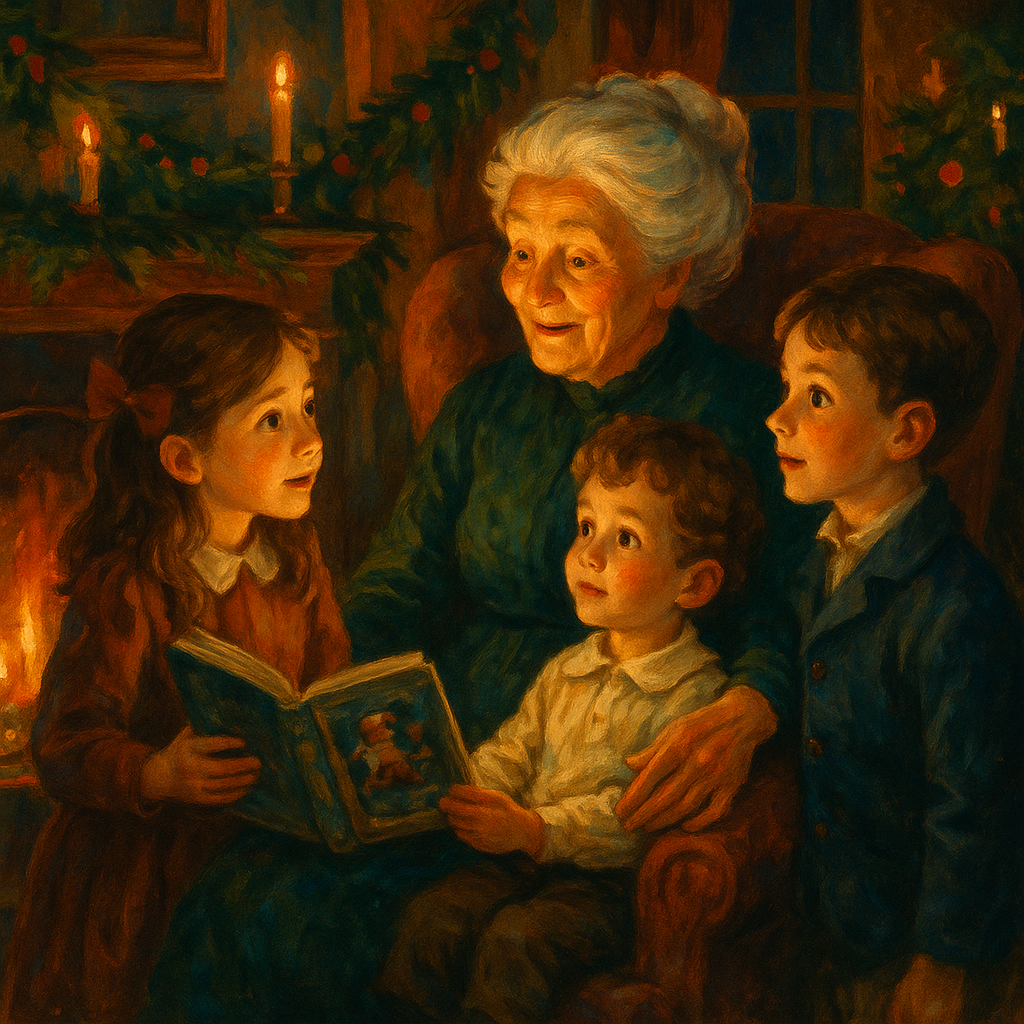
“Please tell us more! Won’t you tell us a story,” said Henrietta — “about Christmas, or New Year’s?”
“And make it begin with ‘When I was a little girl,'” added Roland.
“That’s just like Roland,” laughed Frank. “He always wants a story to start with ‘When I was a little girl’ — or boy — instead of ‘Once upon a time.'”
“Well then,” said Grandmother, smiling at their three satisfied nods, “suppose I begin, ‘Once upon a time, when I was a little girl.'”
“Once upon a time, when I was a little girl, I spent the holidays with my parents in England, visiting some dear friends. Their daughter, Elsie, was about my own age, and she had two cousins staying with her — Gretchen, from Germany, and Adele, from France.
“On Christmas Eve, the four of us fell into quite an argument. Elsie and I were certain that Santa Claus, with his sleigh and reindeer, would soon come prancing over the rooftops — though I worried the steep peaks of the roof might make it hard for him to reach the chimney safely.
“‘No, no,’ said Gretchen. ‘It’s St. Nicholas who brings the gifts. He rides on a white horse, carrying a basket of toys on one arm for the good children — and in his other hand, a bundle of switches for the naughty, disobedient ones!’
“‘But our presents,’ said Adele, ‘usually come on New Year’s Eve, not at Christmas. They’re brought by a young maiden dressed all in white, with long white hair flowing over her shoulders and a golden crown set with glowing candles. In one hand she holds a silver bell, and in the other a basket of sweets.’
“Well! In the end we decided we had better not quarrel about it at all — for fear that bundle of switches might be left for us. So Elsie, Adele, and I hung up our stockings. Gretchen knelt before the wide fireplace and held out her little apron, asking St. Nicholas to drop a pretty gift into it. Then she polished her little shoes until they shone, filled them with oats for St. Nicholas’s white horse, and set them carefully by the hearth.
“While we were busy with all this, we suddenly heard the blast of a horn.
“‘Hark!’ said Elsie. ‘There are the Mummers!’ She ran to the window, and we followed, curious and a little frightened. But in the moonlight we saw only six figures in strange, colourful costumes. They were the Mummers, Elsie explained — players who went from house to house on Christmas Eve, and wherever they were welcomed in, they’d put on a funny little play. Elsie’s father invited them inside and shared the best of what the house had to offer, just as was the custom in those days.
“‘Were the oats all gone from Gretchen’s shoes?’ Roland interrupted — his mind, clearly, still on the white horse rather than the Mummers.
“Yes! When the Christmas bells rang out their silvery chimes on Christmas morning, we all leapt up and ran downstairs — to find the little shoes filled with toys and sweets, and our stockings so stuffed they’d lost the shape of stockings altogether.
“After breakfast we were led into a room wreathed all around with evergreen, smelling sweet and fresh and green — and there, to our astonished eyes, stood a beautiful Christmas tree! It had all been arranged so quietly that not one of us had suspected a thing.
“Then the kind mistress of the house sent out generous parcels of food to the poor families nearby, and she asked each of us to share some of our own gifts with children who had less — so that we, too, might feel how happy giving can make you, not just receiving.
“Do you know, my dears,” Grandmother went on, “that the Christmas tree first came to us from Germany, and the Christmas stocking from Belgium? And that ‘Merry Christmas and Happy New Year’ is the old English greeting people used to shout from window to street and street to window? Wherever these customs began, they’re all part of one beautiful idea: letting go of old grudges along with the old year, and beginning the new one with kindness and goodwill toward everyone.
“So when the bells ring out the old year and ring in the new, this is Grandmother’s wish for you: that you’ll notice your own little faults, and — with the help of everyone who loves you — work to overcome them before they grow too strong. And now, my dears, since you’ve had a merry, merry Christmas, may you have a very Happy New Year!”