
William Elliot Griffis
Dive into William Elliot Griffis’s complete collection of folk tales and fairy stories — read them online for free, filter to discover your favorites, or explore our article to learn more about the author.

William Elliot Griffis (1843–1928) was an American author, educator, and clergyman with a remarkably wide literary and scholarly reach. Born in Philadelphia, he is perhaps best known for his extensive writings on Japan and the Netherlands, two countries he studied with deep personal interest. His long career produced histories, biographies, and collections of folk tales that drew on his travels, his research, and his genuine fascination with the myths and traditions of other cultures.
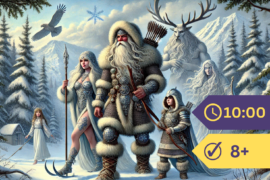
Griffis had a particular gift for retelling the legends and folklore of northern Europe in a way that made them accessible to younger readers without stripping away their cultural texture. His stories often drew on pre-Christian traditions, the natural world, and the kind of wonder that characterized older oral storytelling. In The Ice King and His Wonderful Grandchild, he reaches back to a time when the peoples of northern Europe worshipped nature spirits as gods, weaving together mythology and landscape into a tale of elemental forces. The story reflects his broader interest in how ancient beliefs shaped the cultures he studied.
His connection to the Netherlands also informed his storytelling in meaningful ways. Griffis spent time in Japan as an educator during the Meiji era, but the Dutch influence on Japan — and his admiration for Holland itself — ran throughout much of his writing life. Why the Stork Loves Holland is a gentle folk tale that captures the spirit of the Dutch landscape — its dikes, windmills, and migratory birds — and explains a beloved natural phenomenon through the lens of legend. It is the kind of story that sits comfortably alongside traditional European fairy tales while carrying Griffis’s own scholarly warmth.
Griffis published widely across his lifetime, contributing to American understanding of Japan, Korea, and the Low Countries at a time when such knowledge was rare among general readers. His folk tale collections remain a testament to his belief that the stories a people tell about their world reveal something essential about their character and history.