
William Butler Yeats
Dive into William Butler Yeats’s poems and visionary verse collected in one place — read them online for free, filter to discover your favorites, or explore our article to learn more about the author.
William Butler Yeats (1865–1939) was an Irish poet and playwright, widely regarded as one of the most significant literary figures of the twentieth century. Born in Dublin, he was a central figure in the Irish Literary Revival — a cultural movement that sought to celebrate and revitalize Irish folklore, mythology, and national identity through literature. In 1923, he became the first Irish writer to be awarded the Nobel Prize in Literature, a recognition of his profound influence on modern poetry.
Yeats’s work is marked by a deep engagement with mysticism, symbolism, and the occult, alongside a passionate interest in Irish legend and folklore. His poetry evolved considerably over the decades: early work drew heavily on Romantic imagery and Celtic mythology, while his later verse grew more spare, complex, and philosophical. Throughout his career, he developed an elaborate personal mythology — partly laid out in his prose work A Vision — that underpinned much of his symbolic imagery, including recurring motifs of cycles, spiritual longing, and historical transformation.
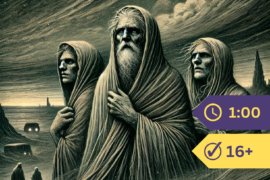
Among the poems collected here, The Magi offers a characteristic example of Yeats’s mature symbolic imagination. The poem depicts the biblical Magi — the wise men of Christian tradition — as restless, unsatisfied figures drifting perpetually through the sky, their ancient faces worn by longing. Rather than treating the Nativity as a moment of fulfilment, Yeats presents it as inadequate to the Magi’s deeper spiritual hunger, suggesting that no single historical event can satisfy the soul’s craving for transcendence. It is a quietly unsettling poem, compact in form but vast in implication.
Yeats spent much of his life between Ireland and England, was a senator of the Irish Free State in his later years, and remained a prolific writer until his death in 1939 in France. His body was later reinterred at Drumcliff in County Sligo — a landscape that had shaped his imagination from childhood. His work continues to be studied as a cornerstone of both modernist literature and the Irish literary tradition.