
William Allingham
Dive into William Allingham’s poems and short verse, read them online for free, filter to discover your favorites, and explore our article to learn more about the author.
William Allingham (1824–1889) was an Irish poet born in Ballyshannon, County Donegal. He is best remembered for his lyrical verse rooted in Irish folklore, landscape, and imagination. Although he spent much of his adult life in England and moved in distinguished literary circles — counting Alfred Lord Tennyson and Dante Gabriel Rossetti among his close acquaintances — his poetry remained deeply connected to the landscapes and traditions of his Irish homeland.
Allingham’s work spans a broad range, from light domestic verse to darker poems steeped in supernatural folk tradition. He had a particular gift for capturing the uncanny atmosphere of Irish legend, blending vivid imagery with a ballad-like simplicity. His most celebrated poem, “The Fairies” (beginning “Up the airy mountain”), became widely known for its rhythmic charm and its portrayal of the fairy world as both alluring and dangerous. This tension between beauty and menace runs through much of his poetry.
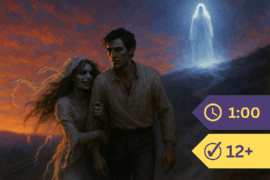
That same tension is powerfully present in The Witch-Bride, a compact and striking poem in which a young man takes a fair witch as his bride, only for a ghostly visitation to reveal the true, unsettling nature of his choice. The poem is characteristic of Allingham’s ability to compress folk-horror into a handful of vivid lines, using light and shadow — the “snowy light” that floods the room — to heighten a sense of dread and revelation.
Allingham edited Fraser’s Magazine from 1874 and published several collections of poetry throughout his life, including Poems (1850) and Songs, Ballads, and Stories (1877). His diary, published posthumously, offers a valuable record of Victorian literary life. Though his reputation has fluctuated over the decades, Allingham is recognised as a significant figure in nineteenth-century Irish poetry, one who helped preserve and transmit folk traditions through the medium of formal verse.