
Wilfred Owen
Dive into Wilfred Owen’s complete poems and discover the voice that defined First World War poetry — read them online for free, filter to find your favorites, and explore our article to learn more.
Wilfred Owen (1893–1918) was an English poet whose work stands as some of the most direct and affecting writing to emerge from the First World War. Born in Oswestry, Shropshire, Owen served as an officer in the British Army and experienced frontline combat on the Western Front. He was killed in action on 4 November 1918, just one week before the Armistice. He was 25 years old.
Owen is best known for poems that confronted the realities of trench warfare with unflinching clarity. He was a close friend and protégé of fellow poet Siegfried Sassoon, whose influence helped Owen sharpen his satirical edge and deepen his technical craft. Owen developed a distinctive use of pararhyme — also called half-rhyme or slant rhyme — in which the consonants of paired words match but the vowels differ, creating an unsettled, dissonant effect that mirrors the psychological disorientation of war. Most of his best-known work was composed in a concentrated period between 1917 and 1918.
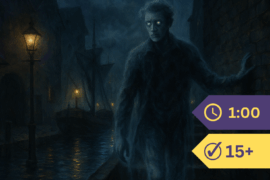
Owen’s poetry ranges across the personal, the political, and the ghostly. His verse frequently inhabits liminal spaces — the border between life and death, the gap between the home front’s patriotic rhetoric and the soldier’s lived experience. Shadwell Stair offers a striking example of this quality: a speaker who identifies as a ghost and yet possesses a body, wandering the wharves and dark passages of the Thames, caught between presence and absence. The poem reflects Owen’s interest in the uncanny and in London’s atmospheric, shadowed geography, and it stands somewhat apart from his war poetry in its symbolist, almost dreamlike register.
During his lifetime, Owen published only a handful of poems. The bulk of his work appeared posthumously, edited initially by Sassoon and later in more complete form by Edmund Blunden. Owen’s reputation grew steadily through the twentieth century, and his poetry became central to how later generations understood and memorialized the human cost of the First World War. His work is now a cornerstone of the English literary canon and is widely studied in schools and universities across the world.