
Thomas Bulfinch
Dive into Thomas Bulfinch’s complete mythology retellings and legendary tales — read them online for free, filter to discover your favorites, and explore our article to learn more.

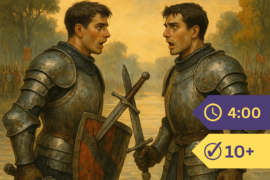
Thomas Bulfinch (1796–1867) was an American author best known for making the myths and legends of the ancient world accessible to a general reading public. Born in Newton, Massachusetts, he spent much of his adult life working as a clerk at the Merchants’ Bank in Boston, writing in his spare time. Although he never achieved financial success through his writing during his lifetime, his works went on to become foundational references in the study of classical mythology in the English-speaking world.
Bulfinch is most celebrated for a trilogy of books published in his later years: The Age of Fable (1855), The Age of Chivalry (1858), and Legends of Charlemagne (1863). Together these volumes are commonly referred to as Bulfinch’s Mythology. His stated aim was to bring the stories of Greek and Roman gods, Arthurian knights, and medieval heroes to readers who had no formal classical education, presenting them in clear, readable prose without requiring knowledge of Latin or Greek.
His retellings draw on a wide range of ancient and medieval sources, weaving together narratives of gods, heroes, monsters, and mortal men. Readers encounter the labors of Hercules, the wanderings of Odysseus, the tragedy of Pyramus and Thisbe, and the quests of King Arthur’s knights — all rendered in a straightforward, dignified prose style that respects the gravity of the original material while remaining approachable. Bulfinch also incorporated generous quotations from English poets such as Milton, Keats, and Tennyson, connecting classical mythology to the literary tradition his readers would have recognized.
Bulfinch’s work arrived at a moment when American and British readers had a growing appetite for cultural self-improvement, and his mythology compendium filled a genuine gap. It became a standard household reference and was widely used in schools and universities throughout the late nineteenth and early twentieth centuries. Literary figures, artists, and educators regularly cited it as an introduction to the mythological allusions that saturate Western literature and art.
Though later scholars have pointed out that Bulfinch sometimes simplified or softened his sources — particularly where ancient texts contained content he considered unsuitable for a Victorian audience — his contribution to the popularization of classical mythology remains significant. His books helped shape how generations of English-speaking readers first understood figures like Zeus, Achilles, Merlin, and Roland, and his name became so closely associated with the subject that “Bulfinch’s Mythology” is still in print and widely referenced more than 150 years after its first publication.