
Stephen Leacock
Dive into Stephen Leacock’s complete short stories and humorous sketches — read them online for free, filter to discover your favorites, or explore our article to learn more.


Stephen Leacock (1869–1944) was a Canadian writer, economist, and humorist widely regarded as one of the most prominent English-language comic writers of the early twentieth century. Born in England and raised in Canada, he spent much of his career as a professor of economics at McGill University in Montreal while simultaneously producing a large body of satirical and humorous literature. His 1910 collection Literary Lapses and the celebrated Sunshine Sketches of a Little Town (1912) established his reputation as a sharp, affectionate observer of everyday Canadian life.
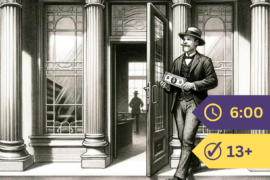
Leacock’s humor is grounded in character and situation rather than wordplay alone. He had a keen eye for social awkwardness, institutional absurdity, and the quiet indignities of middle-class life. This sensibility is on full display in My Financial Career, one of his most celebrated sketches, in which a nervous young man’s simple errand to open a bank account spirals into a comedy of misunderstanding and self-defeat. The piece is compact, precise, and still remarkably funny — a perfect example of how Leacock could locate universal anxiety in a mundane situation.
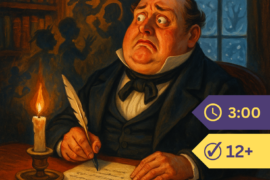
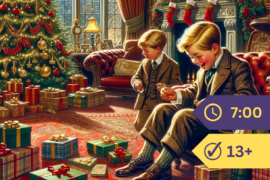
A recurring subject in Leacock’s work is the Christmas season, which he approached with a blend of warmth and gentle cynicism. In Merry Christmas, Father Time himself appears to correct the narrator’s jaded outlook on the holiday, offering a quietly philosophical counterpoint to seasonal grumbling. The Errors of Santa Claus takes a more farcical route, following the logistical confusion that ensues when two well-meaning fathers attempt to coordinate Christmas gifts for their children. And Hoodoo McFiggin’s Christmas presents the holiday from a child’s deeply disappointed perspective, skewering the gap between the magical promise of Christmas morning and the practical gifts actually received.
Across these works, Leacock demonstrates a consistent interest in the distance between expectation and reality — in social rituals that never quite deliver what they promise, and in the small embarrassments that reveal human nature with startling clarity. His prose is economical and conversational, designed to read as though told aloud by a wry, knowing friend. Leacock’s influence on North American humor writing has been substantial, and his shorter pieces in particular remain models of the comic sketch form. He was awarded the Lorne Pierce Medal by the Royal Society of Canada in 1937, and the Stephen Leacock Medal for Humour — awarded annually in Canada since 1947 — was established in his honor.