
Robert Herrick
Dive into Robert Herrick’s complete poems and verses — read them online for free, filter to discover your favorites, or explore our article to learn more about the author.


Robert Herrick (1591–1674) was an English lyric poet of the seventeenth century, widely regarded as one of the finest practitioners of the short lyric form in the English language. A contemporary of John Milton and Ben Jonson — the latter being a significant literary influence — Herrick was ordained as an Anglican minister and spent much of his adult life as a vicar in Devonshire. His major collection, Hesperides (1648), gathered over 1,400 poems and stands as one of the most substantial single-author poetry collections of the early modern period.
Herrick’s poetry is notable for its dual preoccupations: the pleasures and rituals of rural English life on one hand, and classical themes of love, beauty, and the passage of time on the other. He drew heavily on the traditions of ancient Greek and Latin lyric poetry, particularly the work of Horace, Catullus, and Ovid, while grounding his subjects firmly in the English countryside he observed around him in Devon. His verse tends to be compact, musical, and technically precise, favouring short stanzas and crisp rhyme schemes.
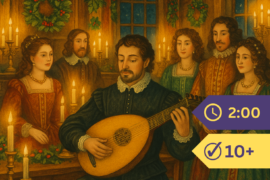
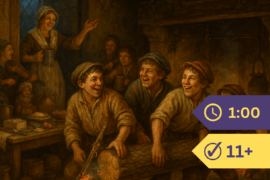
Among the poems collected here, Ceremonies For Christmas illustrates Herrick’s deep interest in English folk customs and seasonal ritual. The poem catalogues the traditional rites of the Christmas season — the lighting of the Yule log, the decoration of the house, and communal feasting — with an attention to domestic detail that feels almost anthropological. Herrick was one of the earliest poets to document these customs seriously, and his verses on seasonal celebration remain an important record of seventeenth-century English rural life.
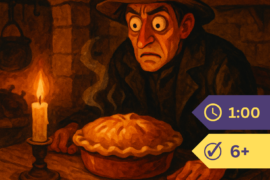
His fascination with folklore extends equally to its darker corners. The Hag depicts a witch riding out on a stormy night, drawing on the rich tradition of English witchcraft lore that was very much alive in Herrick’s era. The poem moves with an unsettling, galloping rhythm that suits its subject, and it reflects the same close attention to popular belief and superstition that runs throughout Hesperides. Herrick treated folk magic and country ritual not with ridicule but with a kind of matter-of-fact curiosity, recording them as authentic features of the world he inhabited.
Though Herrick’s reputation faded for a period after the seventeenth century, his work was substantially rediscovered in the nineteenth century and has held a firm place in the English literary canon since. His shorter lyrics — particularly those on the themes of carpe diem, nature, and ceremony — continue to be studied as exemplary models of the English lyric tradition.