
Philip Kindred Dick
Dive into Philip K. Dick’s short stories and science fiction tales, read them online for free, filter to discover your favorites, and explore our article to learn more.
Philip Kindred Dick (1928–1982) was an American science fiction writer widely regarded as one of the most original and philosophically ambitious voices the genre has ever produced. Writing primarily during the 1950s, 1960s, and 1970s, Dick published dozens of novels and well over a hundred short stories, exploring questions about the nature of reality, identity, consciousness, and what it truly means to be human. His influence extends far beyond literature, with numerous films — including Blade Runner, Total Recall, and Minority Report — adapted from his work.
Dick grew up in Berkeley, California, and began publishing short fiction in science fiction pulp magazines in the early 1950s. Despite producing an enormous body of work during his lifetime, he struggled financially for much of his career and received mainstream literary recognition only gradually. After his death in 1982, his reputation grew considerably, and he is now frequently cited alongside figures such as Ursula K. Le Guin and Isaac Asimov as a defining figure of American science fiction.
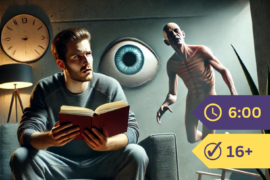
Much of Dick’s fiction is characterized by a deep unease about the stability of everyday reality. His stories frequently feature ordinary protagonists who discover that the world around them — or their own perception of it — cannot be trusted. This paranoid undercurrent runs through both his longer novels and his short fiction, often delivered with a dry, sardonic wit that keeps even his darkest premises from becoming purely grim. His short story The Eyes Have It is a sharp example of this sensibility: a narrator becomes convinced, through a comically literal reading of florid literary metaphors, that Earth is being invaded by alien life forms. The story works simultaneously as deadpan parody and as a subtle commentary on how humans construct meaning — and sometimes absurd meaning — from language.
Dick’s recurring themes include the blurred boundary between authentic and artificial life, the reliability of memory, the ethics of empathy, and the mechanisms of political and corporate control. He was deeply interested in what separated a genuine human experience from a simulated one — a question that animated some of his most celebrated novels, including Do Androids Dream of Electric Sheep? and Ubik. Even in shorter, lighter pieces like The Eyes Have It, his preoccupation with misreading, misperception, and the gap between surface and reality is unmistakably present.
Dick’s place in literary history is now firmly established. The Philip K. Dick Award, given annually to distinguished science fiction published in paperback original form in the United States, was established in his honor the year after his death. His work continues to be studied in academic contexts as much as it is read for pleasure, a testament to the intellectual depth beneath its often pulpy, fast-paced surface.