
Murasaki Shikibu
Dive into Murasaki Shikibu’s complete works and explore the novel that changed world literature — read it online for free, filter to discover your favorites, and learn more about the author.
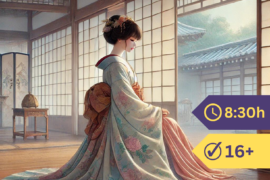
Murasaki Shikibu was a Japanese noblewoman, poet, and lady-in-waiting at the Imperial court during the Heian period, living roughly between 973 and 1025 CE. She is best known as the author of The Tale of Genji, a work widely regarded by scholars as one of the world’s first novels and a foundational text of Japanese literature. Little is known with certainty about her life, but she is believed to have served Empress Shōshi and to have drawn on court life for much of her writing. Her personal name remains unknown; “Murasaki Shikibu” is a sobriquet derived partly from a character in her own fiction.
The Tale of Genji follows the life, loves, and political fortunes of Hikaru Genji, the son of an ancient Japanese emperor. Structured across dozens of chapters — from the opening “Kiritsubo,” which establishes Genji’s origins at court, through episodes such as “The Broom-tree,” “Yūgao,” and “The Festival of Red Leaves” — the narrative explores themes of romantic longing, impermanence, social hierarchy, and the passage of time. The prose is notable for its psychological depth and its nuanced portrayal of both male and female characters, particularly the women of the Heian court whose inner lives Murasaki Shikibu renders with rare sensitivity.
The work is also a rich document of Heian-period aesthetics, poetry, and court ritual. Chapters like “The Flower Feast” and “The Saffron-flower” are suffused with waka poetry and seasonal imagery, reflecting a culture in which artistic refinement was inseparable from social and emotional life. Murasaki Shikibu’s own skill as a poet is evident throughout, and the novel contains hundreds of embedded poems that function as emotional shorthand between characters.
The Tale of Genji has been translated into numerous languages and has influenced Japanese art, theatre, and literature for over a millennium. It stands as a singular achievement in world literary history — a work that anticipated many of the techniques of the modern novel nearly a thousand years before the form became established in the West.