
Kate Douglas Smith Wiggin
Dive into Kate Douglas Smith Wiggin’s complete stories and books — read them online for free, filter to discover your favorites, or explore our article to learn more.

Kate Douglas Smith Wiggin (1856–1923) was an American author and pioneering educator best known for her warm, character-driven fiction for children and adults. Born in Philadelphia and raised in New England, she became one of the most widely read American writers of the late nineteenth and early twentieth centuries. She is perhaps best remembered today as the author of Rebecca of Sunnybrook Farm (1903), though her contributions to children’s literature span well beyond that single title. Wiggin was also a tireless advocate for early childhood education and co-founded one of the first free kindergartens on the West Coast of the United States.
Wiggin’s writing is distinguished by its emotional sincerity, its closely observed domestic detail, and its affection for the inner lives of children. She had a particular gift for portraying young characters with both humor and deep tenderness, never condescending to her readers or her subjects. Her stories often explore themes of community, generosity, and the redemptive power of kindness — values she clearly held as central to a well-lived life.
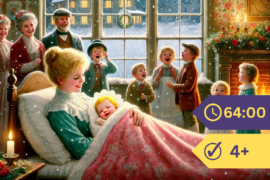
The Birds’ Christmas Carol is among her most celebrated and enduring works. First published in 1887, this short novel tells the story of Carol Bird, a gentle and spiritually luminous girl born on Christmas Day whose brief life brings joy to everyone around her. The book is structured around a Christmas gathering in which Carol arranges a holiday dinner for the rowdy but lovable Ruggles family from next door — a scene that balances comedy with genuine pathos. The story’s chapters, moving from Carol’s birth through her final Christmas, trace an arc that is both quietly sorrowful and ultimately uplifting. It was originally written to raise funds for the Silver Street Kindergarten in San Francisco and became an immediate popular success, read aloud in homes and classrooms across America for decades.
Wiggin’s literary legacy rests on her ability to write fiction that takes childhood seriously as a moral and emotional terrain. Her work helped shape the genre of American children’s literature at a formative moment, and her influence can be felt in the sentimental-realist tradition that would continue through the early twentieth century. As both an educator and a storyteller, she brought the same conviction to her writing that she brought to her classrooms: that children deserve to be met with imagination, respect, and genuine warmth.