
Jules Verne
Dive into Jules Verne’s complete novels and adventure stories, and read them online for free — filter to discover your favorites, or explore our article to learn more about the author.
Jules Verne (1828–1905) was a French novelist widely regarded as one of the founding fathers of science fiction. Born in Nantes, France, Verne became one of the most translated authors in history, with his works spanning the globe in terms of both setting and readership. Writing primarily in the second half of the nineteenth century, he produced an extraordinary body of work under the collective title Voyages Extraordinaires — a series of adventure novels published in collaboration with his editor Pierre-Jules Hetzel.
Verne’s fiction is characterized by a deep fascination with science, technology, and exploration. He imagined submarines, rocket travel, and circumnavigation decades before these became common realities, grounding his fantastic scenarios in meticulous research and scientific reasoning. His stories tend to follow determined, intellectually driven protagonists who are thrust into extraordinary circumstances — whether beneath the ocean, across continents, or through the air.
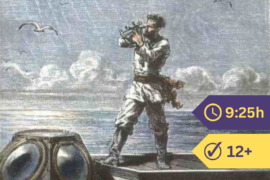
Twenty Thousand Leagues under the Sea, first published in 1870, is among the most celebrated of Verne’s novels. The story follows Professor Pierre Aronnax, his servant Conseil, and the harpooner Ned Land as they are taken aboard the mysterious submarine Nautilus, commanded by the enigmatic Captain Nemo. The novel moves through vividly rendered underwater landscapes — coral forests, submerged ruins, and the crushing depths of uncharted ocean trenches — combining adventure with detailed descriptions of marine biology and oceanography. Captain Nemo himself remains one of the most complex and enduring characters in adventure literature: a man of immense intellect and deep personal grief, who has chosen exile beneath the sea.
Verne’s legacy in literature and popular culture is substantial. His work helped establish science fiction as a legitimate literary genre, influencing writers such as H.G. Wells and, later, countless novelists and filmmakers of the twentieth century. His novels continue to be studied for their prescient imagination and their reflection of nineteenth-century attitudes toward science, empire, and human ambition. The Voyages Extraordinaires series ultimately comprised over fifty novels, making Verne one of the most prolific as well as most visionary authors of his era.