
John Kendrick Bangs
Dive into John Kendrick Bangs’s complete stories and poems, read them online for free, filter to discover your favorites, and explore our article to learn more.
John Kendrick Bangs (1862–1922) was an American author, humorist, and editor, best known for his playful wit and inventive comic fiction. Active during the late nineteenth and early twentieth centuries, Bangs contributed extensively to major American periodicals, including Harper’s and Puck, and earned a reputation as one of the most entertaining popular writers of his era. His work spanned fiction, poetry, and satirical essays, and he had a particular gift for blending the whimsical with the everyday.
Bangs is perhaps best remembered for a subgenre sometimes called “Bangsian fantasy” — stories set in the afterlife where famous historical figures interact in comic and absurdist situations. His novels A House-Boat on the Styx and its sequels imagined a kind of gentlemen’s club populated by the ghosts of Shakespeare, Sherlock Holmes, Napoleon, and others, all engaged in lively, irreverent conversation. This inventive premise influenced later authors who explored similar comedic treatments of the supernatural and the hereafter.
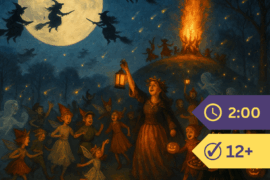
Beyond his longer fiction, Bangs wrote a considerable body of shorter verse and light poetry that reflected the same mischievous, good-natured humor found in his prose. His poem Hallowe’en is a fine example of this lighter register — a spirited, festive piece that captures the playful energy of the holiday, calling forth imagery of jack-o’-lanterns, bobbing for apples, and moonlit mischief. It demonstrates Bangs’s ability to write verse that was accessible, celebratory, and tinged with just enough spookiness to suit its subject.
Throughout his career, Bangs occupied a distinctive space in American letters — neither strictly a serious literary figure nor a mere popular entertainer, but something in between: a writer of genuine craft who chose levity as his primary mode. His editorial work helped shape the tone of American humor magazines during a formative period, and his fiction contributed a lasting concept to fantasy literature. Though his name is less widely recognized today than in his own time, Bangs remains a noteworthy figure in the history of American comic writing and light verse.