
John Donne
Dive into John Donne’s complete poems and writings, read them online for free, filter to discover your favorites, and explore our article to learn more.
John Donne (1572–1631) was an English poet, preacher, and one of the foremost figures of the Metaphysical poetry movement. Born in London into a Roman Catholic family at a time when practicing Catholicism carried serious legal risk, Donne navigated a turbulent religious and political landscape throughout his life. He later converted to Anglicanism and rose to become Dean of St Paul’s Cathedral in London, where his sermons drew large and devoted audiences. His literary reputation rests on his ability to fuse intense intellectual argument with deeply felt emotion — a combination that set him apart from the more purely lyrical poets of his era.
Donne’s poetry is characterized by its use of the conceit — an extended, often startling metaphor that draws unexpected comparisons between unlike things. His verse ranges from boldly sensual love poetry written in his youth to profound religious meditations composed in his later years. The tension between the physical and the spiritual, desire and devotion, life and death, runs through virtually everything he wrote. His language is conversational yet rigorously structured, frequently beginning mid-thought, as if catching the reader in the middle of an argument already underway.
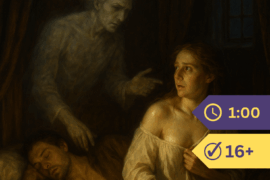
Among the poems collected here, The Apparition offers a sharp illustration of Donne’s characteristic blend of wit and dark emotion. In it, the speaker imagines his own death at the hands of a cruel, indifferent lover, and takes bitter satisfaction in envisioning his ghost returning to haunt her. The poem moves with Donne’s trademark compressed energy — sardonic, psychologically acute, and formally controlled even as it portrays emotional extremity. It belongs to a tradition of his Songs and Sonnets, a collection of love poems that explore seduction, betrayal, jealousy, and longing with remarkable intellectual force.
Donne’s reputation declined sharply after his death and remained relatively low through much of the eighteenth and nineteenth centuries, when critics found his style too rugged and his conceits too strained. It was not until the early twentieth century — largely through the critical advocacy of T. S. Eliot — that Donne was reassessed and recognized as a major voice in English literature. Today he is widely studied and regarded as one of the most original poets of the early modern period, his work notable for its psychological depth, argumentative boldness, and the singular intensity with which it examines what it means to love, to suffer, and to believe.