
James Joyce
Dive into James Joyce’s complete short stories and discover the works of one of modernism’s most important voices — read them online for free, filter to find your favorites, and explore our article to learn more.
James Joyce (1882–1941) was an Irish novelist and short story writer, widely regarded as one of the most significant literary figures of the twentieth century. Born in Dublin, Ireland, Joyce spent much of his adult life in continental Europe — in Trieste, Zurich, and Paris — yet Ireland, and Dublin in particular, remained the obsessive center of his imagination throughout his entire career. His work fundamentally changed the course of modern literature, most notably through his pioneering use of stream-of-consciousness narration and his meticulous attention to the texture of everyday speech and thought.
Joyce’s short fiction is collected in Dubliners (1914), a cycle of fifteen stories that together form a precise and unsentimental portrait of Irish middle-class life in the early twentieth century. The stories move through different stages of life — childhood, adolescence, maturity, and public life — and are unified by what Joyce himself called an aesthetic of “scrupulous meanness”: a spare, exact prose style that finds moral and emotional complexity in ordinary moments. Themes of paralysis, escape, and self-deception recur throughout the collection, with characters who are often trapped — by social convention, religion, family obligation, or their own illusions.
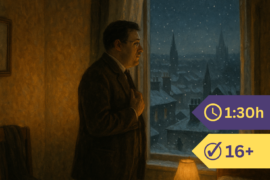
The collection’s final and longest story, The Dead, is frequently cited as one of the greatest short stories ever written in the English language. Set during a festive Christmas dinner party hosted by the Morkan sisters in Dublin, it follows Gabriel Conroy through an evening of social performance and private anxiety, culminating in a devastating revelation that forces him to reconsider everything he thought he understood about his wife, his marriage, and himself. The story’s closing paragraphs — in which snow falls “faintly through the universe” — represent one of the most celebrated passages in modern prose.
Beyond Dubliners, Joyce went on to write the semi-autobiographical novel A Portrait of the Artist as a Young Man (1916), the landmark modernist novel Ulysses (1922), and the experimental Finnegans Wake (1939). His influence on subsequent writers of fiction, from Samuel Beckett to Salman Rushdie, has been profound and far-reaching. Joyce’s ability to render the inner life of ordinary people with psychological depth and linguistic precision remains central to his enduring place in literary history.