
Henry James
Dive into Henry James’s complete novels and stories — read them online for free, filter to discover your favorites, or explore our article to learn more about the author.
Henry James (1843–1916) was an American-born author who spent much of his life in Europe and eventually became a British citizen. Widely regarded as one of the greatest novelists in the English language, he is celebrated for his intricate psychological realism and his precise, deeply nuanced prose style. His work occupies a unique position between the Victorian novel and literary modernism, and his influence on later writers — from Edith Wharton to Virginia Woolf — has been immense.
James was a prolific writer whose output spanned novels, novellas, short stories, travel writing, and literary criticism. He is perhaps best known for his sustained attention to the inner lives of his characters, often placing sensitive, observant protagonists in situations that test their moral perception. His fiction frequently explores the collision between American innocence and European sophistication — a tension that gave his best work a distinctive dramatic charge.
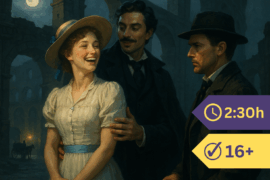
Among his most celebrated shorter works is Daisy Miller: A Study, a novella set largely in Switzerland and Italy that follows the free-spirited American Daisy Miller as she navigates European social conventions. Through the eyes of the cautious Winterbourne, James dissects questions of class, propriety, and cultural misunderstanding with cool precision. The story was an immediate success when it appeared in 1878 and helped establish James’s international reputation.
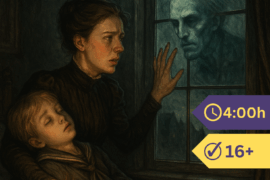
The Turn of the Screw, published in 1898, represents a very different register of James’s talent. This ghost story — or psychological study, depending on one’s reading — follows a governess who comes to believe that the two children in her care are being haunted, or perhaps corrupted, by the ghosts of two former servants. The narrative is constructed with deliberate ambiguity, leaving the reader uncertain whether the supernatural events are real or projections of the governess’s disturbed imagination. It remains one of the most discussed and debated works in American literature, praised for the unsettling tension James sustains throughout.
James’s literary legacy rests on his conviction that the novel was a serious art form capable of exploring consciousness and moral complexity with the same rigor as philosophy or poetry. His later style — dense, elaborate, and demanding — pushed the boundaries of what prose fiction could do, and his critical essays, particularly his prefaces to the New York Edition of his collected works, laid the groundwork for modern literary criticism. His body of work continues to be studied closely in universities and read by those drawn to fiction of depth and precision.