
George Gordon Byron
Dive into George Gordon Byron’s complete poems and dramatic verses — read them online for free, filter to discover your favorites, or explore our article to learn more about the poet.
George Gordon Byron, better known as Lord Byron, was an English Romantic poet born in London in 1788. One of the most celebrated literary figures of the early nineteenth century, he became a defining voice of the Romantic movement alongside contemporaries such as Percy Bysshe Shelley and John Keats. His work was marked by a restless intensity, a fascination with moral ambiguity, and a willingness to explore the darker corners of human passion and guilt. Byron’s dramatic personal life — his scandals, his travels across Europe and the Near East, and his death in Greece in 1824 while supporting the Greek War of Independence — made him as legendary a figure as any character he invented.
Byron’s poetry is known for its fierce emotional energy, biting wit, and a brooding quality that gave rise to the literary archetype of the “Byronic hero” — a figure who is proud, defiant, haunted by past transgressions, and set apart from ordinary society. This archetype runs through much of his narrative and dramatic verse, shaping morally complex protagonists who operate in the shadows of crime, exile, and obsession.
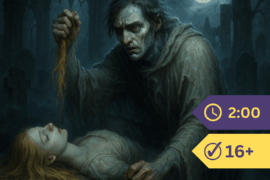
Among the works featured here, The Giaour (Unquenched, unquenchable) is a striking example of Byron’s dark Romantic imagination at work. The passage draws on the folklore of the vampire — a figure then still fresh in European literary consciousness — and deploys it as a metaphor for the consuming, inescapable nature of guilt and inner torment. The lines “Unquenched, unquenchable, / Around, within, thy heart shall dwell” speak to Byron’s recurring preoccupation with a suffering that cannot be extinguished, a psychological hell that follows the transgressor beyond death itself. The Giaour, published in 1813, is a fragmented Turkish tale set against the backdrop of the Ottoman world Byron had encountered during his travels, and it was one of the first of his enormously popular “Oriental Tales.”
Byron’s place in literary history is secure not only as a poet of individual genius but as a cultural phenomenon of his era. His influence reached across Europe, inspiring writers, composers, and painters throughout the nineteenth century. The brooding intensity of his verse, his command of dramatic narrative, and his fusion of autobiography with fiction gave his work an immediacy that continued to resonate long after his death at the age of thirty-six.