
George Crabbe
Dive into George Crabbe’s complete poems and verse narratives, read them online for free, filter to discover your favorites, and explore our article to learn more.
George Crabbe (1754–1832) was an English poet known for his unflinching, realistic portrayals of rural and small-town life in late eighteenth- and early nineteenth-century Britain. Writing at a time when pastoral poetry often idealized the countryside, Crabbe deliberately countered that tradition with closely observed, sometimes stark depictions of poverty, hardship, and the moral lives of ordinary people. His work sits at a distinctive crossroads between the Augustan verse tradition and the emerging sensibilities of the Romantic era, earning him the admiration of writers as varied as Samuel Johnson, Lord Byron, and Jane Austen.
Crabbe wrote almost exclusively in heroic couplets, a form he wielded with precision and economy. His narratives are character-driven, often built around a single figure whose life, choices, and circumstances are examined with the eye of a moral realist rather than a sentimentalist. He drew heavily on his own experience growing up near Aldeburgh on the Suffolk coast, and the social world he knew — the clergy, the gentry, the rural poor — recurs throughout his work. He is perhaps best known for collections such as The Village (1783), The Borough (1810), and Tales (1812), which together form a sustained portrait of English provincial life.
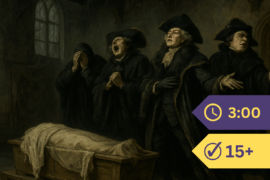
Among the poems available here, The Lady of the Manor (Next died the Lady) is a fine example of Crabbe’s method. The poem sketches a woman of rank whose life in town left her estate to decay — worms eating the floors, tapestry falling from the walls — and then traces the quiet, melancholy accounting of her death and burial. It is a compact moral study, using a single life to illuminate themes of neglect, social performance, and the indifferent passage of time. The physical detail is characteristic: Crabbe never allows abstraction to replace the observed particular.
Crabbe’s literary reputation fluctuated considerably after his death. The Victorians largely set him aside, but the twentieth century brought renewed critical appreciation of his psychological acuity and his place as a forerunner of the realist tradition in English literature. His influence can be felt in later writers who turned their attention to the lives of ordinary and marginal people, and his verse narratives remain valuable documents of the social textures of Georgian England.