
Fyodor Dostoyevsky
Dive into Fyodor Dostoyevsky’s complete short stories and prose — read them online for free, filter to discover your favorites, and explore our article to learn more about the author.
Fyodor Mikhailovich Dostoyevsky (1821–1881) was a Russian novelist, short story writer, and journalist, widely regarded as one of the greatest and most influential writers in world literature. Born in Moscow, he lived through poverty, political persecution, and a mock execution before being exiled to Siberia — experiences that profoundly shaped both his worldview and his writing. His major novels, including Crime and Punishment, The Idiot, and The Brothers Karamazov, placed him at the forefront of Russian literary realism and earned him an enduring place in the Western literary canon.
Dostoyevsky’s work is characterized by its unflinching psychological depth, its preoccupation with morality, suffering, free will, and the tension between faith and doubt. His characters are rarely straightforward heroes or villains; instead, they are tormented, contradictory human beings grappling with guilt, pride, and redemption. This psychological intensity is present not only in his longer novels but also in his shorter prose pieces, which demonstrate the same sharp social observation and moral complexity in a more concentrated form.
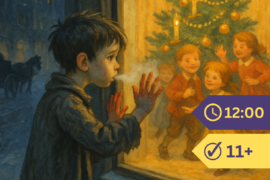
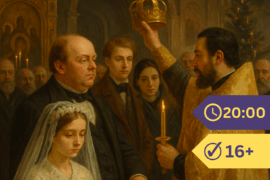
Among the shorter works attributed to Dostoyevsky, The Christmas Tree and the Wedding is a particularly striking example of his early style. Written in the manner of a casual narrator recounting a social observation, the story opens deceptively lightly — with a Christmas party among St. Petersburg’s upper classes — before revealing a quietly devastating commentary on greed, social calculation, and the commodification of marriage. In just a few pages, Dostoyevsky exposes the moral hollowness lurking beneath polished social surfaces, a theme that would recur throughout his career in far grander literary forms.
Dostoyevsky’s legacy extends well beyond Russian literature. His explorations of the human psyche anticipated many ideas later developed in psychology and existentialist philosophy. Writers such as Franz Kafka, Albert Camus, and William Faulkner acknowledged his influence, and his work continues to be studied, translated, and debated in literary and academic circles worldwide. His shorter fiction, though less celebrated than his novels, offers a valuable window into the development of his moral and artistic vision — compact, observational, and quietly devastating in its conclusions.