
Franz Kafka
Dive into Franz Kafka’s complete stories and novels, and explore our article to learn more about one of literature’s most distinctive and enduring voices.
Franz Kafka (1883–1924) was a German-language writer from Prague, then part of the Austro-Hungarian Empire. Writing in the early twentieth century, he produced a body of work that defies easy categorization — rooted in realism yet saturated with dream logic, bureaucratic dread, and existential unease. Though he published relatively little during his lifetime and famously asked his friend Max Brod to destroy his manuscripts after his death, Brod instead preserved and published them, ensuring Kafka’s place among the most influential writers of modern literature.
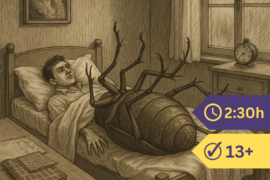
Kafka is perhaps best known for his novella The Metamorphosis (1915), in which a traveling salesman named Gregor Samsa wakes one morning to find himself transformed into a monstrous insect. The story examines alienation, family obligation, and the dehumanizing effects of work and social expectation with an unsettling matter-of-factness. His novel The Trial, published posthumously, follows Josef K., a man arrested and prosecuted by an inscrutable authority for an unspecified crime — a narrative that has come to define the modern sense of institutional absurdity. The Castle, another posthumous novel, similarly places its protagonist in an endless, fruitless struggle to gain access to a remote and indifferent bureaucratic power.
Kafka’s shorter prose pieces, including parables and fictions such as In the Penal Colony and A Hunger Artist, are equally characteristic. His writing returns again and again to themes of guilt, authority, transformation, and the individual’s helplessness before vast, impersonal systems. His settings — offices, courtrooms, villages, boarding houses — are mundane on the surface but charged with menace and uncertainty beneath. This tension between the ordinary and the inexplicable is the hallmark of what critics and readers have come to call “Kafkaesque.”
Writing largely in isolation and rarely seeking publication, Kafka worked as an insurance official by day and wrote at night. His Jewish identity, his complicated relationships with his father and with romantic partners, and the political turbulence of early twentieth-century Central Europe all left traces in his fiction, though his work resists straightforward autobiographical or allegorical readings. His three unfinished novels and his collected short prose have been translated into dozens of languages and studied across literary, philosophical, and cultural disciplines. Kafka died of tuberculosis in 1924 at the age of forty, leaving behind a relatively small but extraordinarily dense literary legacy that continues to shape how readers and writers think about modern life.