
Charles Baudelaire
Dive into Charles Baudelaire’s complete poetry and prose, including his landmark collection The Flowers of Evil — read it online for free, filter to discover your favorites, or explore our article to learn more.
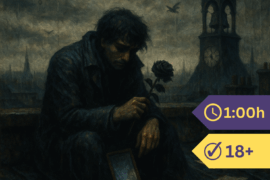
Charles Baudelaire (1821–1867) was a French poet, critic, and translator whose work fundamentally altered the course of modern literature. Born in Paris, he is widely regarded as one of the most significant figures in nineteenth-century French poetry and a key precursor to the Symbolist movement. His writing bridged the Romantic tradition and literary modernism, earning him a permanent place in the Western literary canon.
Baudelaire is best known for The Flowers of Evil (Les Fleurs du Mal), first published in 1857 and expanded in subsequent editions. The collection is structured into distinct thematic sections, moving through subjects such as beauty, idealism, sensuality, suffering, and spiritual longing. Individual poems — including “Benediction,” “The Sick Muse,” “The Enemy,” and “The Evil Monk” — demonstrate Baudelaire’s extraordinary range, shifting between ecstatic lyricism and unflinching confrontation with decay, guilt, and mortality. The collection was prosecuted by French authorities upon publication for alleged obscenity and blasphemy, with six poems ordered suppressed — a censorship that paradoxically cemented Baudelaire’s notoriety across Europe.
What distinguishes Baudelaire’s verse is his doctrine of correspondances — the idea that the physical world echoes a deeper spiritual reality, and that the poet’s task is to decode those hidden connections. His poems move fluidly between the sensory and the transcendent, using dense imagery drawn from city life, art, perfume, music, and the human body. Poems such as “Interior Life” and “Ill Luck” reveal his persistent preoccupation with the tension between the ideal and the earthly, between aspiration and failure — what he termed spleen and idéal.
Baudelaire also worked extensively as an art critic and was an early champion of the painter Eugène Delacroix and the composer Richard Wagner. His translations of Edgar Allan Poe introduced that writer to French-speaking audiences and shaped how Poe was received throughout Europe. These critical and translating activities reflect the same sensibility as his poetry: a deep belief in the moral seriousness of art and the artist’s role as an isolated, suffering figure within modern society.
Baudelaire died in Paris in 1867 at the age of forty-six. His influence on poets such as Paul Verlaine, Arthur Rimbaud, Stéphane Mallarmé, and later T.S. Eliot and Rainer Maria Rilke is well documented. The Flowers of Evil remains one of the most studied and translated poetry collections in the French language, read today both for its technical mastery and for the raw psychological honesty that still feels remarkably modern.