
C.S. Lewis
Dive into C.S. Lewis’s complete stories and poems, read them online for free, filter to discover your favorites, and explore our article to learn more.
C.S. Lewis (1898–1963) was a British author, academic, and literary critic born in Belfast, Ireland. He spent much of his career as a professor of English literature at Oxford and later Cambridge, becoming one of the twentieth century’s most influential writers of fiction and poetry. He is perhaps best known for his fantasy series The Chronicles of Narnia and his works of Christian apologetics, though his literary output spanned poetry, essays, allegory, and literary scholarship.
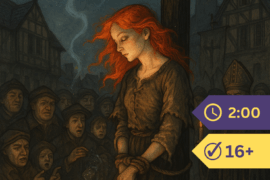
Before he became widely celebrated for his prose fiction, Lewis was a dedicated poet, and poetry remained a personal and serious pursuit throughout his life. His verse often drew on classical mythology, medieval allegory, and a deep familiarity with the Western literary tradition. In The Witch, Lewis channels this erudition into a compact, darkly atmospheric poem that evokes the figure of Medea — the Colchian sorceress of Greek myth — alongside images of dark woodland, bound captives, and ancient supernatural dread. The poem’s compressed, rhyming couplets and its allusions to the Argonaut legend place it firmly within a tradition of learned, mythologically grounded verse.
Lewis’s imaginative writing consistently drew on older story traditions — Greek and Norse mythology, Arthurian legend, and medieval cosmology — transforming them into vivid, morally textured narratives. His interest in myth was not merely academic; he believed that mythological storytelling could carry profound truths in ways that discursive argument could not. This conviction shaped both his fiction and his poetry, where supernatural figures like witches, gods, and enchantresses often serve as focal points for deeper explorations of power, fate, and human vulnerability.
As a literary critic and scholar, Lewis also produced significant works including The Allegory of Love and The Discarded Image, which examined medieval and Renaissance literature with great depth. His legacy rests on an unusually broad range of achievement — fiction, poetry, theology, and scholarship — making him a distinctive and enduring figure in twentieth-century English letters.