
Beatrice Clay
Dive into Beatrice Clay’s complete collection of stories and her retelling of Arthurian legend — read online for free, filter to discover your favorites, or explore our article to learn more.
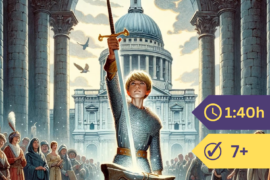
Beatrice Clay was a British author best known for her prose retellings of classic medieval legends, particularly the stories surrounding King Arthur and his Knights of the Round Table. Writing in the late nineteenth and early twentieth centuries, Clay crafted accessible, narrative-driven versions of these ancient tales that brought the world of Camelot to a wide readership. Her work sits within a broader Victorian and Edwardian tradition of retelling chivalric romances for general audiences, making complex and fragmentary medieval source material coherent and engaging.
Clay’s most significant work is her retelling of King Arthur (Full Book), a structured prose narrative that follows the Arthurian legend from its earliest episodes to its culmination. The book opens with Arthur’s mysterious birth and his rise to kingship, moves through the founding of the Round Table, and explores the wizardry of Merlin the Magician. It also recounts the legendary acquisition of the sword Excalibur and follows the adventures of individual knights, including the celebrated Sir Launcelot and his trial at the Castle Peril. Clay organises these episodic tales into a cohesive whole, giving readers a clear through-line across what is otherwise a sprawling and often contradictory body of legend.
The themes running through Clay’s retelling are those central to Arthurian tradition: honour, loyalty, the conflict between personal desire and duty, and the ideal of chivalric conduct. Her prose is straightforward and dignified, favouring clarity over ornament, which makes the material approachable without stripping it of its ceremonial weight. She draws on established sources within the Arthurian canon — including the traditions associated with Malory — while shaping the narrative for readers who may be encountering these stories for the first time.
Clay’s retelling of the Arthurian legend occupies a modest but genuine place in the history of popularising medieval literature. Her version of King Arthur contributed to a tradition — alongside the work of writers such as Howard Pyle and Andrew Lang — of rendering the great chivalric cycles in plain, readable English prose, ensuring that stories originating in medieval romance remained part of the living literary culture of the English-speaking world well into the twentieth century.