
Anton Chekhov
Dive into Anton Chekhov’s complete short stories and discover his sharp wit and keen observations on human nature — read them online for free, filter to find your favorites, and explore our article to learn more.

Anton Chekhov (1860–1904) was a Russian author and playwright widely regarded as one of the greatest writers of short fiction in world literature. Born in Taganrog in southern Russia, Chekhov trained as a physician while simultaneously developing his literary voice, eventually producing hundreds of short stories alongside his celebrated plays. His work captured the textures of everyday Russian life with remarkable precision and economy, influencing virtually every short story writer who came after him.
Chekhov’s fiction is distinguished by its restraint and psychological acuity. Rather than relying on dramatic plot twists, he built tension through small human moments — a misremembered name, a social awkwardness, a quiet humiliation. His stories frequently explore the gap between how people present themselves and who they truly are, and they do so with a tone that balances gentle irony with genuine compassion. Characters are rarely condemned outright; they are observed, with all their vanities and self-deceptions intact.
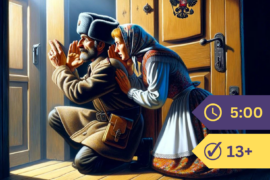
This quality is visible throughout his shorter comic pieces, which often hinge on moments of social comedy rooted in class and status. In Fat and Thin, for instance, two old school friends meet by chance at a railway station and exchange warm greetings — until one learns of the other’s higher rank, at which point the entire texture of the conversation shifts. The story is barely a page long, yet it captures something precise and enduring about deference, hierarchy, and the way social position distorts human relationships. Similarly, A Blunder derives its comedy from a moment of flustered inattention, as a family eavesdropping on a private scene in the next room draws entirely the wrong conclusions — a scenario built on the kind of domestic absurdity Chekhov rendered with effortless timing.
Across his body of work, Chekhov demonstrated that the short story could be a complete and serious literary form — not a sketch or a lesser cousin to the novel, but a genre with its own demands and possibilities. His influence extends across the twentieth century and beyond, shaping writers as varied as Katherine Mansfield, Raymond Carver, and Alice Munro. He died of tuberculosis in 1904 at the age of forty-four, leaving behind a body of work whose clarity and depth have ensured its place in the literary canon.