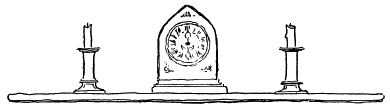
Once upon a time there was a clock that stood on the mantel in a little boy’s mother’s room, ticking merrily night and day, “Tickity, tickity tock.” It told the little boy’s father when to go to work and his mother when to get dinner, and sometimes it talked to the little boy himself. “Go to bed, Sleepy Head,” that is what it seemed to say at bedtime; and in the morning it ticked out loud and clear, as if it were calling, “Wake up! wake up! wake up!”
The little boy’s mother always knew just what it meant by its tickity, tickity tock, and late one afternoon, when he was playing with his toys and the clock was ticking on the mantel, she said:—
“Listen, little boy, the clock has something to tell you:—

“‘Tickity, tickity tock,’ it is saying,
‘Tickity tock, it is time to stop playing;
Somebody’s coming so loving and dear,
You must be ready to welcome him here.'”
Then the little boy jumped up in a hurry and put his hobby-horse in the corner and his pony lines on a hook in the closet and his tin soldiers in a straight row on the cupboard shelf.

“Now I’m ready,” he said, but:—
“‘Tickity, tickity, tickity tock!
Time to tidy yourself,’ said the clock.”
“Oh!” said the little boy, when his mother told him this; but he stood very still while she washed his hands and his rosy face and combed his curls till they were smooth and shining.
“Now I’m ready,” he cried, but Mother said:—
“Why, are you going to forget your nice little blouse that you’ve never worn yet?”
“‘Tickity, tickity, tickity tock,
Time for clean clothes, little boy,’ says the clock.”
Then she made haste to get the blouse out of the dresser drawer, where it had been ever since it was finished. It had a big collar and a tie, and when the little boy put it on he looked like a sailor man.
“Now I’m ready,” he said, and—do you believe it?—the very next minute the door opened and in walked the little boy’s father.
“I knew you were coming,” said the little boy, “and so did Mother. The clock told us and I have on my new blouse.”