
A.A. Milne
Dive into A.A. Milne’s complete collection of Winnie-the-Pooh stories and poems — read them online for free, filter to discover your favorites, and explore our article to learn more about the author.


A.A. Milne (Alan Alexander Milne, 1882–1956) was an English author and playwright whose children’s fiction brought him lasting international recognition. Born in London, Milne worked as a journalist and successful playwright before turning his attention to children’s literature in the 1920s. It was this shift that would define his literary legacy, producing two story collections and two poetry books that have remained in continuous print for nearly a century.
Milne drew his inspiration directly from his son, Christopher Robin Milne, and the boy’s collection of stuffed animals. Set in a forest modeled on Ashdown Forest in East Sussex, the stories follow Winnie-the-Pooh — a bear of very little brain with an enormous appetite for honey — alongside a cast of carefully drawn companions: the melancholy donkey Eeyore, the anxious Piglet, the bouncing Tigger, the maternal Kanga, and young Roo. Christopher Robin himself appears throughout as a gentle, wise presence who anchors the animal characters to a child’s everyday world.
The stories are episodic and gently comic, built around small domestic adventures and misunderstandings. In Winnie the Pooh and the Honey Tree, Pooh’s single-minded pursuit of honey leads him to disguise himself as a cloud. In Winnie the Pooh: Stuck at Rabbit’s House, the same appetite results in Pooh becoming wedged in Rabbit’s front door. Eeyore, whose persistent gloom is one of Milne’s most recognizable comic creations, takes center stage in stories such as Eeyore Has A Birthday And Gets Two Presents and A House Is Built at Pooh Corner for Eeyore. Newer arrivals to the forest are handled with the same light touch: in Kanga And Baby Roo Come To The Forest, the other animals’ initial wariness gives way to warm acceptance.
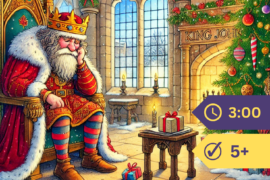
Milne also wrote verse for children, and his poem King John’s Christmas demonstrates his facility for comic rhyme and quietly pointed character study — qualities present throughout his prose as well. The final chapter of the second Pooh book, represented here by Christopher Robin and Pooh Come to an Enchanted Place, and We Leave Them There, is widely noted for its elegiac tone, marking the end of childhood with an unusual tenderness for children’s literature of the period. Milne’s work influenced generations of writers and illustrators, and the Hundred Acre Wood remains one of the most fully realized fictional landscapes in the English-language children’s canon.